Postage free from 99€ (DE)
High customer satisfaction


 DE | €

- Scooter 50-850cc
- Flange nut with locking tooth M5

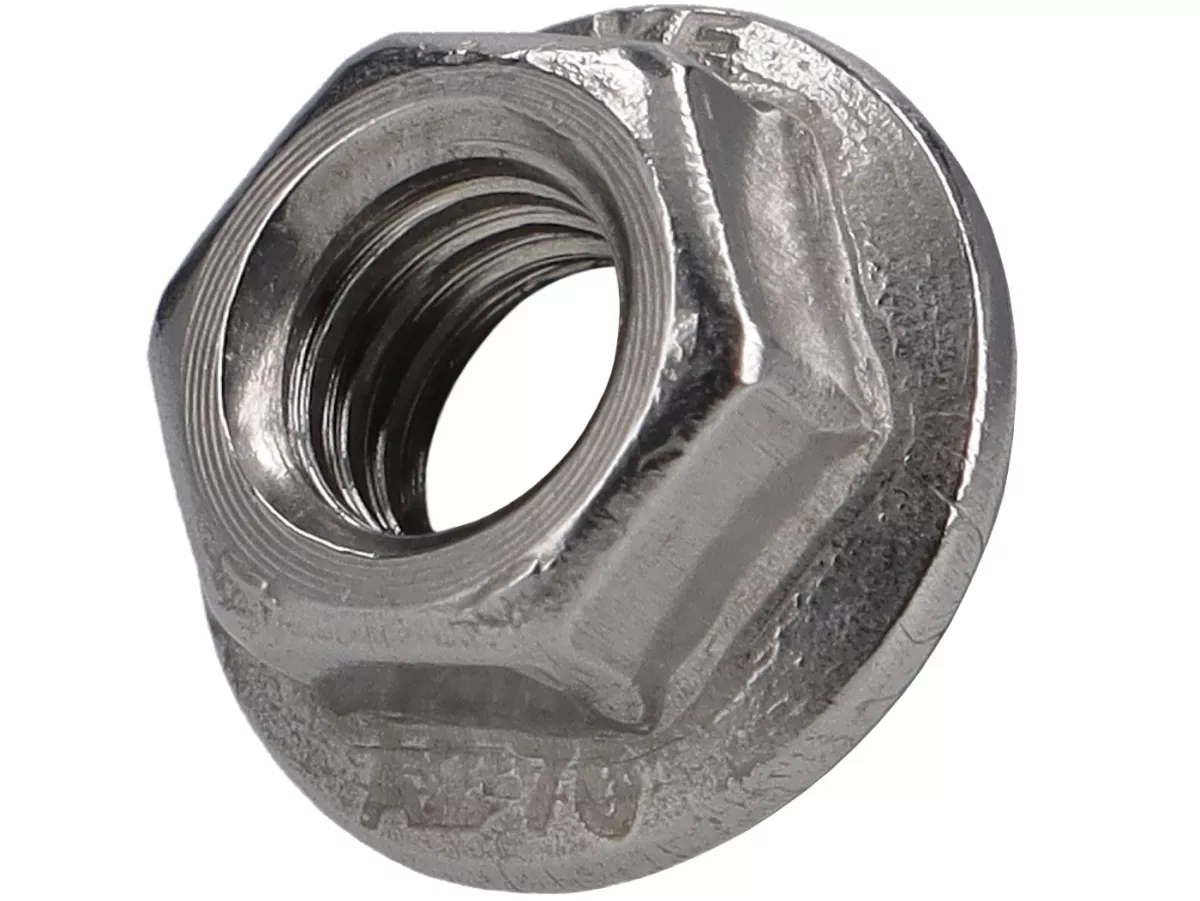
Genuine Royal Alloy flange nut with M5 internal thread and serrated locking flange for fastening various vehicle components. The metal hex nut features an integrated circular flange that provides an enlarged contact surface. Additional locking serrations on the underside of the flange help secure the threaded connection against unintended loosening.
The nut is used at various fastening points on Royal Alloy vehicles. It combines the function of a conventional hex nut with an enlarged contact surface and a mechanical anti-loosening feature.
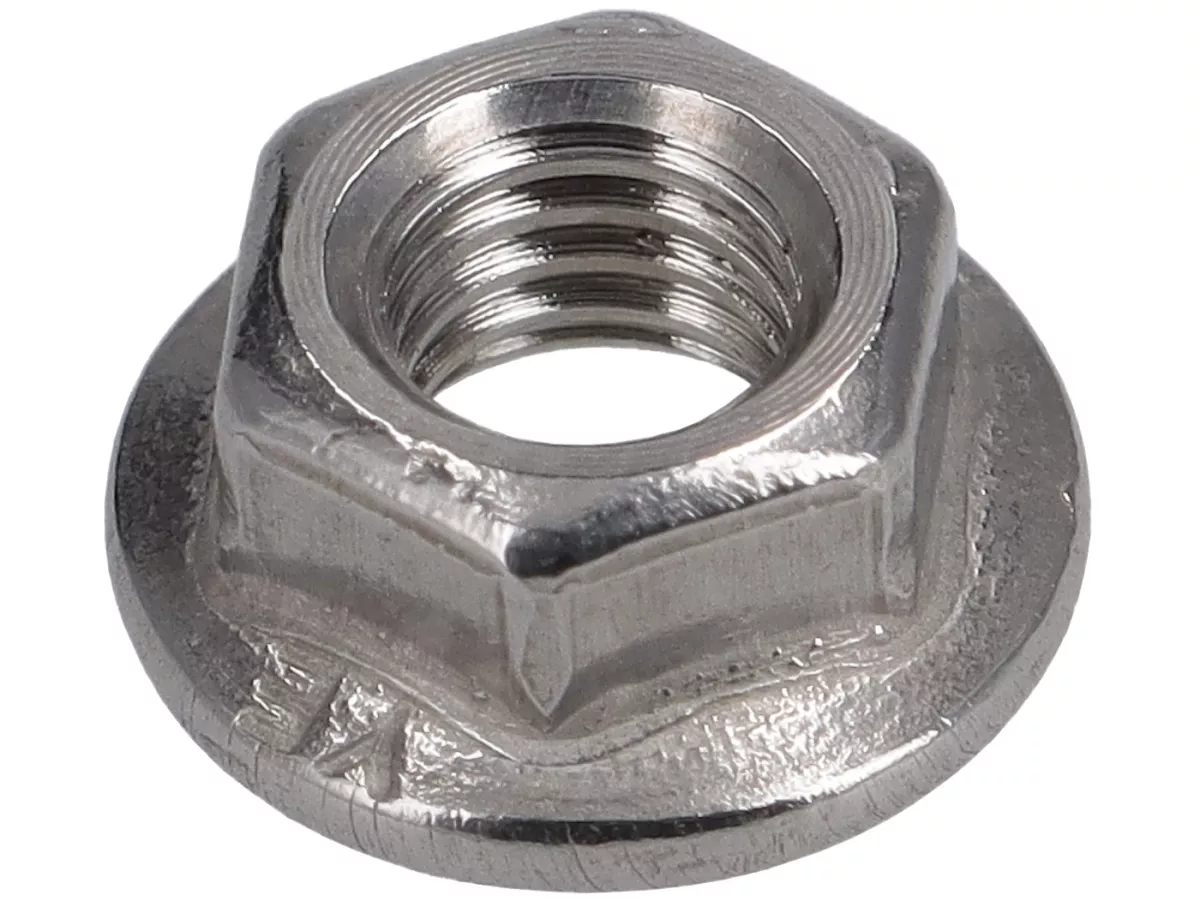
The flange nut has a hexagonal body with a continuous metric M5 internal thread. The hexagonal shape allows the nut to be tightened and loosened using a suitable spanner or socket.
At the lower end of the hexagonal body is an integrally formed circular flange. This increases the contact area between the nut and the component being fastened.
When tightened, the clamping force is distributed over a larger area than with a conventional hex nut without a flange. This can reduce local surface pressure and distribute the load more evenly across the adjacent component surface.
Thanks to the integrated contact surface, no additional washer is required for appropriately designed threaded connections.
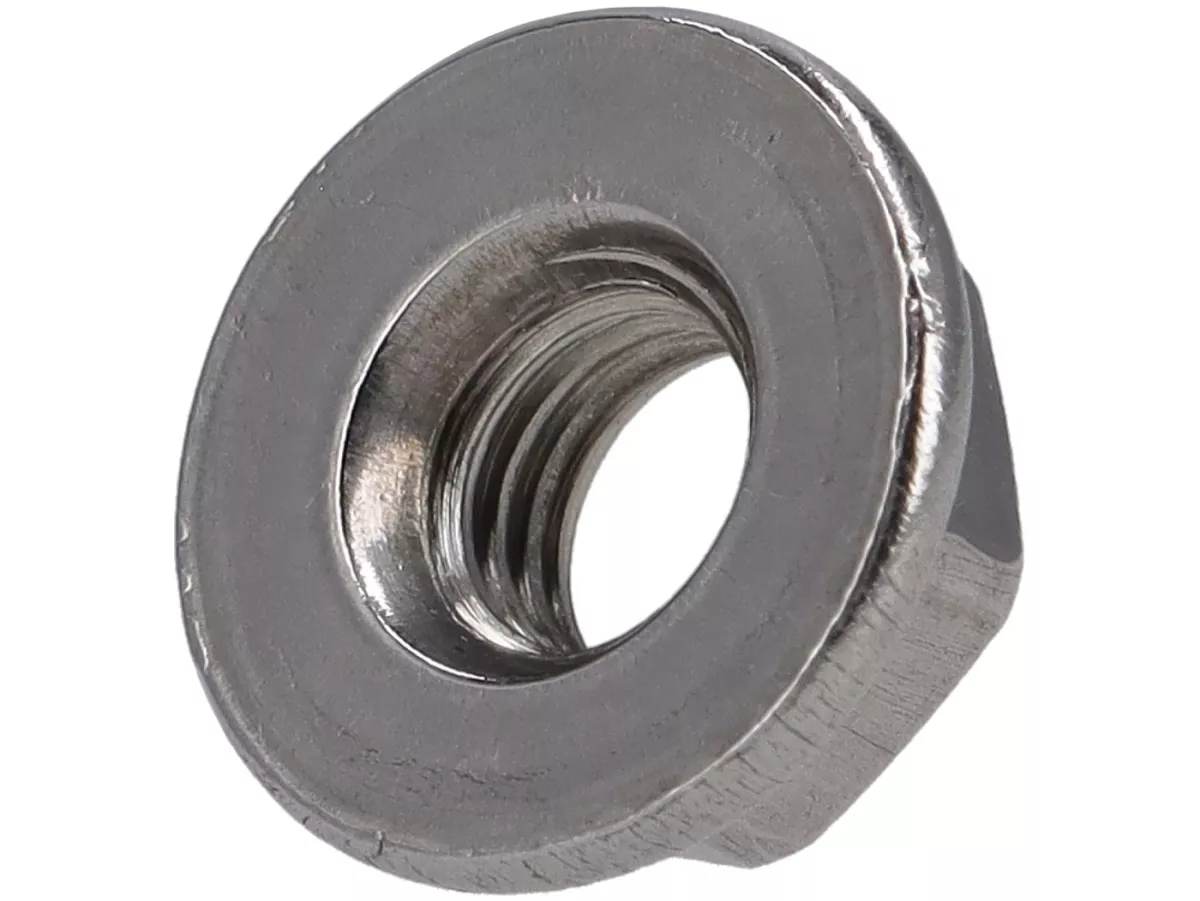
A distinctive feature of this version is the locking serration on the underside of the flange. The small, angled teeth engage with the opposing component surface when the nut is tightened.
This increases resistance to rotational movement of the nut. The serrations help counteract unintended loosening of the threaded connection, for example as a result of vibration or alternating mechanical loads.
The locking effect is created directly at the contact surface between the flange and the component. This design does not use an additional nylon locking insert.
The actual locking effect depends on the condition of the contact surface, the preload force and the respective installation conditions.
It should be noted that the locking teeth can leave marks on the contact surface when tightened and may damage existing paintwork or surface coatings.
The product images show a silver-grey metal nut with a hexagonal body and a clearly protruding circular flange.
The central internal thread is continuous. The thread turns are clearly visible in the view from the underside.
The surface has a metallic finish. The contours typical of the manufacturing process are visible at the transitions between the hexagonal body and the flange.
An embossed marking is also visible on the flange. This serves to identify the fastener, but on its own does not allow a reliable determination of the strength class or the surface coating used.
The flange nut is equipped with a metric M5 internal thread and is screwed onto a corresponding matching external thread.
On Royal Alloy vehicles, flange nuts of this type are used to secure various components. These include fastening points around the seat and its mounting brackets.
Royal Alloy spare parts diagrams list the version with original part number 07GB6177-M5-004, for example, within the seat assembly.
As different screws, nuts and fastening configurations are used throughout the vehicle, the exact application should always be checked against the relevant spare parts diagram.
The flange nut is used as a fastener in various Royal Alloy assemblies. Original part number 07GB6177-M5-004 is documented, among other applications, in spare parts diagrams for the Royal Alloy GP series.
As the nut can be used in different positions, its exact application is not limited exclusively to one specific vehicle assembly.
For reliable identification, the original part number, M5 thread and the installation position specified in the relevant spare parts diagram are decisive.
Serrated flange nuts should be inspected for damage during maintenance and repair work. Particular attention should be paid to the condition of the internal thread, the hexagonal flats and the locking teeth on the underside of the flange.
Damaged threads, deformed tool flats or worn locking teeth can impair the function of the threaded connection.
Before installation, the external thread and the corresponding contact surface must be checked for damage and contamination.
The nut is installed with the serrated flange side facing the component being fastened. When tightening, make sure that the flange sits evenly against the intended contact surface.
The specified tightening torque depends on the particular threaded connection and the vehicle-specific workshop specifications. A general tightening torque cannot be reliably determined from the M5 thread size alone.
As the locking serrations can bite into the contact surface when tightened, safety-relevant threaded connections and nuts that have been removed should be checked to determine whether replacement is required according to the manufacturer's specifications.
The genuine Royal Alloy flange nut 07GB6177-M5-004 allows a damaged or missing fastener to be replaced individually. The combination of an M5 internal thread, integrated flange and locking serrations provides a compact threaded connection with an additional mechanical locking effect.