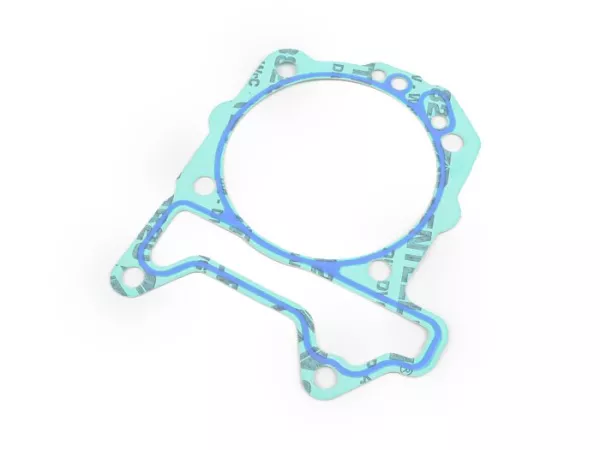
Cylinder Base Gasket Piaggio 125–310cc – Vespa, Piaggio, Aprilia, Gilera
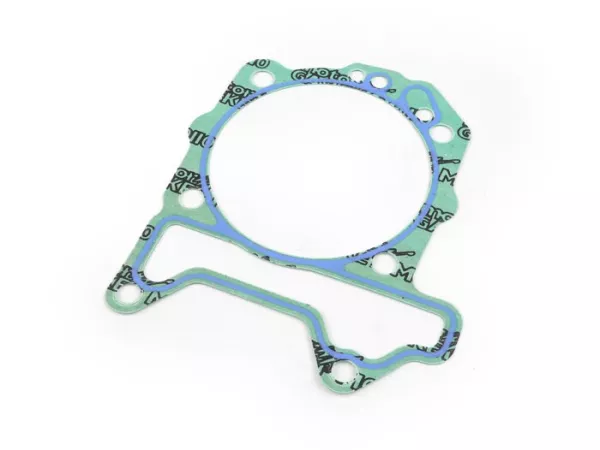
The cylinder base gasket seals the connection between the cylinder and the engine crankcase. It prevents engine oil from leaking and ensures reliable sealing of the corresponding oil and coolant passages. At the same time, its thickness determines the installed height of the cylinder and therefore influences important engine geometry measurements.
These cylinder base gaskets are used in numerous Piaggio four-stroke engines with displacements ranging from 125 to 310cc. These include both air-cooled (AC) and liquid-cooled (LC) engines from the Leader and Quasar series, as well as various subsequent engine generations, including iGet and HPE versions. They are used in Vespa GTS, GTV, Primavera, Sprint and numerous Piaggio, Aprilia and Gilera models.
Why Are Different Gasket Thicknesses Available?
Piaggio offers the cylinder base gasket in three thicknesses: 0.4 mm, 0.6 mm and 0.8 mm. These variations make it possible to compensate for manufacturing tolerances in engine components and adjust the intended piston position at top dead centre (TDC).
The thickness of the cylinder base gasket affects the distance between the piston and the cylinder head at top dead centre, known as the squish clearance. A thinner gasket positions the cylinder closer to the crankshaft, while a thicker gasket raises the cylinder accordingly. This also changes the remaining combustion chamber volume and the geometric compression ratio.
The correct gasket thickness is therefore a technical requirement and should not be selected arbitrarily. The manufacturer's specifications and the measurements taken during engine assembly are decisive.
Construction and Sealing
The gasket is made from die-cut flat gasket material with openings for the cylinder bore, mounting points and corresponding engine passages. An additional applied sealing bead supports sealing in particularly demanding areas.
Whenever the cylinder is removed, the base gasket should generally be replaced. Before installation, the sealing surfaces must be clean, flat and free from any old gasket residue.
Technical Features
- Cylinder base gasket for Piaggio four-stroke engines from 125 to 310cc
- Suitable for numerous air-cooled (AC) and liquid-cooled (LC) engines
- Available in 0.4 mm, 0.6 mm and 0.8 mm thicknesses
- Die-cut gasket with an additional sealing bead
- Seals the connection between the cylinder and crankcase
- Influences cylinder installation height and squish clearance
- Piaggio original part numbers 875112, 875113 and 875114
Suitable for Vespa
- Vespa ET4 125–150 (2000–2005)
- Vespa GT / GT L 125–250 (2003–2006)
- Vespa GTS / GTS Super 125–310 (2005–)
- Vespa GTV / GTV HPE 125–310 (2006–)
- Vespa LX / LXV 125–150 (2005–2013)
- Vespa LT 125–150 (2014)
- Vespa Primavera 125–150 (2013–)
- Vespa Sprint 125–150 (2014–)
- Vespa 946 125–150 (2013–)
Piaggio Models
- Piaggio Beverly / Beverly HPE 125–310 (2002–)
- Piaggio Carnaby 125–300 (2007–2010)
- Piaggio Fly 125–150 (1998–2015)
- Piaggio Hexagon GTX 125–180 (1999–2003)
- Piaggio Liberty 125–200 (1998–2024)
- Piaggio MP3 / MP3 HPE / MP3 Yourban 125–310 (2006–)
- Piaggio Skipper ST 125–150 (2000–2005)
- Piaggio TPH 125 (2010–2016)
- Piaggio X7 / X8 / X9 / X9 Evo / X10 / XEvo 125–300 (2000–2016)
- Piaggio Zip II 125 (2000–2003)
Other Models
- Aprilia Atlantic 125–300 (2003–2012)
- Aprilia Mojito 125–150 (2003–2008)
- Aprilia Scarabeo 125–300 (2003–2009)
- Aprilia SR Max 125–300 (2011–2014)
- Aprilia SR Motard 125 (2012–2014)
- Derbi Boulevard 125–200 (2002–2012)
- Derbi GP1 125–250 (2006–2009)
- Derbi Rambla 125–300 (2008–2011)
- Derbi Sonar 125–150 (2010–2011)
- Gilera DNA 125–180 (2001–2003)
- Gilera Nexus 125–300 (2006–2012)
- Gilera Runner VX 125 / VXR 200 (2001–2016)
- Malaguti Madison 300 (2019–2021)
Installation Note: The required gasket thickness must be determined according to the manufacturer's specifications or by checking the relevant installation measurements. Particular attention must be paid to the specified squish clearance when installing the cylinder. Using a different gasket thickness can alter the compression ratio and mechanical clearances within the combustion chamber.


 DE | €