Piston Piaggio Original – 50cc Hi-PER4 AC 2V – Vespa ET4, LX, Primavera, Sprint – Category A, B, C, D
Original Piaggio pistons for air-cooled 50cc four-stroke engines from the Hi-PER4 series with two valves. These pistons are intended as replacements in cases of wear, damage or engine overhaul. They are available in four size categories, allowing the piston to be selected according to the corresponding cylinder classification.
This piston design is used in Vespa ET4, LX, LXV, Primavera, S and Sprint models, among others, as well as numerous 50cc four-stroke models from Piaggio, Aprilia and Derbi. Compatibility requires the corresponding air-cooled Hi-PER4 engine version with a two-valve cylinder head.
Hi-PER4 – Piaggio's Four-Stroke Engine Family
Hi-PER4 is the designation used by Piaggio for a family of compact four-stroke engines installed in various scooter models within the group. The designation primarily distinguishes these engines from the Hi-PER2 series of two-stroke engines.
Hi-PER4 engines were developed for everyday use. Their design combines compact dimensions with a drive concept intended for small scooters. The engines feature a separate engine oil lubrication system and an automatic transmission using a variator and centrifugal clutch.
Different cylinder head configurations with two or four valves exist within the Hi-PER4 family. The Hi-PER4 designation therefore refers to the four-stroke engine family rather than the number of valves.
The 50cc 2V version described here features a cylinder head with one intake valve and one exhaust valve. Both valves are operated by an overhead camshaft driven by a timing chain.
On the corresponding models, the air-fuel mixture is prepared by a carburettor. Cooling is provided by an engine-driven fan that directs air over the cooling surfaces of the cylinder and cylinder head.
Technical Characteristics of the Hi-PER4 50 4T 2V
The Piaggio Hi-PER4 50 4T 2V is an air-cooled, single-cylinder four-stroke engine with a displacement of approximately 49.9cc.
The standard cylinder bore is 39mm, while the piston stroke is 41.8mm. The combination of these dimensions produces the displacement specified for this engine class.
Gas exchange takes place through two valves in the cylinder head. The intake valve controls the admission of the fresh charge, while the exhaust valve releases the combustion gases. Valve timing is determined by the mechanical connection between the crankshaft, timing chain and camshaft.
The moving components are lubricated through an engine oil circulation system. This lubrication concept differs fundamentally from that of the conventional two-stroke engines in the Hi-PER2 family.
Power is transmitted through a continuously variable automatic transmission with a variator, drive belt and centrifugal clutch. This drive concept allows operation without manual gear changes.
Four Size Categories for the Standard Cylinder Fit
The original pistons are available in categories A, B, C and D, also designated 1, 2, 3 and 4. This classification accounts for small dimensional differences within the manufacturing tolerances of pistons and cylinders.
The different categories allow the selection of a piston whose dimensions match the corresponding cylinder size class. These are not conventional repair oversizes for rebored cylinders.
The four available versions are assigned the following article numbers:
- Category A / 1 – Article number 9696040001
- Category B / 2 – Article number 9696040002
- Category C / 3 – Article number 9696040003
- Category D / 4 – Article number 9696040004
The correct version must be selected according to the existing cylinder marking and the actual condition of the cylinder bore. On an engine that has already been in service, professional measurement is necessary to assess wear and the remaining piston-to-cylinder clearance.
A different piston category must not be installed simply because it is available. The decisive factor is the technically correct combination of piston dimensions, cylinder dimensions and specified running clearance.
Piston Construction – Features Visible in the Product Images
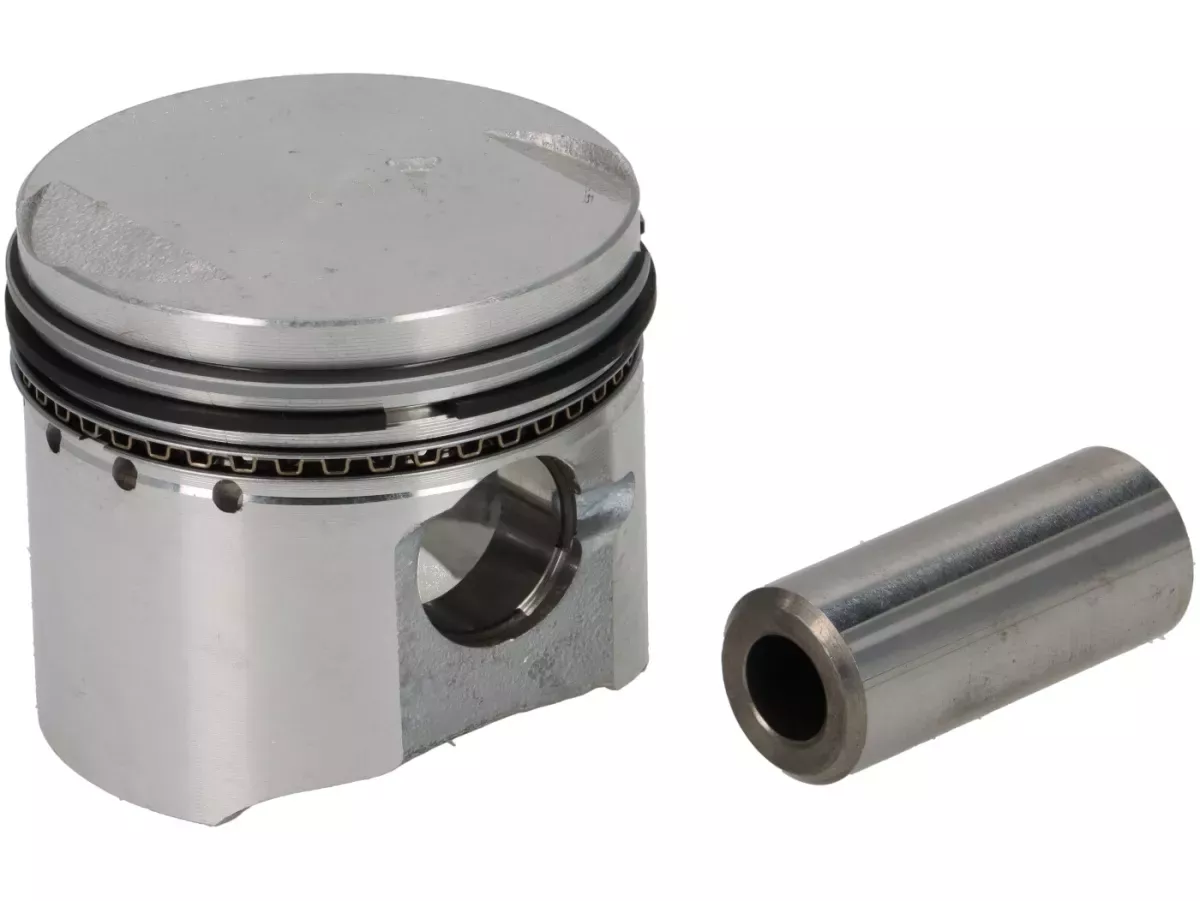
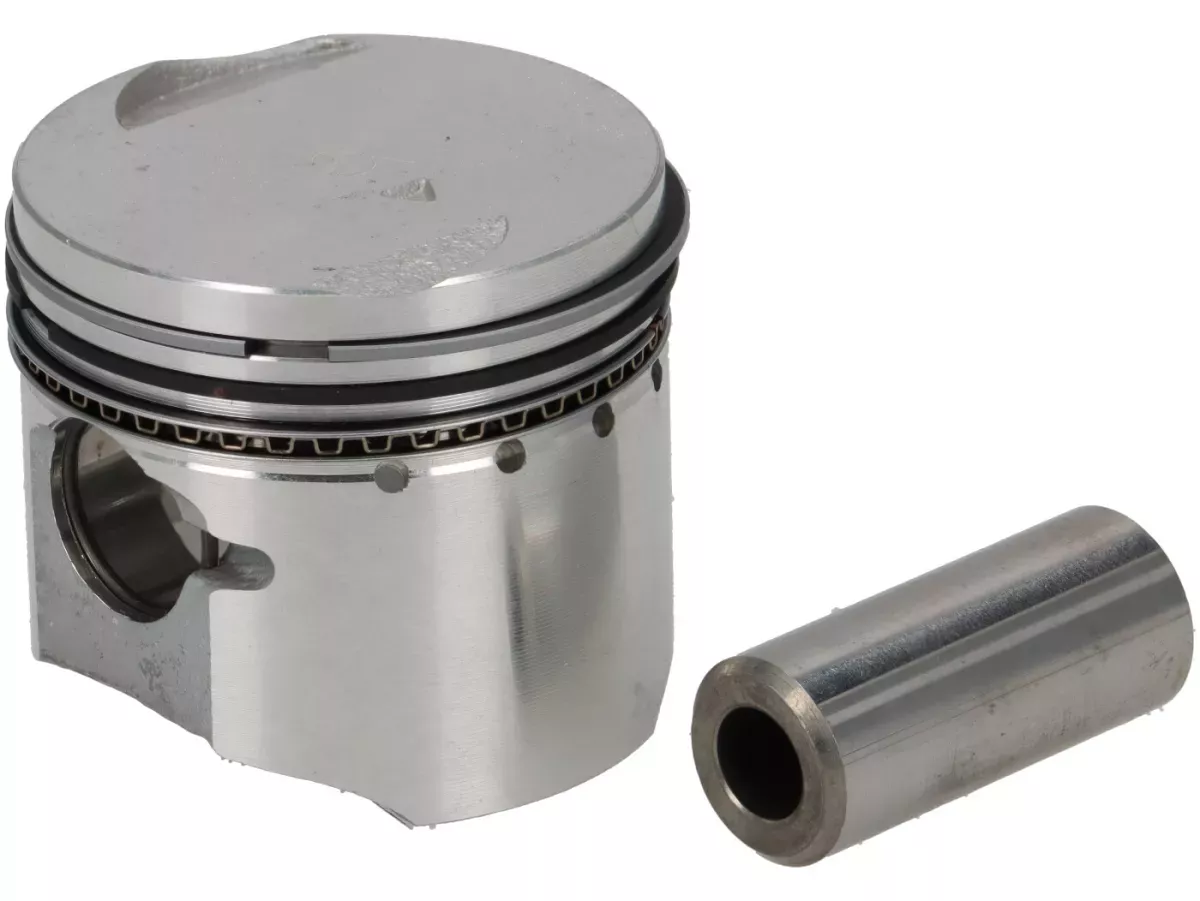
The original piston shown has a largely flat piston crown with two opposing valve pockets. These recesses are matched to the valve arrangement of the two-valve cylinder head and provide the necessary clearance for valve movement.
The piston crown features machined surfaces as well as areas with a visible cast texture. A marking is also present on the piston crown and must be taken into account when determining the prescribed installation orientation.
Three piston ring positions are visible in the upper section of the piston. The two upper piston rings perform essential functions in sealing the combustion chamber. The oil control ring positioned below regulates the oil film on the cylinder wall and returns excess oil.
The product images show the oil control ring with its characteristic multi-piece construction. The ring grooves and adjacent piston surfaces are machined accordingly.
The piston also features a machined skirt that guides it inside the cylinder. The piston pin bore is located on the side and provides the connection to the connecting rod.
The corresponding piston pin has a nominal diameter of 13mm and is shown separately next to the piston in the images. The exact contents supplied with each article variant must be checked before ordering.
Technical Specifications
- Manufacturer: Piaggio
- Product: Original piston
- Engine family: Hi-PER4
- Engine version: 50cc 4T AC 2V
- Engine type: Single-cylinder four-stroke engine
- Displacement: Approx. 49.9cc
- Nominal engine bore: 39mm
- Engine piston stroke: 41.8mm
- Number of valves: Two
- Valve arrangement: One intake valve, one exhaust valve
- Valve train: Overhead, chain-driven camshaft
- Cooling: Forced-air cooling (AC)
- Fuel mixture preparation: Carburettor
- Engine lubrication: Separate engine oil circulation system
- Piston pin diameter: 13mm
- Piston crown: Largely flat with two valve pockets
- Piston ring arrangement: Two upper piston rings and one oil control ring
- Available size categories: A, B, C, D or 1, 2, 3, 4
- Article number category A / 1: 9696040001
- Article number category B / 2: 9696040002
- Article number category C / 3: 9696040003
- Article number category D / 4: 9696040004
- Application: Replacement in cases of wear, damage or engine overhaul
Suitable for Vespa
- Vespa ET4 50 4T (1998–2002)
- Vespa LX 50 4T 2V (2005–2012)
- Vespa LXV 50 4T 2V (2012–2013)
- Vespa Primavera 50 4T 2V (2014–2017)
- Vespa S 50 4T 2V (2010–2012)
- Vespa Sprint 50 4T 2V (2014–2017)
Suitable for Piaggio Models
- Piaggio Fly 50 4T 2V (2004–2017)
- Piaggio Liberty 50 4T 2V (2001–2017)
- Piaggio Zip II 50 4T 2V (2002–2016)
Other Compatible Models
- Aprilia Scarabeo 50 4T (2002–2009)
- Aprilia Sport City One 50 4T (2008–2011)
- Derbi Atlantis 50 4T 2V (2004–2007)
- Derbi Boulevard 50 4T (2009)
The vehicle compatibility listed applies exclusively to the corresponding versions with an air-cooled 50cc four-stroke engine and two valves. Before ordering, the specific engine version, existing cylinder classification and required piston category must be verified.
Selection and Installation Instructions
Before replacing the piston, the condition of the cylinder must be inspected. This includes checking the cylinder bore for scoring and damage and measuring the cylinder diameter at the specified measuring points.
Correct matching of the piston and cylinder is essential for achieving the required running clearance. Insufficient clearance can lead to excessive friction and piston seizure at operating temperature. Excessive clearance, on the other hand, can impair piston guidance and sealing.
During installation, the prescribed piston orientation, correct piston ring arrangement and the respective ring end gaps must be observed. The condition of the piston pin, connecting rod small end and retaining components must also be checked.
The four size categories are intended to match the standard manufacturing tolerances. They are not designed as repair oversizes for severely worn or rebored cylinders.
Original Pistons for Professional Engine Overhaul
Piaggio pistons in categories A, B, C and D allow targeted replacement of the piston in the corresponding 50cc Hi-PER4 two-valve engines.
Selecting the appropriate size category helps restore the piston-to-cylinder fit intended for the standard engine, provided that the cylinder remains within the permissible dimensional and wear limits.
An original Piaggio replacement part for overhauling the corresponding Vespa ET4, LX, LXV, Primavera, S and Sprint models, as well as numerous other Piaggio, Aprilia and Derbi models equipped with an air-cooled 50cc four-stroke two-valve engine.


 DE | €