Piaggio Original Piston – 300cc Quasar LC 4V – Vespa GTS, GTS Super, GTV, Piaggio Beverly, MP3 – Category 1, 2, 3, 4
Original Piaggio pistons for liquid-cooled 300cc Quasar four-stroke engines with four valves. These pistons are designed for the repair of the original cylinder and piston assembly and are available in four different size categories. They allow a worn or damaged piston to be replaced while taking into account the manufacturing tolerances specified by the manufacturer.
The four versions differ in their dimensional classification. They are designated as categories 1, 2, 3 and 4. When ordering a replacement piston, it is important to ensure that the selected version matches the size classification of the existing cylinder.
What does Quasar mean in Piaggio engines?
Quasar is the designation of an engine family developed by the Piaggio Group. The abbreviation QUA.S.A.R. stands for Quarter Liter Smooth Augmented Range. Originally, it referred to a new generation of four-stroke engines in the 250cc displacement class.
The Quasar engine family was developed in the early 2000s and builds on the experience gained with the previous Piaggio LEADER engines. Its design incorporated solutions for larger engine displacements, smooth engine operation and use in different scooter models.
The engines were initially introduced in the 250cc class and later expanded to include additional displacement variants. Within the Piaggio Group, they were used in Vespa, Piaggio, Aprilia, Gilera and Derbi vehicles.
The 300cc Quasar version described here is a liquid-cooled, single-cylinder four-stroke engine with four valves, an overhead camshaft and electronic fuel injection.
The engine has a cylinder bore of 75mm and a piston stroke of 63mm. This results in an actual displacement of approximately 278cc. The designation 300cc therefore refers to the commonly used displacement class rather than the exact geometric engine capacity.
The liquid cooling system transfers the heat generated during combustion through a coolant circuit. Together with the four-valve technology and electronic fuel injection, it forms the technical basis of this Quasar engine generation.
Four piston categories for the standard cylinder bore
During the manufacturing of pistons and cylinders, small dimensional variations occur within the specified production tolerances. To compensate for these differences, Piaggio uses four different piston categories for the 300cc Quasar engines.
These categories allow the piston to be matched as precisely as possible to the existing cylinder bore. The decisive factor is the piston-to-cylinder clearance specified by the manufacturer.
The following original part numbers correspond to the respective size categories:
- Category 1 – Piaggio original part number 8764580001
- Category 2 – Piaggio original part number 8764580002
- Category 3 – Piaggio original part number 8764580003
- Category 4 – Piaggio original part number 8764580004
The size classes are sometimes also identified by letters. Spare parts catalogues list these pistons under the designations M, N, O and P, among others. When selecting a piston, priority should therefore be given to the unambiguous identification provided by the Piaggio original part number and the corresponding size category.
The different piston categories are not conventional repair oversizes. They represent dimensional grades within the standard piston and cylinder dimensions. They are not intended for repairing cylinders that have been rebored to a significantly larger diameter.
The required category must be determined using the existing markings and the actual cylinder dimensions. Identification based solely on the vehicle model or year of manufacture is insufficient.
Piston crown and construction
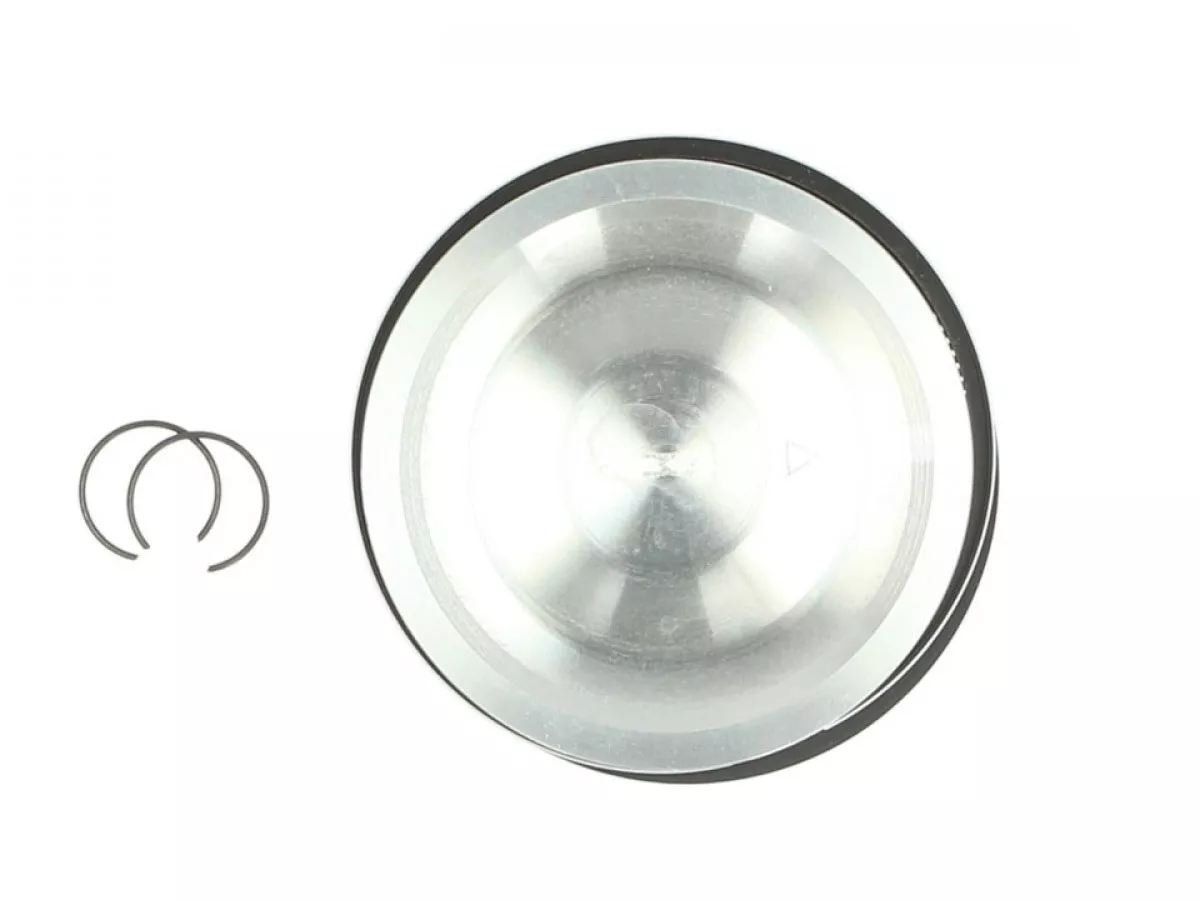
The piston features a distinctly recessed piston crown. Its contour forms part of the piston geometry designed for the Quasar combustion chamber and influences, among other things, the compression ratio specified by the engine design.
The product images show the machined surface of the piston crown, the circumferential ring grooves and the installed piston rings. The piston rings seal the combustion chamber, assist heat transfer to the cylinder wall and regulate the lubricating oil film.
The piston skirt guides the piston within the cylinder bore. The laterally positioned piston pin bosses provide the mechanical connection to the connecting rod through the piston pin.
The product images also show two piston pin retaining clips. These secure the piston pin axially and prevent it from moving sideways during engine operation.
A marking on the piston crown helps ensure correct orientation during installation. The installation direction specified by the manufacturer must be observed.
Technical specifications
- Manufacturer: Piaggio
- Product: original piston for four-stroke engines
- Engine family: Quasar
- Engine version: 300cc LC 4V
- Actual engine displacement: approx. 278cc
- Engine configuration: single-cylinder four-stroke engine
- Number of valves: four
- Valve train: overhead camshaft
- Cooling: liquid cooling (LC)
- Fuel system: electronic fuel injection
- Nominal engine bore: 75mm
- Engine stroke: 63mm
- Available size categories: 1, 2, 3, 4
- Piaggio original part number category 1: 8764580001
- Piaggio original part number category 2: 8764580002
- Piaggio original part number category 3: 8764580003
- Piaggio original part number category 4: 8764580004
- Piston crown: recessed, machined contour
- Piston rings: shown installed in the product images
- Piston pin retention: two retaining clips shown in the product images
- Application: replacement in cases of wear, damage or engine overhaul
Suitable for Vespa
- Vespa GTS 300 (2012–2017)
- Vespa GTS Super 300 (2008–2018)
- Vespa GTV 300 (2010–2013, 2017)
Suitable for Piaggio models
- Piaggio Beverly 300 (2009–2020)
- Piaggio Carnaby 300 Cruiser (2009)
- Piaggio MP3 300 (2009–2018)
- Piaggio MP3 Yourban 300 (2011–2018)
- Piaggio X7 300 (2011)
Other compatible models
- Gilera Nexus 300 (2008–2012)
- Aprilia Atlantic 300 (2010–2012)
- Aprilia Scarabeo 300 Light (2009)
- Aprilia Sport City 300 (2008–2013)
- Aprilia SR Max 300 (2011–2014)
- Derbi Rambla 300 (2010–2011)
The listed vehicle compatibility applies to the corresponding models equipped with the liquid-cooled 300cc Quasar four-valve engine. As different engine generations and technical versions were used within certain model ranges, the engine version and required piston category must be checked before ordering.
Important information on selection and installation
Before replacing the piston, the condition of the cylinder bore must be checked. In addition to visible damage such as scoring or wear marks, particular attention should be paid to wear, ovality and possible dimensional deviations.
The selection of the correct piston category depends on the dimensional classification and the actual condition of the cylinder. During an engine overhaul, the cylinder bore should be checked using suitable measuring instruments.
Insufficient piston-to-cylinder clearance can lead to increased friction and thermal problems. Excessive clearance, on the other hand, can adversely affect piston guidance, sealing and noise levels.
During installation, the specified piston orientation, correct positioning of the piston rings and piston ring end gap must be observed. The piston pin retaining clips must be properly seated in their grooves.
The condition of the piston pin, connecting rod small end and associated bearing surfaces should also be checked. Worn or damaged components must be professionally replaced before reassembly.
The four size categories allow precise selection within the standard manufacturing tolerances. However, they do not eliminate the need for cylinder repair or replacement in cases of excessive wear or damage.
Original Piaggio replacement part for the Quasar engine generation
The original Piaggio pistons with part numbers 8764580001 to 8764580004 are intended for the targeted repair of liquid-cooled 300cc Quasar engines.
With four available size categories, the piston version matching the existing cylinder can be selected during an engine overhaul. The correct combination of piston, cylinder and piston rings forms the basis for reliable sealing and the intended mechanical operation.
An original replacement part for the professional repair of Quasar engines in Vespa GTS, GTS Super, GTV and numerous Piaggio, Aprilia, Gilera and Derbi models.


 DE | €