Piston Piaggio Original – 125cc LEADER 4T AC 2V – Cast Iron Cylinder – Category A, B, C, D
Original Piaggio pistons for air-cooled 125cc LEADER four-stroke engines with two valves and a cast iron cylinder. The pistons in the 831974 series are intended for standard engine rebuilding and are available in four different size classes.
When replacing a piston, choosing the correct engine type is only part of the process. The relationship between the piston diameter and the actual cylinder bore is equally important. Piaggio therefore offers categories A, B, C and D to accommodate the small dimensional variations that occur during standard manufacturing.
These pistons are used in Vespa LX, LXV and S models, among others, as well as numerous Piaggio, Aprilia and Derbi models equipped with the corresponding 125cc LEADER engine.
What does LEADER mean in Piaggio engines?
LEADER stands for Low Emission ADvanced Engine Range. Piaggio uses this designation for an engine family developed and introduced in various scooter ranges from around the year 2000.
The LEADER engine concept combines compact construction with a four-stroke power unit designed for regular use in urban traffic and on longer journeys. Development objectives included low exhaust emissions, economical fuel consumption and reliable power delivery.
The LEADER family includes different displacement classes as well as air-cooled and liquid-cooled versions. Valve technology also varies depending on the engine version. In addition to two-valve engines, versions with four valves were developed.
The relevant 125cc LEADER AC 2V is an air-cooled single-cylinder four-stroke engine with two valves. Valve timing is controlled by an overhead camshaft driven by a timing chain. One intake valve and one exhaust valve control the gas exchange process.
Engine lubrication is provided by a separate oil circuit. Power transmission is handled by an automatic variator transmission with a drive belt and centrifugal clutch. The corresponding engine versions use a carburettor to prepare the air-fuel mixture.
125cc LEADER with cast iron cylinder
The 125cc LEADER two-valve engine has a nominal cylinder bore of 57.0mm and a piston stroke of 48.6mm. This results in a displacement of approximately 124cc.
The pistons offered here are intended exclusively for the corresponding engine version with a cast iron cylinder. Piaggio distinguishes between grey cast iron cylinders and aluminium cylinders for this engine type. Both cylinder versions have their own original pistons with different spare part numbers.
The cast iron cylinder features a cylinder running surface made of grey cast iron. This material provides a durable contact surface for the piston rings and allows the bore diameter, ovality and taper to be measured during professional engine rebuilding.
Depending on the condition of the cylinder, mechanical reworking of the running surface may be possible with the cast iron version. Whether this is permissible and technically appropriate must be assessed according to the manufacturer's specifications and the availability of suitable repair pistons.
However, the standard pistons in categories A to D described here are not intended for cylinders that have been rebored to a repair oversize.
Piaggio selective size classes A to D – Determining the correct piston size
During the standard manufacturing of pistons and cylinders, minor dimensional differences occur within specified production tolerances. Piaggio accommodates these differences by dividing the components into four selective size classes.
The markings A, B, C and D correspond to categories 1, 2, 3 and 4. This allows the piston to be selected according to the respective cylinder size classification.
The following original pistons are available:
- Category A / 1 – Piaggio original part number 8319740001
- Category B / 2 – Piaggio original part number 8319740002
- Category C / 3 – Piaggio original part number 8319740003
- Category D / 4 – Piaggio original part number 8319740004
All four categories belong to the standard nominal bore of 57.0mm. These are graduated selective sizes, not oversized pistons intended for repairing an enlarged cylinder bore.
The correct selection is based on the existing cylinder marking and its actual dimensions. Particularly with used engines, the cylinder running surface should be measured before ordering.
The original size class alone is not always sufficient for a cylinder that has already experienced wear. During operation, the diameter, roundness and cylinder geometry may have changed.
The piston-to-cylinder clearance specified by the manufacturer is essential for reliable long-term engine operation. The appropriate size class must therefore match both the cylinder version and the measured condition of the running surface.
Construction and features of the original piston
The product images show a piston with a largely flat piston crown. A shallow, crescent-shaped recess is positioned towards one side. The surface is machined and displays the typical machining marks of a standard production engine piston.
A small triangular marking is visible on the piston crown. It serves as an orientation reference during installation. The specified installation direction must be observed according to the relevant Piaggio assembly instructions.
Three circumferential ring grooves are located below the piston crown. They accommodate the piston rings, which perform different functions in sealing the combustion chamber and controlling the oil film.
The two upper ring positions provide sealing and assist with heat transfer from the piston to the cylinder running surface. The lower ring section is designed to regulate and scrape excess engine oil from the cylinder wall.
The piston skirt forms the lateral guiding surfaces of the piston. A transverse bore for the piston pin is located in the central section, providing the connection to the connecting rod.
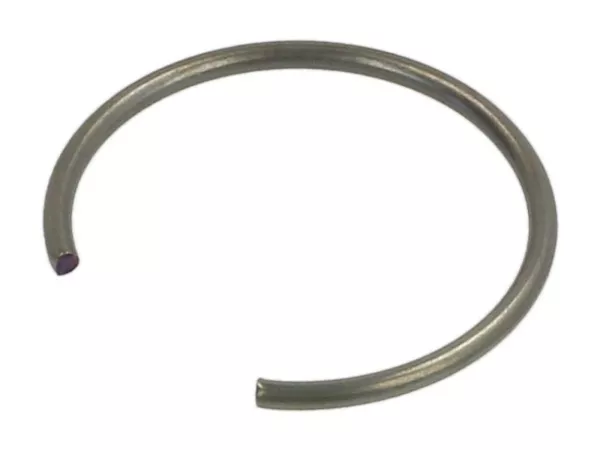
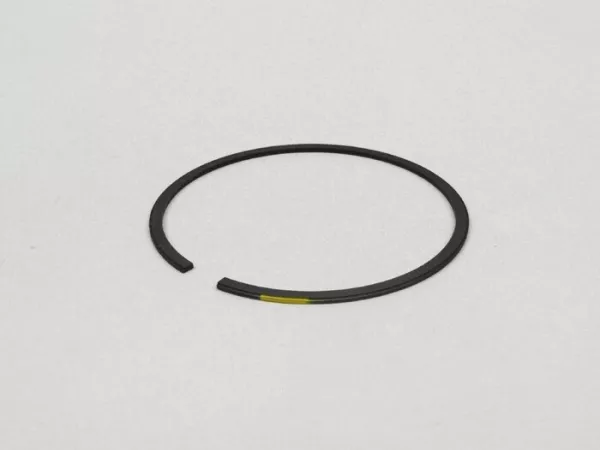
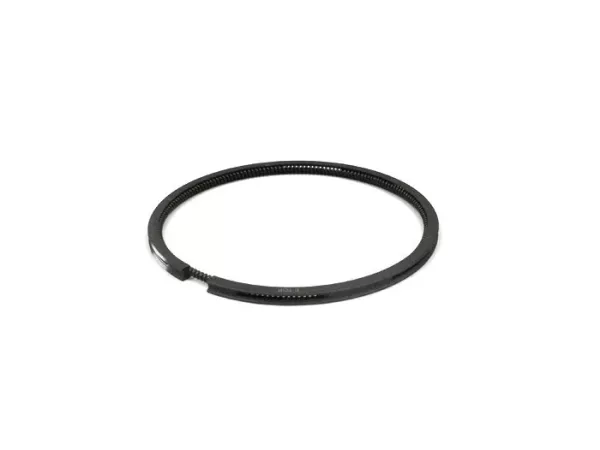
The images also show the piston pin, two piston pin retaining clips, two upper piston rings and the components of the oil control ring.
The exact contents of the package must be checked for the respective product variant.
Technical specifications
- Manufacturer: Piaggio
- Product: original piston
- Original part number series: 831974
- Engine family: LEADER
- Engine type: 125cc 4T AC 2V
- Engine configuration: single-cylinder four-stroke engine
- Displacement: approx. 124cc
- Nominal bore: 57.0mm
- Piston stroke: 48.6mm
- Cylinder material: grey cast iron
- Cooling: forced-air cooling (AC)
- Valve configuration: two valves, one intake valve and one exhaust valve
- Valve train: chain-driven overhead camshaft (SOHC)
- Engine lubrication: separate engine oil circuit
- Power transmission: automatic variator transmission with centrifugal clutch
- Piston crown: largely flat with an offset recess
- Piston ring arrangement: three ring grooves
- Piston pin: floating connection to the connecting rod, axially secured by retaining clips
- Available size classes: A, B, C, D or 1, 2, 3, 4
- Category A / 1: Piaggio 8319740001
- Category B / 2: Piaggio 8319740002
- Category C / 3: Piaggio 8319740003
- Category D / 4: Piaggio 8319740004
- Application: replacement due to piston wear, damage or engine rebuilding
Suitable for Vespa
- Vespa LX 125 (2006–2011)
- Vespa LXV 125 (2006–2013)
- Vespa S 125 (2009–2011)
Suitable for Piaggio models
- Piaggio Fly 125 (2004–2012)
- Piaggio Liberty 125 (2001–2015)
- Piaggio Skipper 125 ST Leader (2000–2005)
- Piaggio TPH 125 (2010–2016)
- Piaggio X8 125 Street (2006)
Other compatible models
- Aprilia Mojito 125 (2003–2007)
- Aprilia Sport City One 125 (2008–2011)
- Aprilia SR Motard 125 (2012–2014)
- Derbi Boulevard 125 (2007–2012)
- Derbi Sonar 125 (2010–2011)
- Derbi Variant Sport 125 (2012)
Vehicle compatibility applies exclusively to the corresponding versions equipped with an air-cooled 125cc LEADER two-valve engine and a cast iron cylinder. As different cylinder versions were used within certain model ranges, the installed engine version, cylinder material and required piston category must be checked before ordering.
Important information on replacement and engine rebuilding
Before installing a new piston, the reason for replacement should first be established. In the event of piston damage, particular attention should be paid to whether the cylinder running surface has also been damaged and whether other components of the crank mechanism are affected.
The cylinder bore must be checked at several points and in different measuring directions. This allows wear, ovality and taper to be identified. Only on the basis of these measurements can it be determined whether the existing cylinder may continue to be used with a standard piston.
During installation, the specified piston-to-cylinder clearance and correct piston ring end gaps must be maintained. Insufficient clearances can lead to excessive friction and piston seizure at operating temperature. Excessive clearances can cause piston noise, increased oil consumption and reduced combustion chamber sealing.
The piston rings must be installed in the correct order and orientation. The positions of the ring gaps must also be set according to the manufacturer's specifications.
The piston pin must be capable of being installed in the intended manner. The retaining clips must be fully seated in their grooves to prevent the piston pin from moving sideways during operation and damaging the cylinder running surface.
If the cast iron cylinder is machined to a repair oversize due to wear or damage, a piston specifically designed for that oversize must be used. The selective pistons in categories A to D are not suitable for this purpose.
Original Piaggio piston for professional engine repair
With the original pistons in the 831974 series, Piaggio provides suitable replacement parts for rebuilding the corresponding 125cc LEADER two-valve engines with cast iron cylinders.
The four available selective size classes allow piston selection matched to the standard manufacturing tolerances. Together with careful cylinder inspection and professional installation, this provides the basis for reliable engine operation.
An original Piaggio spare part for the repair and maintenance of compatible Vespa LX, LXV and S models, as well as numerous Piaggio, Aprilia and Derbi models equipped with the 125cc LEADER AC 2V engine.


 DE | €