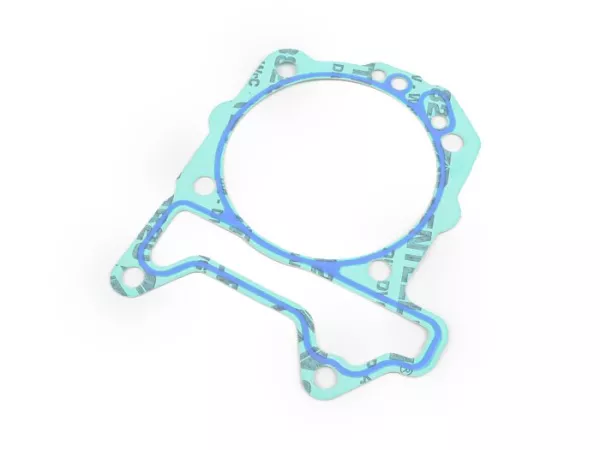
Piston Piaggio Original – 150cc LEM / IGET AC 3V – Vespa Primavera, Sprint, LX, LT, 946, Piaggio Liberty – Category A, B, C, D
Original Piaggio pistons for air-cooled 150cc four-stroke engines from the LEM and IGET series with three valves. The pistons are designed to replace worn or damaged standard pistons and are available in four different size categories. This allows the piston version to be selected during an engine overhaul according to the factory size classification of the existing cylinder.
The available categories A, B, C and D are also designated as 1, 2, 3 and 4. The different versions accommodate minor dimensional variations within standard manufacturing tolerances. The cylinder marking and its actual condition are essential for selecting the correct piston.
Piaggio LEM – the development of modern three-valve engines
LEM stands for Low Emission Motor. Piaggio uses this designation for an engine generation introduced in the early 2010s, designed to reduce fuel consumption and exhaust emissions while improving everyday usability.
LEM engines were used in the Vespa LX, LT, Primavera and Sprint model ranges, among others, as well as in various Piaggio models. They represent an important stage in the development of the manufacturer's air-cooled four-stroke engines.
A key feature of the LEM series is the three-valve cylinder head. While earlier Piaggio four-stroke engines frequently used two valves, the LEM design incorporates two intake valves and one exhaust valve.
The two intake valves allow the intake ports to be designed more precisely and provide greater flexibility in optimising gas exchange. The single exhaust valve is responsible for discharging combustion gases from the combustion chamber.
The valves are operated by an overhead camshaft driven by a timing chain. This design allows the valve train to be arranged compactly within the cylinder head.
During the development of LEM engines, particular attention was paid to efficient combustion and smooth power delivery. Together with electronic fuel injection, the three-valve technology forms an essential part of the engine design.
Technical design of the 150cc LEM engines
The 150cc LEM engines are air-cooled, single-cylinder four-stroke engines. They feature a three-valve cylinder head and electronic fuel injection.
With a cylinder bore of 58mm and a piston stroke of 58.6mm, the actual engine displacement is approximately 155cc. The designation 150cc corresponds to the conventional classification within this displacement category.
The almost identical bore and stroke dimensions result in a compact engine geometry. The piston moves inside the cylinder between top dead centre and bottom dead centre, transmitting the forces generated during combustion to the crankshaft through the piston pin and connecting rod.
Engine cooling is provided by an airflow generated by a cooling fan. This airflow passes over the cooling surfaces of the cylinder and cylinder head, carrying away the heat produced during engine operation.
Piaggio uses electronic fuel injection to prepare the air-fuel mixture. The system meters the fuel quantity according to the respective operating conditions and allows the combustion process to be precisely controlled.
LEM engines therefore combine a relatively straightforward air-cooled engine design with modern valve operation and electronic fuel delivery.
From LEM to IGET – the evolution of Piaggio engine technology
IGET stands for Italian Green Experience Technology. Piaggio uses this designation for a further-developed generation of its four-stroke engines, with particular attention paid to combustion, mechanical friction losses, smooth running and compliance with modern exhaust emission regulations.
IGET engines build on technical concepts from earlier Piaggio engine generations. These include the compact single-cylinder configuration, electronic fuel injection and an engine design optimised for economical everyday operation.
In the air-cooled 150cc three-valve engines, the basic valve configuration with two intake valves, one exhaust valve and an overhead, chain-driven camshaft is retained.
Further development includes refinements to the combustion process and various construction details. The objective is efficient engine operation combined with smooth power delivery and reduced operating noise.
The electronic engine management system adjusts the fuel supply to the respective operating conditions. Together with the three-valve technology, it provides an important basis for meeting the intended emission requirements.
Although LEM and IGET engines share numerous design features, individual components and their specifications may differ. The specific engine version must therefore be taken into account when ordering replacement parts.
The correct piston is identified using the Piaggio original part number and the required size category. Matching engine displacement and valve configuration alone is not sufficient to identify a suitable replacement part reliably.
Four piston categories for standard manufacturing tolerances
Even with precision manufacturing, small dimensional variations occur during the production of pistons and cylinders. These variations remain within the tolerances specified by the manufacturer and are accommodated through different size categories.
Piaggio uses four categories for the original pistons offered here. The specified original part numbers are assigned as follows:
- Category A / 1 – Piaggio original part number 1A0007670A, additional stated reference B0180130001
- Category B / 2 – Piaggio original part number 1A0007670B, additional stated reference B0180130002
- Category C / 3 – Piaggio original part number 1A0007670C, additional stated reference B0180130003
- Category D / 4 – Piaggio original part number 1A0007670D, additional stated reference B0180130004
The size categories are intended to match the piston as precisely as possible to the existing cylinder bore. The piston-to-cylinder clearance specified by the manufacturer must be maintained.
Categories A to D are not conventional repair oversizes. They differ within standard production dimensions and are not intended for cylinders that have been rebored to a significantly larger diameter.
The correct category must be selected according to the existing cylinder marking and its actual dimensions. The vehicle model or year of manufacture alone is not sufficient for reliable identification.
Functions and design requirements of the piston
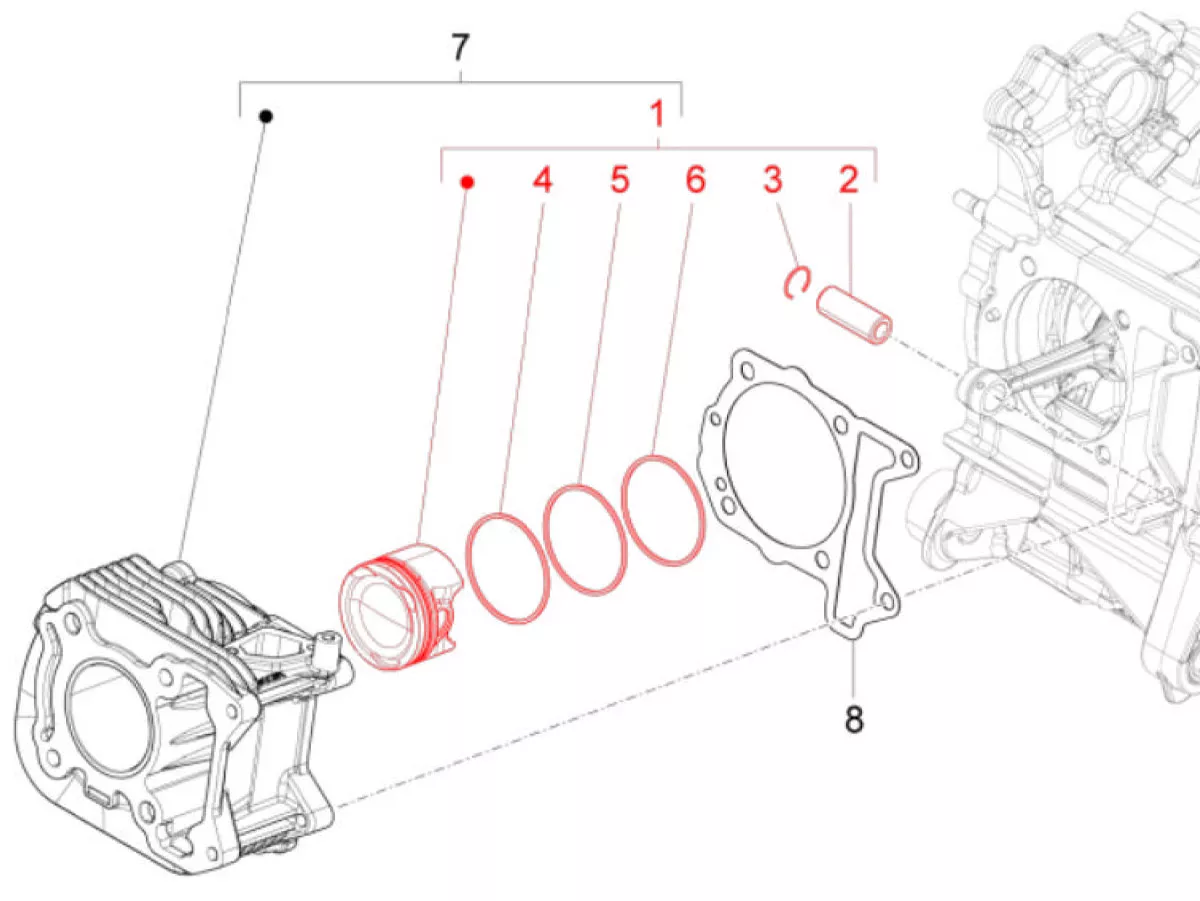
The piston is one of the central components of a four-stroke engine. It transfers the pressure generated during combustion to the connecting rod and, together with the piston rings, provides the necessary seal between the combustion chamber and the crankcase.
The piston crown forms the moving boundary of the combustion chamber. Its geometry is part of the design specifically matched to the engine and influences, among other factors, the intended compression ratio.
The piston rings perform several functions. The compression rings limit the passage of combustion gases between the piston and cylinder wall and assist heat transfer. The oil control ring regulates the lubricating oil film on the cylinder bore.
The piston skirt guides the piston as it moves inside the cylinder. Its sliding surfaces must accommodate both mechanical loads and the thermal expansion of the components.
The piston is connected to the connecting rod by the piston pin. This transmits the forces involved while allowing the connecting rod to pivot as required.
Correct interaction between the piston, piston rings, piston pin and cylinder is essential for reliable engine operation. Even small deviations from the specified piston clearance can affect friction, sealing and wear.
Technical specifications
- Manufacturer: Piaggio
- Product: original piston for four-stroke engines
- Engine family: LEM / IGET
- Engine version: 150cc AC 3V
- Actual engine displacement: approx. 155cc
- Engine configuration: single-cylinder four-stroke engine
- Number of valves: three
- Valve arrangement: two intake valves, one exhaust valve
- Valve operation: overhead, chain-driven camshaft
- Cooling: air cooling (AC)
- Fuel system: electronic fuel injection
- Nominal engine bore: 58mm
- Engine stroke: 58.6mm
- Available size categories: A, B, C, D or 1, 2, 3, 4
- Piaggio original part number category A / 1: 1A0007670A
- Piaggio original part number category B / 2: 1A0007670B
- Piaggio original part number category C / 3: 1A0007670C
- Piaggio original part number category D / 4: 1A0007670D
- Additional stated references: B0180130001, B0180130002, B0180130003, B0180130004
- Size classification: four categories within standard manufacturing tolerances
- Application: replacement in cases of wear, damage or engine overhaul
Suitable for Vespa
- Vespa 946 150 (2018–)
- Vespa LT 150 (2014)
- Vespa LX 150 (2012–2013)
- Vespa Primavera 150 (2013–)
- Vespa Sprint 150 (2015–)
Suitable for Piaggio models
- Piaggio Liberty 150 (2014–2024)
The vehicle compatibility information applies to the corresponding versions equipped with an air-cooled 150cc three-valve engine. As different engine generations and technical variants were used within individual model ranges, the specific engine version and required piston category must be checked before ordering.
Important information on selection and installation
Before replacing the piston, the condition of the cylinder bore must be checked. In addition to visible damage such as scoring or wear marks, particular attention should be paid to wear, ovality and possible dimensional deviations.
The correct piston category is determined by the size classification and the actual condition of the cylinder. During an engine overhaul, the cylinder bore should be checked using suitable precision measuring instruments.
Insufficient piston clearance can lead to increased friction and thermal problems. Excessive piston clearance, on the other hand, can adversely affect piston guidance, sealing and operating noise.
During installation, the specified piston orientation, correct positioning of the piston rings and piston ring end gap must be observed. The piston pin retaining clips must be fully and correctly seated in their grooves.
The condition of the piston pin, connecting rod small end and associated bearing surfaces should also be inspected. Worn or damaged components must be properly replaced before reassembly.
The four size categories allow accurate selection within standard manufacturing tolerances. However, they do not eliminate the need for cylinder repair in cases of excessive wear or damage.
Original Piaggio replacement part for LEM and IGET engines
The original Piaggio pistons in the 1A0007670A to 1A0007670D series are intended for targeted repair of the corresponding air-cooled 150cc three-valve engines.
The four size categories make it possible to select the piston version that matches the existing cylinder. The correct combination of piston, cylinder and piston rings provides the basis for reliable sealing and the intended mechanical operation of the engine.
An original replacement part for professional repair of the corresponding 150cc LEM and IGET engines in Vespa Primavera, Sprint, LX, LT, 946 and Piaggio Liberty.


 DE | €