Original Piaggio Oil Sump – Leader, Quasar 125–250 cc – Vespa ET4, GT, GTS, GTV, LX, LXV, S
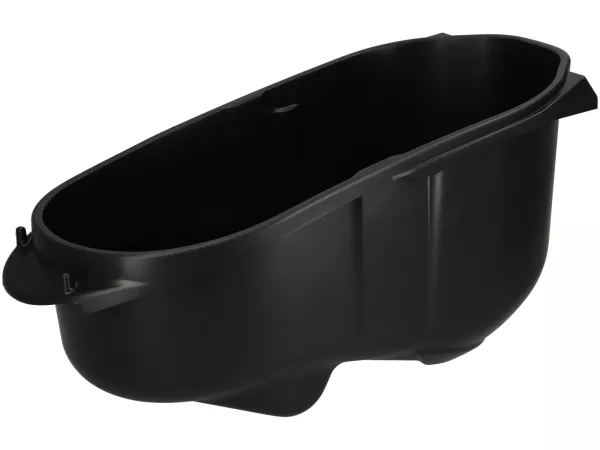
The original Piaggio oil sump with part number 843761 is a replacement part for numerous four-stroke engines from the Leader series and corresponding engine variants within the Piaggio Group. It forms part of the lower engine housing and serves as a reservoir for the engine oil required for lubrication. The oil sump is mounted directly to the engine crankcase and is designed to meet the structural requirements of the respective engine version.
This component is used in Vespa ET4, GT L, GTS, GTV, LX, LXV and S models, among others, as well as various vehicles from Piaggio, Gilera, Aprilia and Derbi. In addition to the widely used Leader engines with displacements of 125, 150, 180 and 200 cc, the oil sump is also used in certain 250 cc engine variants. The original Piaggio part number 843761 is the decisive reference for identifying the correct application.
Construction and Function
The oil sump is made from a dimensionally stable cast light-alloy component with a continuous machined sealing surface. Several mounting holes allow it to be bolted to the engine crankcase. The external reinforcing ribs increase the rigidity of the component while also enlarging its surface area.
A characteristic feature is the integrated, outward-facing threaded neck for the corresponding oil filler cap. The internal geometry is matched to the respective engine design and takes into account the necessary clearances and the arrangement of adjacent components.
The oil sump performs several functions within the engine. It forms the lower closure of the oil chamber, holds part of the engine oil supply and provides the structurally specified connection to the engine crankcase. An undamaged oil sump is therefore essential for a leak-free and properly functioning engine lubrication system.
Original Piaggio Replacement Part for Leader and Corresponding Quasar Engines
Piaggio Leader engines were used in numerous scooter models with air and liquid cooling. Some of the best-known applications include the Vespa ET4 125 and 150, Vespa GT L 125 and 200, and various versions of the Vespa GTS 125, LX and LXV.
In addition, the oil sump with part number 843761 is listed in spare parts applications for other Piaggio Group vehicles, including certain models equipped with 250 cc engines. Its application therefore extends across different engine and vehicle generations. However, not every Leader or Quasar engine version uses the same oil sump.
Important: Before ordering, the existing oil sump should be checked against the original Piaggio part number 843761 or the relevant spare parts documentation. Different oil sump designs may be used, particularly between different engine versions, production years and technical revisions.
Technical Features and Original Part Numbers
- Manufacturer: Piaggio
- Component: oil sump for four-stroke engines
- Original Piaggio part number: 843761
- Reference numbers for earlier versions: 827772, 829523
- Additional reference numbers: AP8176255, AP8580175
- Construction: cast light-alloy component with reinforcing ribs
- Design: machined sealing surface, mounting holes and threaded neck for the oil filler cap
- Application: corresponding Piaggio Leader engines and selected additional engine variants
Suitable for Vespa
- Vespa GT L 125 (2003–2005)
- Vespa GT L 200 (2003–2006)
- Vespa GTS 125 (2007–2012)
- Vespa GTV 125 (2006–2008)
- Vespa ET4 125 (2000–2005)
- Vespa ET4 150 (2001–2004)
- Vespa LX 125 (2005–2011)
- Vespa LX 150 (2006, 2009–2012)
- Vespa LXV 125 (2006–2013)
- Vespa S 125 (2007, 2009–2011)
- Vespa S 150 (2008–2012)
Other Compatible Piaggio Models
- Piaggio Beverly 125 (2002–2006)
- Piaggio Beverly 200 (2002–2005)
- Piaggio Beverly 250 (2004–2008)
- Piaggio Fly 125 (2004–2007, 2009–2010, 2012)
- Piaggio Fly 150 (1998, 2004, 2006–2008)
- Piaggio Hexagon GTX 125 (2003)
- Piaggio Hexagon GTX 180 (2001)
- Piaggio Liberty 125 (2001–2002, 2006–2015)
- Piaggio Liberty 150 (1998, 2008–2013)
- Piaggio Liberty 200 (2002, 2006–2008)
- Piaggio MP3 125 (2006–2008)
- Piaggio Skipper ST 125 (2000–2005)
- Piaggio Skipper ST 150 (2000)
- Piaggio TPH 125 (2010–2016)
- Piaggio X7 125 (2008–2009)
- Piaggio X8 125 LC (2004–2005, 2007–2008)
- Piaggio X8 125 Potenziato 4V LC (2005–2006)
- Piaggio X8 125 Street AC (2006)
- Piaggio X8 150 Street AC (2006)
- Piaggio X8 200 (2004–2007)
- Piaggio X9 125 (2000–2003)
- Piaggio X9 180 Amalfi (2002)
- Piaggio X9 200 (2002)
- Piaggio X9 Evo 125 (2003–2007)
- Piaggio X9 Evo 200 (2004)
- Piaggio X9 Evo 250 (2004)
- Piaggio XEvo 125 (2007–2016)
- Piaggio Zip II 125 (2000–2003)
Suitable for Gilera
- Gilera DNA 125 (2002–2003)
- Gilera DNA 180 (2001–2003)
- Gilera Nexus 125 (2007–2008)
- Gilera Runner VX 125 (2001–2016)
- Gilera Runner VXR 200 (2003–2004, 2006–2011)
Suitable for Aprilia
- Aprilia Atlantic 125 (2003–2008, 2010–2011)
- Aprilia Atlantic 200 (2003–2005)
- Aprilia Atlantic 250 (2004–2006)
- Aprilia Mojito 125 AC (2003–2007)
- Aprilia Mojito 125 LC (2008)
- Aprilia Mojito 150 (2003–2004)
- Aprilia Scarabeo 125 (2003–2006)
- Aprilia Scarabeo 200 (2003)
- Aprilia Scarabeo 250 (2004–2006)
- Aprilia Sport City 125 (2004–2006)
- Aprilia Sport City 200 (2004, 2007–2008)
- Aprilia Sport City Cube 200 (2008–2010)
- Aprilia Sport City One 125 (2008–2011)
- Aprilia SR Motard 125 (2012–2014)
Suitable for Derbi
- Derbi Boulevard 125 (2003–2009, 2011–2012)
- Derbi Boulevard 150 (2002–2004, 2010)
- Derbi Boulevard 200 (2005–2006)
- Derbi GP1 125 4V LC (2006–2009)
- Derbi GP1 125 Low Seat LC (2007)
- Derbi Sonar 125 (2010–2011)
- Derbi Sonar 150 (2010)
- Derbi Variant Sport 125 (2012)
Installation and Repair Instructions
Replacing the oil sump may be necessary if the component has been damaged by mechanical impact, has developed cracks or if the sealing surface or threads are no longer in proper condition. Replacing a damaged oil sump may also be advisable during a comprehensive engine overhaul.
Before installation, the contact surfaces on the engine crankcase must be carefully cleaned and inspected for damage. The new oil sump must be installed using the gasket specified for the respective engine version. For various Leader engines, Piaggio spare parts documentation lists the oil sump gasket with part number 830128. The exact application must be checked against the specific engine.
When fastening the oil sump, the tightening sequence and torque specifications prescribed by the vehicle manufacturer must be followed. The bolts should be tightened evenly to prevent uneven loading of the sealing surface. Excessive tightening torque can damage the threads or the housing.
After installation, the oil filler cap and its seal must be checked, and the prescribed quantity of engine oil approved for the respective engine must be added. The oil capacity and viscosity markings on the oil sump do not replace the vehicle-specific maintenance specifications. The assembly must be checked for oil leaks after the engine has been run for the first time.
The original Piaggio oil sump 843761 allows a damaged component or one that no longer provides a reliable seal to be replaced with the corresponding standard specification part. Its original-equipment design enables a professional repair while maintaining the intended arrangement of components in the lower engine area.


 DE | €