EGIG PERFORMANCE Piston Ø65 mm – Short Version for EGIG 170/180/187 cm³
Genuine EGIG PERFORMANCE replacement piston with a 51 mm stroke length for the entire 170/180/187-cm³ gray cast iron cylinder series. The short piston version corresponds to the original EGIG 170 design and is particularly suitable for engine builds where the priority is on installation that is as simple as possible without requiring additional machining of the crankcase opening.
What makes the EGIG concept unique is that all three displacement variants use the same gray cast iron cylinder with a 65 mm bore. The different displacements result from the crankshaft stroke. The respective cylinder head geometry and installation configuration account for the changed stroke ratios.
The short piston can therefore be used in both the EGIG 170 and the 180- and 187-cm³ versions, provided the appropriate piston size class is selected and the mechanical installation conditions are correct.
Original short design for easy installation
The original EGIG 170 design was specifically developed for the simplest possible installation on classic Vespa small-frame engine cases. Despite the large 65-mm bore, the cylinder can be used in combination with the specified crankshaft—which has a 51-mm stroke and 115-mm connecting rod length —without having to ream the crankcase opening.
The key to this is the deliberately short piston design. With this engine configuration, the 51-mm-long piston skirt does not extend into the standard, smaller crankcase opening at bottom dead center.
This preserves the characteristic plug-and-play feature of the original EGIG-170 concept. The piston is suitable both for replacing a worn or damaged original piston and for a new engine build.
One Piston for Three Displacement Variants
The EGIG engines with 170, 180, and 187 cm³ are based on the same cylinder design with a 65 mm bore. Therefore, the piston does not need to be replaced solely based on displacement.
| Engine variant |
Cylinder Bore |
Piston |
| EGIG 170 cm³ | Ø65 mm | 51 mm, short version |
| EGIG 180 cm³ | Ø65 mm | 51 mm, short version |
| EGIG 187 cm³ | Ø65 mm | 51 mm, short version |
In the longer-stroke variants, the piston positions at top dead center and bottom dead center change. The correct cylinder positioning and head geometry must therefore be matched to the respective crankshaft configuration.
Important: The “plug-and-play” claim—which does not require machining the crankcase opening—applies to the intended EGIG 170 setup. For 180 and 187 cm³ configurations, as well as for connecting rod lengths that differ from standard, clearance must be verified on a case-by-case basis.
Product Features
- Original short design: 51 mm piston length
- Universal application: For EGIG 170, 180, and 187 cm³
- Ø65 mm nominal diameter: Compatible with the standard EGIG gray cast iron cylinder base
- Easy to install: Short piston skirt for maximum clearance to the cylinder head opening
- Four size classes: A, B, C, and D for matching the actual cylinder bore
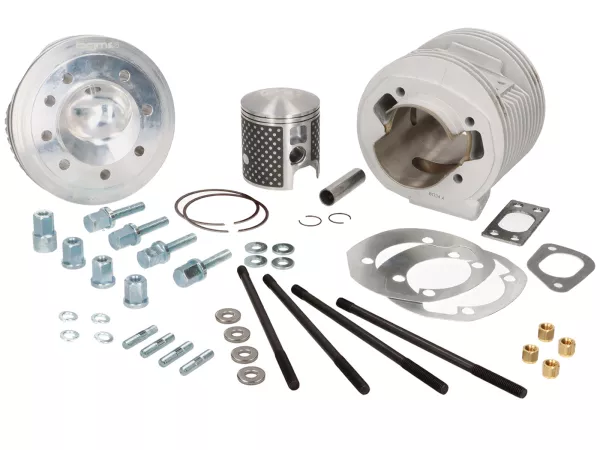
- Complete piston set: Includes two piston rings, piston pins, and retaining clips
Available piston size classes
| Size class |
Piston diameter |
| A | 64.87 mm |
| B | 64.88 mm |
| C | 64.89 mm |
| D | 64.90 mm |
Important: The appropriate piston size class must be selected based on the actual measured cylinder bore and the specified piston clearance. A larger piston is not automatically the better choice.
Package Contents
- 1 × EGIG PERFORMANCE piston, 51 mm long
- 2 × Piston rings
- 1 × piston pin
- 2 × Piston pin retaining clips
Compatible Vehicles and Cylinders
For Vespa small-frame engines with one of the following EGIG gray cast iron cylinders:
- EGIG PERFORMANCE 170 cm³, Ø65 mm
- EGIG PERFORMANCE 180 cm³, Ø65 mm
- EGIG PERFORMANCE 187 cm³, Ø65 mm
Typical vehicle models:
- Vespa PV125 / Primavera
- Vespa 125 ET3
- Vespa PK125
- Other Vespa small-frame engines built to the same specifications
Installation Instructions
The short 51-mm piston version is designed for the simplest possible installation. With the original EGIG 170 engine configuration featuring a 51-mm stroke and 115-mm connecting rod, no enlargement of the standard crankcase opening is required for the piston skirt.
For other crankshaft strokes or connecting rod lengths, the piston position and clearance must be rechecked. This applies in particular to the 180- and 187-cm³ variants.
The following points should be checked before assembly:
- Select the piston size class corresponding to the cylinder bore
- Check piston clearance and piston ring end play
- Check the piston position at top dead center and bottom dead center
- Check the compression edge and cylinder timing
- Ensure that the piston skirt and crankshaft assembly move freely
Alternative: Long-stroke piston version with 56 mm
A piston with a 56 mm overall length is also available for the EGIG-170/180/187 series. Compared to the short standard version, it has a piston skirt that is 5 mm longer.
The larger guide surface improves the lateral support of the piston in the cylinder bore. This helps reduce tilting movements and the associated mechanical piston rattling noises.
However, the additional guide area requires more space at bottom dead center. Depending on the stroke, connecting rod length, and engine design, machining of the housing opening may therefore be necessary.
Frequently Asked Questions (FAQ)
Does the short piston also fit the EGIG 180 and 187 cm³ models?
Yes. The three EGIG displacement variants use the same gray cast iron cylinder with a 65 mm bore. The short 51 mm piston is suitable for all three variants, provided the size class and other installation conditions are correct.
Why does the same piston fit different displacement sizes?
The differences between the EGIG 170, 180, and 187 cm³ models stem from the crankshaft stroke. The cylinder bore and basic piston geometry remain identical. The various stroke variants are accommodated through the appropriate cylinder head and installation configuration.
Does the engine block need to be bored out for the short piston?
In the intended EGIG 170 setup with a 51 mm stroke and 115 mm connecting rod length, no enlargement of the crankcase opening is required for the piston skirt. For other stroke and connecting rod configurations, clearance must be verified.
What is the difference between the short and long piston versions?
The short version is 51 mm long and features a design that is particularly easy to install. The long version has a 56 mm-long piston skirt for a larger contact surface and potentially lower mechanical running noise. However, the long version may require additional housing machining.
Which piston size class do I need?
The selection depends on the actual diameter of the cylinder bore and the required piston clearance. The displacement alone does not determine the appropriate size class.
Are piston rings and a piston pin included?
Yes. The piston comes with two piston rings, a piston pin, and two retaining clips.


 DE | €