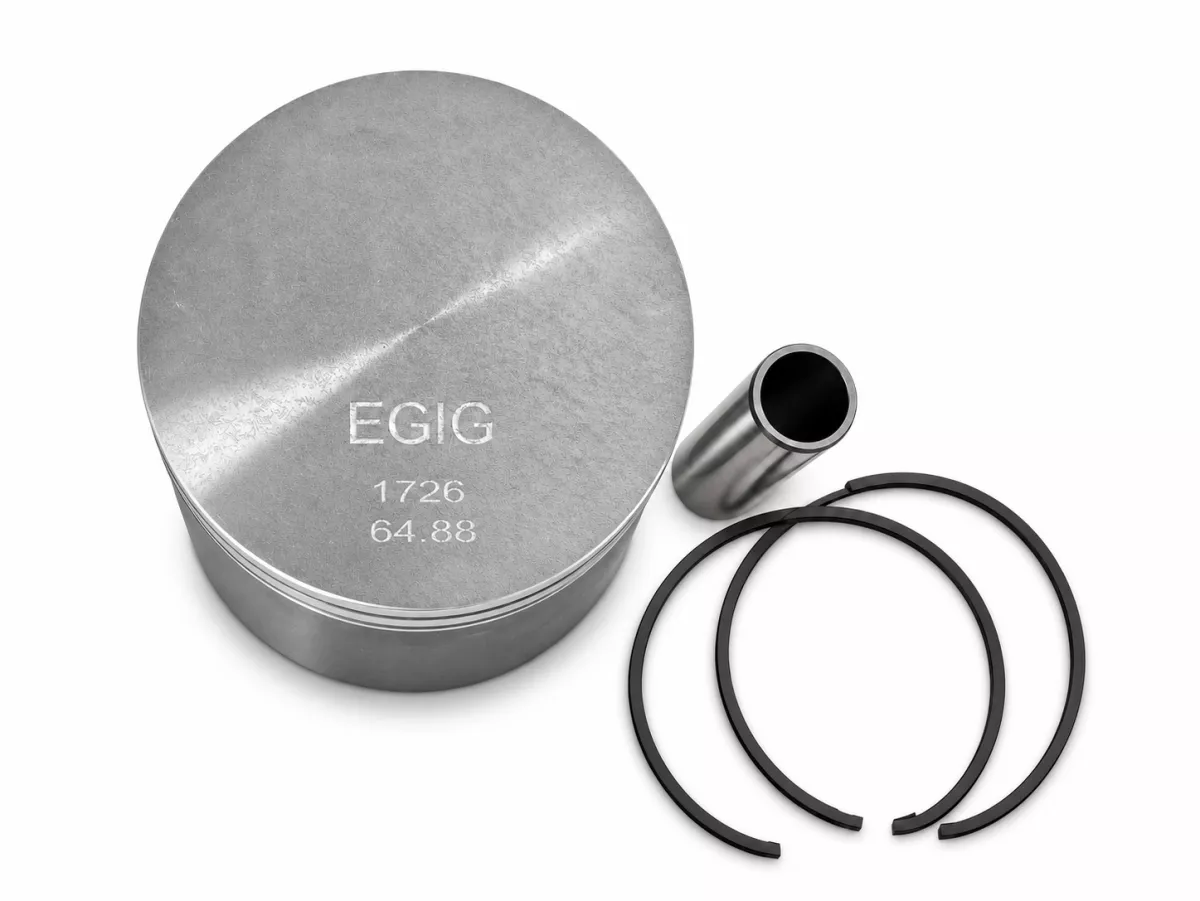
EGIG PERFORMANCE Piston Ø65 mm – Long Version for EGIG 170/180/187 cm³
EGIG PERFORMANCE piston with extended piston skirt for all three displacement variants of the EGIG 170/180/187 cast-iron cylinder series. The 56 mm long version improves piston guidance and can significantly reduce mechanical piston knock compared to the shorter standard version.
What makes the EGIG concept unique: The 170-, 180-, and 187-cm³ engines all use the same gray cast iron cylinder with a 65 mm bore. The different displacements result exclusively from the respective crankshaft stroke. The cylinder head geometry and installation configuration are designed accordingly.
The piston offered here is therefore suitable for all three displacement variants, provided the correct size class is selected and there is sufficient clearance for the extended piston skirt.
56 mm piston length – improved guidance and reduced running noise
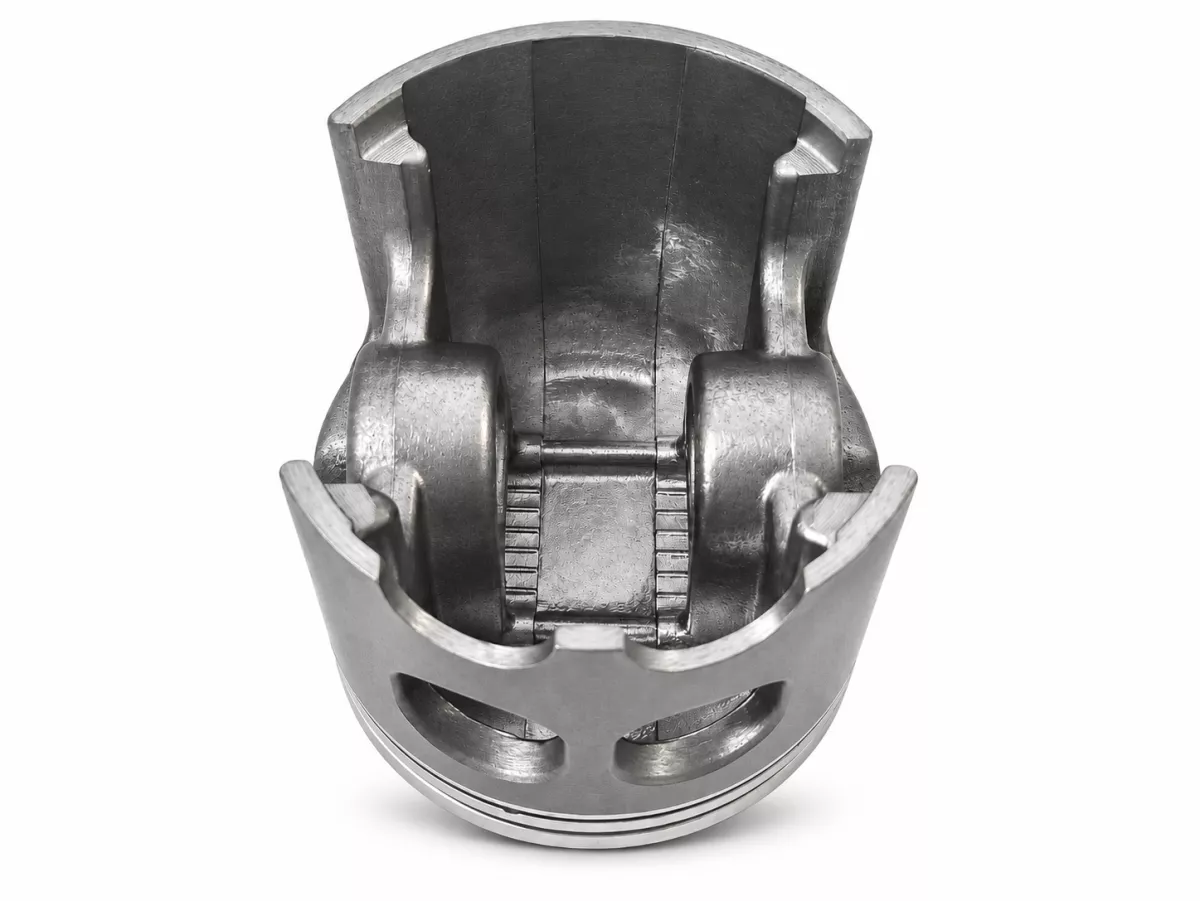
Compared to the original 51-mm version, this piston has a piston skirt that is 5 mm longer. The additional guiding surface improves the piston’s lateral support in the cylinder bore and counteracts unwanted tilting movements.
In every reciprocating piston engine, the angled position of the connecting rod generates lateral forces that press the piston against the cylinder wall. When the direction of the load changes, the piston may tilt slightly within its clearance. Especially in large-displacement single-cylinder engines, this movement can manifest as a clearly audible mechanical piston clatter.
The extended piston skirt provides a larger guiding surface and stabilizes the piston within the cylinder bore. This helps reduce the typical piston tilt.
The advantage: improved piston guidance and potentially significantly lower mechanical running noise—regardless of whether the cylinder is operated at 170, 180, or 187 cm³.
One Piston for EGIG 170, 180, and 187 cm³
All three EGIG displacement variants are based on the same cylinder bore of 65 mm. Therefore, the piston does not need to be replaced solely based on displacement.
The differences between the engine variants result from the crankshaft stroke and the corresponding cylinder head and installation configuration. For the use of the long piston, clearance at bottom dead center and the correct piston size class are particularly crucial.
| Engine Variant |
Cylinder Bore |
Piston |
| EGIG 170 cm³ |
Ø65 mm |
56 mm, long version |
| EGIG 180 cm³ |
Ø65 mm |
56 mm, long version |
| EGIG 187 cm³ |
Ø65 mm |
56 mm, long version |
Product Features
- Extended design: 56 mm piston length instead of 51 mm in the standard version
- Universal application: For EGIG 170, 180, and 187 cm³
- Improved piston guidance: Greater lateral support in the cylinder bore
- Reduced piston wobble: Less wobbling within the piston clearance
- Smoother engine operation: Potentially reduced mechanical piston rattling noises
- Ø65 mm: Compatible with the common EGIG gray cast iron cylinder base
- Four size classes: A, B, C, and D to match the actual cylinder bore
- Complete piston set: Includes piston rings, piston pins, and retaining clips
Important installation note: Clearance to the engine block
The long-stroke piston version is not fully plug-and-play!
The original EGIG piston design uses a deliberately short piston skirt measuring 51 mm in length. This allows the cylinder to be installed without reaming the crankcase opening, provided the crankshaft and engine block configuration are suitable.
The piston offered here has a piston skirt that is 5 mm longer. As a result, it extends further toward the crankcase at bottom dead center.
Depending on the crankshaft stroke, connecting rod length, and cylinder position, it may be necessary to ream out the crankcase opening to create sufficient clearance for the longer piston skirt.
This applies in principle to all three displacement variants. Since the piston position at bottom dead center changes depending on the stroke and connecting rod configuration used, clearance should be checked individually for each engine build.
Before final assembly, it must be ensured that the piston skirt does not come into contact with the engine block or other components throughout the entire crankshaft rotation.
Available Piston Size Classes
| Size Class |
Piston Diameter |
| A | 64.87 mm |
| B | 64.88 mm |
| C | 64.89 mm |
| D | 64.90 mm |
Important: The appropriate size class is selected based on the actual measured cylinder bore and the required piston clearance. The longer piston cannot compensate for excessive piston clearance or a worn or damaged cylinder bore.
Package Contents
- 1 × EGIG PERFORMANCE piston, 56 mm long
- 2 × Piston rings
- 1 × piston pin
- 2 × Piston pin retaining clips
Compatible Vehicles and Cylinders
For Vespa small-frame engines with one of the following EGIG gray cast iron cylinders:
- EGIG PERFORMANCE 170 cm³, Ø65 mm
- EGIG PERFORMANCE 180 cm³, Ø65 mm
- EGIG PERFORMANCE 187 cm³, Ø65 mm
Typical vehicle models:
- Vespa PV125 / Primavera
- Vespa 125 ET3
- Vespa PK125
- Other Vespa small-frame engines built to the same specifications
A prerequisite is the use of the appropriate EGIG gray-cast iron cylinder and sufficient clearance for the extended piston skirt.
Which piston version is the right one?
Short version – 51 mm: The original design with a short piston skirt. Particularly suitable for engine builds where the housing opening should remain as unmodified as possible.
Long version – 56 mm: The version with a larger guide surface for improved piston support and potentially lower mechanical running noise. Particularly suitable for demanding engine builds where any necessary housing modifications are not an obstacle.
Frequently Asked Questions (FAQ)
Does the piston also fit the EGIG 180 and 187 cm³ engines?
Yes. The EGIG 170-, 180-, and 187-cm³ engines use the same gray cast iron cylinder with a 65 mm bore. The piston can therefore be used in all three variants, provided the dimensional class and mechanical clearance are correct.
Why does the same piston fit three different displacements?
Because the difference in displacement is due solely to the crankshaft stroke. The cylinder bore remains identical across all three variants. The different stroke geometries are accommodated by the respective cylinder head and installation configurations.
What are the benefits of the longer piston skirt?
The piston skirt, which is 5 mm longer, improves the piston’s guidance in the cylinder bore. This helps reduce wobble and the associated mechanical running noise.
Does the engine block need to be machined for the long piston?
That depends on the specific engine design. Due to the longer piston skirt, additional space may be required at bottom dead center. Therefore, clearance must be checked, and the housing opening must be machined accordingly if necessary.
What piston size class do I need?
The appropriate size class depends on the actual diameter of the cylinder bore and the required piston clearance. Selecting a size based solely on the engine variant (170, 180, or 187 cm³) is not sufficient.
Are piston rings and piston pins included?
Yes. The piston is supplied with two piston rings, a piston pin, and two retaining clips.


 DE | €