Postage free from 99€ (DE)
High customer satisfaction


 DE | €
- Scooter 50-850cc
- PIAGGIO Oil Pan Gasket for Vespa ET4, GT, GTS, GTV, LX, LXV, S, Piaggio Leader/Quasar 125–250 cc

Original Piaggio oil sump gaskets are designed to provide a reliable seal between the oil sump and the engine crankcase. They are used in various four-stroke engines from the Piaggio Leader and Quasar series and prevent engine oil from escaping through the joint between the two components.
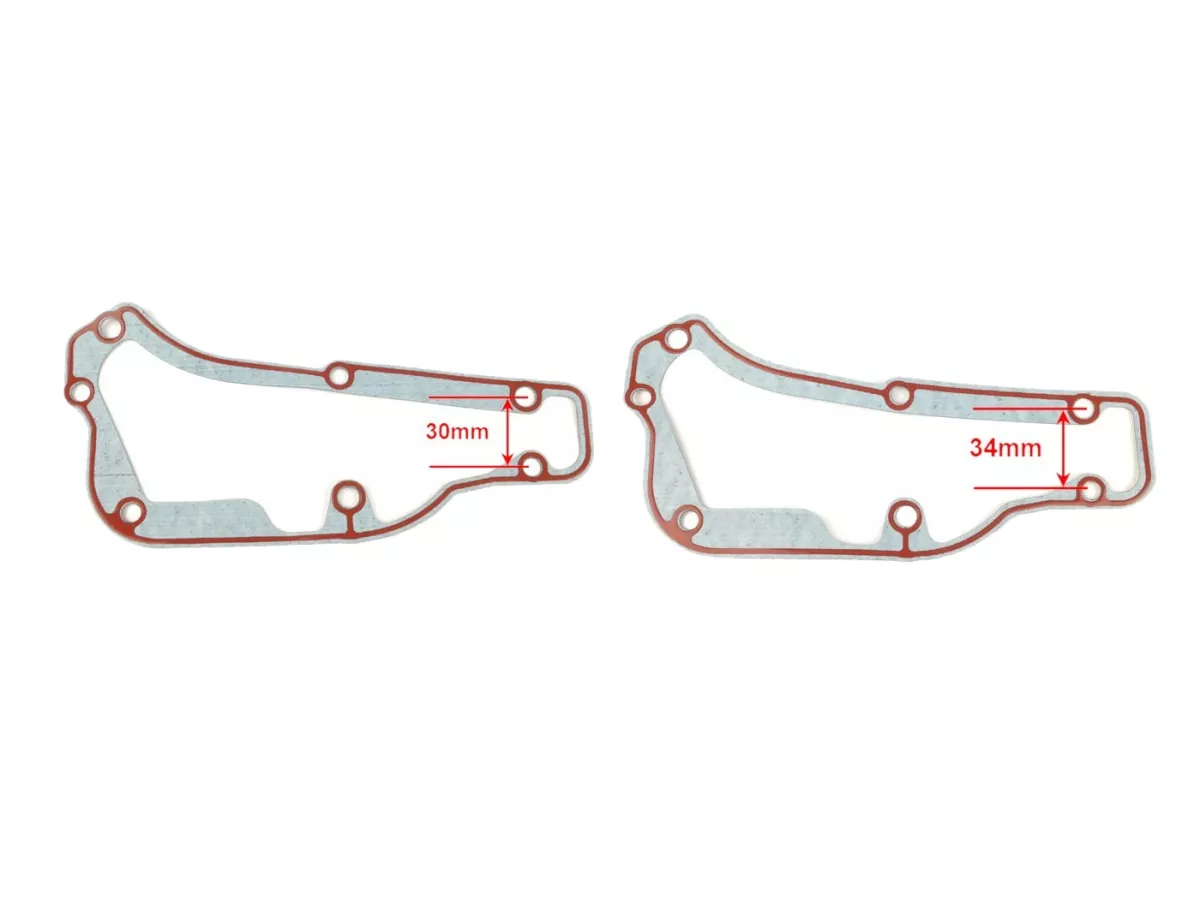
This product group includes Piaggio original part numbers 830128 and 846098. Both gaskets perform the same basic function but are intended for different oil sump designs. They are therefore not generally interchangeable.
The oil sump forms part of the lower engine assembly and is connected to the engine crankcase by a bolted joint. A specially shaped gasket is positioned between the two components, with its contour matched to the respective design.
The oil sump gaskets feature a flat carrier structure with applied sealing areas. When the oil sump and engine crankcase are bolted together, these sealing areas are compressed, forming a seal along the designated contact surfaces and mounting holes.
The gasket must match both the shape of the oil sump and the arrangement of the mounting points. Even differences in the sealing contour or the position of individual openings may require a different gasket version.
Piaggio used Leader engines in numerous scooter models from different brands within the Piaggio Group. These engines were available in air-cooled and liquid-cooled four-stroke versions with displacements of 125, 150, 180 and 200 cc.
The Quasar engines expanded the engine range with additional displacements and development stages, including 250 cc versions. Various design modifications were introduced over the production years, which may also affect the construction of the oil sump and its corresponding gasket.
The oil sump gaskets in this product group are used in selected engine versions. Compatibility is determined not only by engine displacement or model designation, but also by the specific engine configuration and original spare part number.
The two versions differ in their application to the respective engine and oil sump designs. It is therefore particularly important to check the correct spare part number when dealing with different development stages of Leader and Quasar engines.
Important: Gaskets 830128 and 846098 are not generally interchangeable alternatives. Before ordering, it is essential to check which version is fitted to the respective engine. The determining factors are the Piaggio original part number, the engine configuration and, where necessary, the existing gasket.
Corresponding oil sump gaskets are used in various vehicles from Vespa, Piaggio, Gilera, Aprilia and Derbi. These include selected versions of the Vespa ET4, GT, GT L, GTS, GTV, LX, LXV and S, as well as numerous other scooters equipped with Piaggio four-stroke engines.
Exact vehicle compatibility depends on the selected gasket version. Even within the same model series, different oil sump gaskets may be used depending on the year of manufacture, engine displacement and engine version.
When removing the oil sump, the existing gasket should generally be replaced. A gasket that has already been compressed may lose its original sealing properties and cause leaks if reused.
Before installation, all remnants of the old gasket must be carefully removed. The sealing surfaces of the oil sump and engine crankcase must be clean, flat and free from damage. The new gasket is positioned according to its contour and the designated mounting holes.
The mounting bolts must be tightened in the sequence specified by the vehicle manufacturer and to the correct tightening torque. Even tightening is essential to ensure that the gasket is sufficiently compressed along its entire contour.
Additional sealants must only be used if expressly specified for the respective engine version. After installation, the specified engine oil level and the sealing integrity of the joint must be checked.
Original Piaggio oil sump gaskets allow the seal between the oil sump and engine crankcase to be correctly restored during maintenance and repair work. Selecting the gasket version that matches the specific engine configuration is essential for a reliable, long-lasting seal.