Postage free from 99€ (DE)
High customer satisfaction


 DE | €
- Blog
- Piaggio moped - Tuning and setup
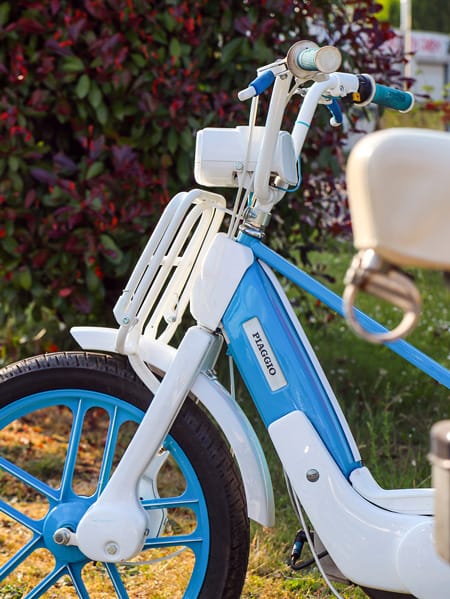
The subject of Ciao and Piaggio moped tuning is very close to our hearts. For many of us, the Ciao was the first motorized means of transport of our own, with which we explored "the big wide world" as teenagers. Back then, the "chrome pot" was a must, a hole was drilled in the air filter and you could scratch 32 km/h on the speedometer (of course, only after you had sealed the hole in the air filter with a cigarette filter ;-). Then the "small" disk was added and bang, you had to pedal uphill... but downhill ... off you went! :-) Back then ...
Ciao, Bravo and Si have long since become collector's items, but people still like to tune them today! Even today, anything from + 5 km/h to + 100 km/h is still possible - to help you decide when tuning, we have put together 3 simple setups here, peppered with a few technical tips.
Simple plug-in tuning, quiet and inconspicuous, because it is basically the moped components. Can be registered at some TÜV offices after prior consultation. The original 50cc cylinder is retained and a Sito Plus and an SH12/12 carburetor with moped air filter are fitted, main jet around 48. belt pulley remains original 90 mm.

The Sito Plus has the look of the original exhaust and is particularly quiet. It also has the necessary E-marking required for conversion to a moped.

For fans of the 70s and 80s, there is also still the original "chrome muffler" with the separable silencer and screw in the middle - disadvantage, no marking, but pure retro feeling. Available in chrome and black:

The moped carburetor with a 12 mm passage replaces the original carburetor with a 10 mm passage.

The moped air filter is externally indistinguishable from the moped air filter, but inside there are 6 holes under the steel mesh filter instead of 3 holes.

A new spark plug never hurts, it is always better to have one more than too few at home. For the above tuning you need an NGK B 6HS with short thread.

If you are planning to experiment a little more in the future, a jet set is worthwhile.
Now it gets technical for a moment: So that you can find the right cylinder: Once you have picked out a cylinder, you will quickly come across the specification "piston pin 10 mm" and "piston pin 12 mm". If you do NOT want to replace the crankshaft, you must now measure the piston pin of your installed cylinder (10 or 12 mm) before ordering the cylinder and then decide on the appropriate cylinder:
You can find out more about crankshafts, 10 and 12 mm piston pins below.
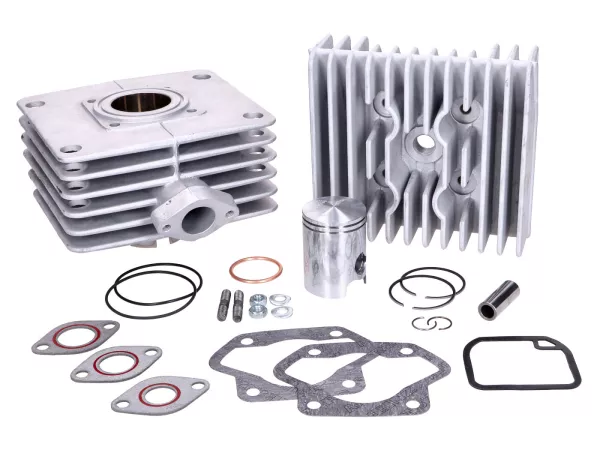
So that you can now get going more quickly and powerfully, the heart of your classic is now replaced - the cylinder! Look for a cylinder in the 60 - 63cc class with a bore of 41-43 mm, starting with the DR cylinder in cast iron or the Athena cylinder in aluminum. Even if the manufacturers talk loudly about 60cc and more - if we start the calculator, a standard stroke of 43 mm results in the following cc figures:
Calculate cylinder volume, seventh grade: Diameter divided by 2 = radius "r", "h" the height (stroke) of the crankshaft original = 43mm, results in the following formula: Circular area at the base multiplied by the height: r² x pi x h = volume of the cylinder.
The real ccm figures for standard tuning cylinders:
With a bore of 43mm, the standard housing is no longer suitable, as otherwise the housing would have to be spindled.

Once you know which piston pin you have fitted, choose a cylinder from manufacturers such as D.R., Athena, Polini or Malossi. All the cylinders listed below are absolutely stable and provide a noticeable increase in power, torque and speed.

Due to the increased power of the cylinder, we can now also adapt the transmission ratio, i.e. fit a smaller pulley and the appropriate V-belt. We recommend the following setup in combination with a 60cc + class cylinder:
Again the DellOrto moped carburetor with 12/12mm or the DellOrto 13/13mm carburetor, main jet approx. 53-55, plus the moped or Polini air filter. All these components are Plug&Play:

As we are still inconspicuous when tuning, we again recommend the Sito Plus exhaust or the Gianelli "Ori-Power" as an alternative.

Reinforced clutch springs are now used for better acceleration due to a higher clutch engagement speed:

If you have the feeling that the linings are no longer 100%, you can fit the Malossi shoes with reinforced linings (incl. springs):

With this setup you must use a "colder" spark plug, e.g. an NGK B8HS or BR8HS:
Our gear ratio recommendation for Setup 2 with the 80cc pulley is based on the original "10.5:1" gearbox of the German Ciao 25 km/h mopeds.
How do I know which gearbox I have installed on a Ciao?
The ratio of the number of revolutions of the rear pulley to the full 360 degree rotation of the rear wheel is the gear ratio. E.g. Ciao moped original gearbox 10.5:1. To measure, mark the rear wheel and the belt pulley with a line, turn the rear wheel once through 360 degrees and count the number of revolutions of the belt pulley - done.
Standard mono (pulley) transmission:
Difference Mono vs Vario:
Mono gearboxes are designed to take pulleys. Vario gearboxes have a long output shaft and can accommodate the combined torque converter/clutch unit. Vario gearboxes then have the variator on the crankshaft instead of a clutch.