Postage free from 99€ (DE)
High customer satisfaction


 DE | €
- Blog
- Adjusting the Vespa carburetor: Instructions, jetting table and professional tips
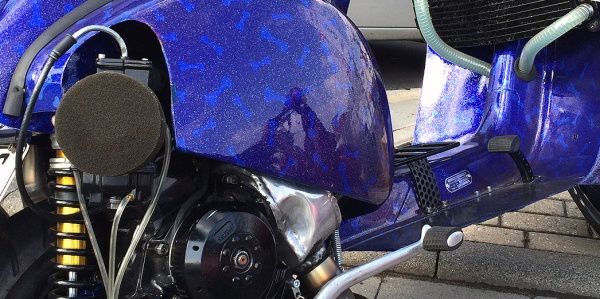
The choice of carburetor size has a considerable influence on the performance and characteristics of the engine. Useful carburetor sizes range from 19 mm to 35 mm. In addition to the experience of other mechanics, there are also formulas or tables for determining the required carburetor size. This is largely determined by engine speed and cubic capacity:
d = k * Vh * n

Many engine failures are caused by poorly tuned engines. Critical factors are compression, squish, ignition and carburetor adjustment. The correct carburetor setup is not as simple as the ignition timing and is not as easy to control. Our jetting tips table will help you to find an initial point of reference.
Modern synthetic oils make it difficult to interpret the spark plug pattern. However, the spark plug can be used as a rough indicator after a full throttle run.
So that you don't have to start from scratch when setting up your carburetor, we have put together a small overview of carburetor setups that work well. You should use this as a guide to get the engine running. Then you should make it richer from range to range and then jetting down. No guarantee!
| Cylinder | Carburetor | Main jet | Secondary jet | Mixing tube | Needle |
|---|---|---|---|---|---|
| Vespa Smallframe 75 ccm | SHB 16/10 | 55-60 | |||
| Vespa Smallframe 75 ccm | SHB 16/16 | 68-75 | |||
| Vespa Smallframe 75 ccm | SHB 19/19 | 75-82 | |||
| Vespa Smallframe 85 ccm | SHB 19/19 | 75-82 | |||
| Vespa Smallframe 110 ccm | SHB 19/19 | 82-88 | |||
| Polini 130 | PHBL 24/25 | 85-98 | |||
| D.R. 133 | SHB 19/19 | 85-90 | |||
| Malossi 136 | PHBL 24/25 | 98-115 | |||
| D.R. 135 | SI 20/20 | 102 (TÜV) | |||
| D.R. 135 | SI 24/24 | 112-115 | |||
| D.R. 177 | SI 24/24 | 108-112 | |||
| D.R. 177 | PHBH 30 | 112-118 | |||
| D.R. 177 | PHBH 30 | 105-120 | 50-60 | AV262 | X2 |
| Malossi 139 | SI 20/20 | 112 (TÜV) | |||
| Malossi 139 | SI 24/24 | 100-110 | |||
| Malossi 166 | SI 24/24 | 125-130 | |||
| Malossi 166 | PHBH 30 | 125-135 | |||
| Malossi 166 | TMX 30 | 350 | 17,5 | std. | hd. |
| Malossi 210 | Dell'Orto 28 | 128-138 | 50-56 | AV266 | |
| Malossi 210 | Mikuni 30 | 300-330 | 20-27,5 | fixed | 5EL68 |
| Polini 177 | SI 24/24 | 120-125 | |||
| Polini 177 | PHBH 30 | 125-130 | |||
| Pinasco 177 | SI 20/20 | 108-112 | |||
| Pinasco 177 | SI 24/24 | 118-122 | |||
| Pinasco 177 | PHBH 30 | 138-150 | 52-55 | AV262 | X3 |
| Pinasco 213 | SI 24/24 | 125-130 | 55/160 or 52/140 | BE3 | 190 or 160 |
| T5 Polini 152 | SI 24/24 | 112-120 | |||
| T5 Malossi 172 | SI 24/24 | 115-120 | |||
| T5 Malossi 172 | PHBH 30 | 125-130 |
The idle throttle is set when the engine is warm. First screw in the idle mixture screw (often on the side) completely and then unscrew it approx. 1.5 turns (basic setting). Then use the idle throttle screw (top, lifts the slider) to set the speed so that the engine runs smoothly and does not stall. Now use the mixture screw to find the point of maximum speed and then correct it back to normal level with the idle speed screw.
When a 2-stroke engine "four-strokes", it does not ignite at every revolution. The noise sounds stuttering or bubbling (similar to a 4-stroke). This is usually a sign that the engine is running too rich in this area (too much fuel, too little air).
An engine that is too lean (too much air, too little gasoline) gets hot and dangerous! Symptoms are
Safety first: Always start with a main jet that is too large (rich). The engine will stutter and not turn over. Now gradually reduce the jet size until the engine revs cleanly and runs smoothly at full throttle. This will prevent sticking due to a too lean initial setting.
A decisive one! A sports air filter or omitting the filter allows significantly more air through. The carburetor must then be sprayed with more air (larger main jet), otherwise there is a risk of engine damage due to leaning. Holes in the air filter box (a popular tuning option in the past) also require the jetting to be adjusted.

