Postage free from 99€ (DE)
High customer satisfaction
Shipping today with order in 11 h 1 min


 DE | €
- Blog
- Carbon Italy - Carbon Prototypes "Made in Italy"
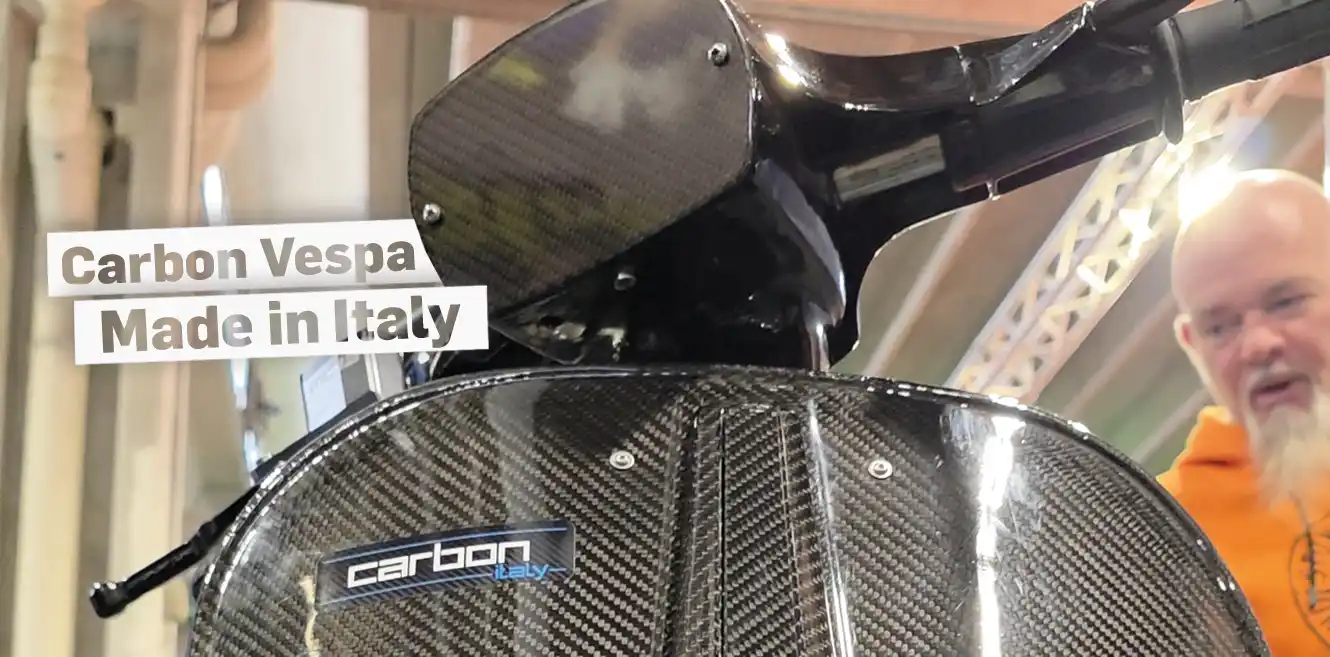
At the Motor Bike Expo (MBE), we came across a booth that makes every custom bike enthusiast’s heart race: Carbon Italy. We had the opportunity to conduct an exclusive interview and see a prototype that redefines the limits of what’s possible with classic Vespas.
What makes Carbon Italy so special is its absolute commitment to in-house production. Instead of sourcing components from outside suppliers, everything is manufactured in-house.
“We produce all components that are interchangeable with the original parts entirely from carbon fiber—from the frame to the cascade to the fender and the engine cover.”
The secret to their stability and appearance lies in the autoclave process. Using their own molds, the team ensures that every part corresponds exactly to the original but has been improved in terms of weight and, in some cases, functionality. It’s impressive to see how a personal passion has evolved into highly professional craftsmanship here.
Carbon Italy in shop
The centerpiece of the booth was a Vespa that really packs a punch. Beneath the sleek carbon fiber body lies a Quattrini M200 engine, which is estimated to deliver about 30 PS to the road. For a scooter made almost entirely of carbon fiber, this power-to-weight ratio ensures absolutely brutal handling.
The frame on display is currently the developer’s personal project. His goal is not to alter the Vespa’s classic lines through cuts or extreme modifications, but rather to preserve its aesthetics while switching to high-tech materials.
When we asked whether this carbon-fiber speedster was also intended for the racetrack, we received a very nuanced answer. The current prototype is optimized for street use. However, different rules apply to racing:
Special reinforcements: A racing frame requires different stability points and higher torsional stiffness.
Customization: Carbon Italy is ready to accommodate customer requests and implement the necessary modifications.
Carbon Italy leaves nothing to chance. The current prototype is being produced in small batches and subjected to further rigorous testing. Crash tests and torsional tests are planned.