Postage free from 99€ (DE)
High customer satisfaction


 DE | €
- Blog
- New POLINI Engine Case for Vespa PX & Motovespa – What's the Story?
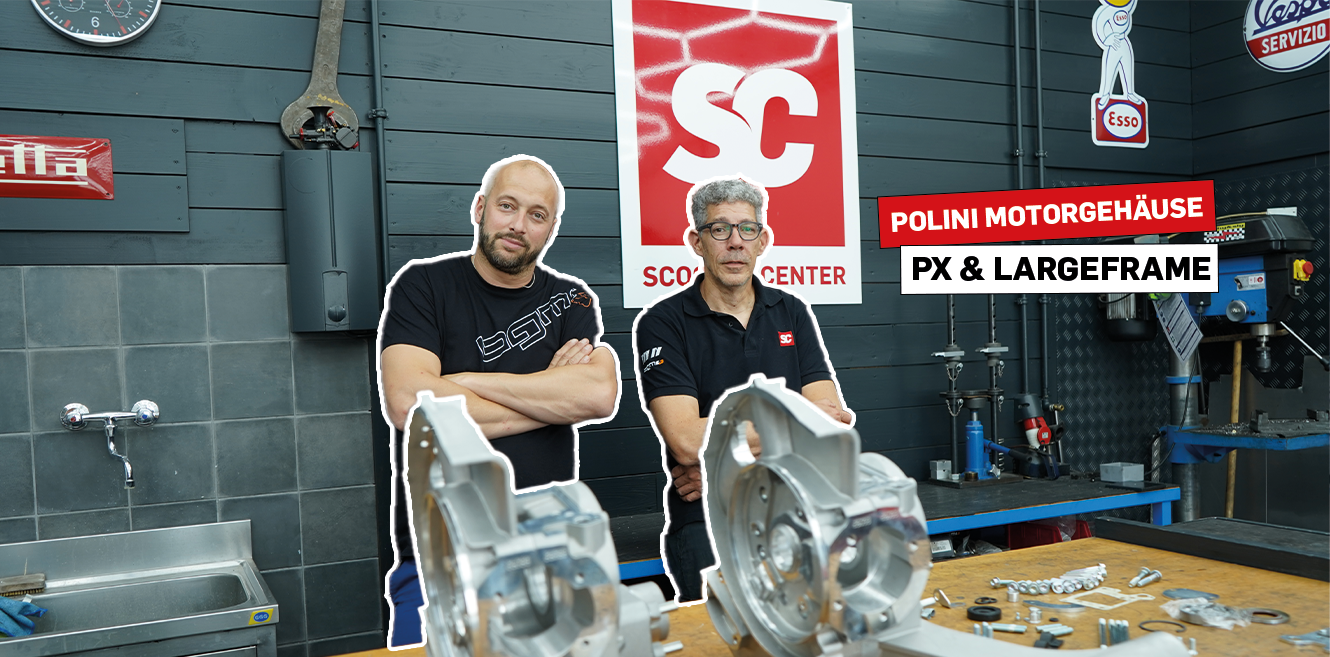
At first glance, the diaphragm inlet immediately catches the eye. But it quickly became clear that :contentReference[oaicite:0]{index=0} has gone significantly further than simply replacing the rotary valve with a diaphragm solution.
The first differences are already evident in the crankshaft bearing assembly. A newly designed structure ensures that typical problems with the original Largeframe cases are specifically addressed. The bearing support has also been redesigned and made more robust.
While many aftermarket casings merely copy existing designs, POLINI has developed its own solutions in numerous areas.
Particularly noticeable are the extensive reinforcements in the area of the rear wheel mount and the main shaft bearing.
Especially with high-performance engines, these areas are among the most heavily stressed parts of the entire engine case. Additional ribs and significantly more material provide structural reserves here that are evident at first glance inside the case.
The wall thicknesses are also significantly greater than those of a standard PX case. Anyone planning to use high-performance cylinders or modern tuning concepts will find a correspondingly stable foundation here.
Of course, the newly developed diaphragm channel plays a central role.
POLINI relies on a generously shaped intake port designed for modern diaphragm systems and carburetor sizes ranging from 28 to 30 millimeters. Alternatively, various diaphragm solutions are available for setups with or without separate lubrication.
What’s interesting here is that the housing already appears, in many places, to be prepared for components that go far beyond classic touring engines. Large crankshafts, high-performance cylinders, and modern racing setups find significantly better conditions here than in a stock engine housing.
The numerous detail improvements are particularly exciting.
For example, the oil supply system has been redesigned. The fill neck is now in a new position, allowing more transmission oil to be added. At the same time, lubrication at key bearing locations has been improved.
Special attention was also paid to sealing. On the kickstarter side, double O-rings provide additional security, while the bearing bores and sealing surfaces have been designed to a significantly higher standard overall.
In addition, centering sleeves between the housing halves enable precise alignment of the bearing races—a detail that plays a particularly important role in high-performance engines.
In our view, the housing is primarily aimed at riders who are rebuilding their engine from the ground up or seeking a truly robust foundation for high-performance setups.
Those who simply want to replace a stock-style engine will likely never fully take advantage of many of the design benefits. On the other hand, those who rely on diaphragms, modern cylinder designs, and significantly more power will find a housing here that was developed precisely for this purpose.
The new POLINI engine case does not appear to be a classic replica of the original case. Rather, it has been reimagined, reinforced, and improved in many areas.
From the diaphragm intake to the bearing mounts and the numerous structural reinforcements, there is a clear focus on durability, performance, and modern engine designs.
The many small details make almost as much of an impression as the major technical changes.
If you’d like to see for yourself, check out the video—there, we go into much greater detail about the individual features.