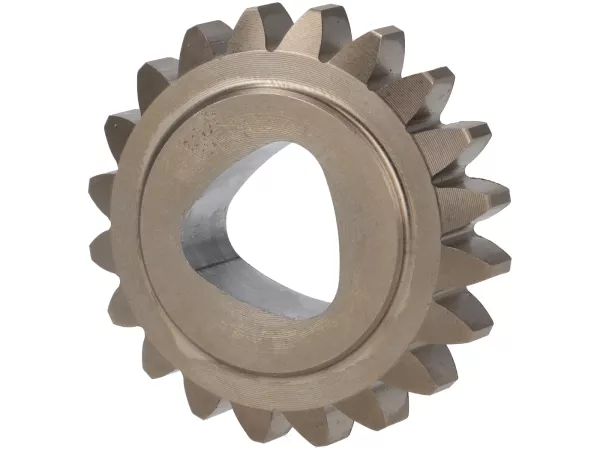
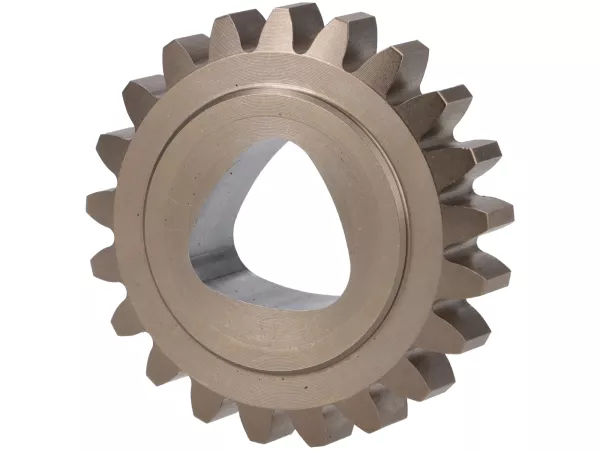
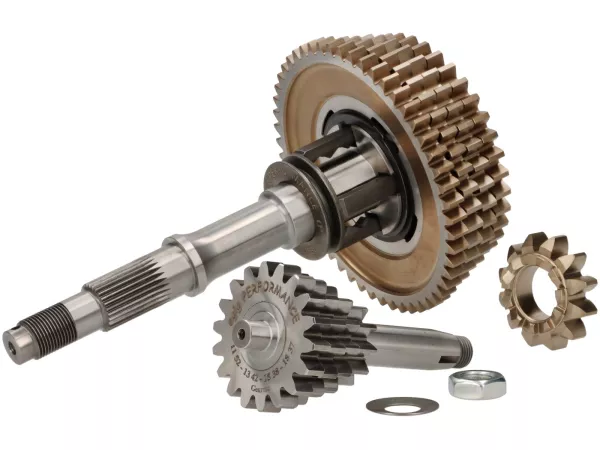
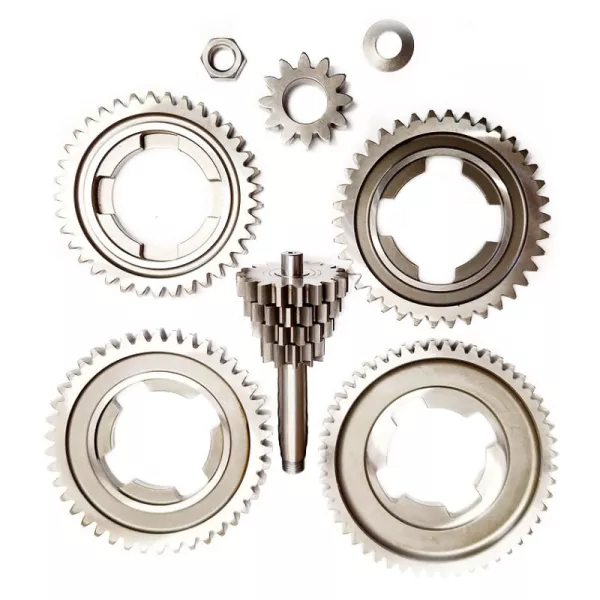
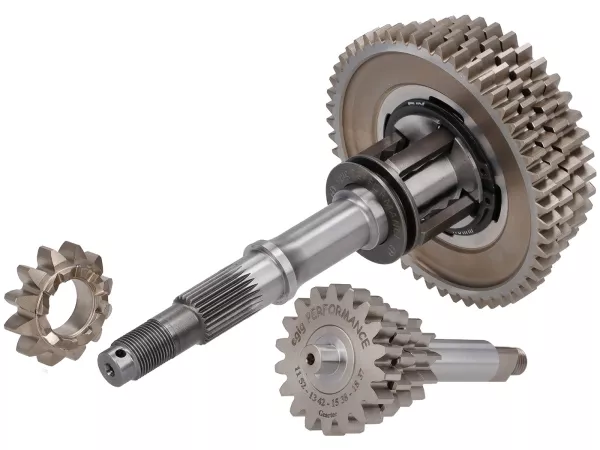
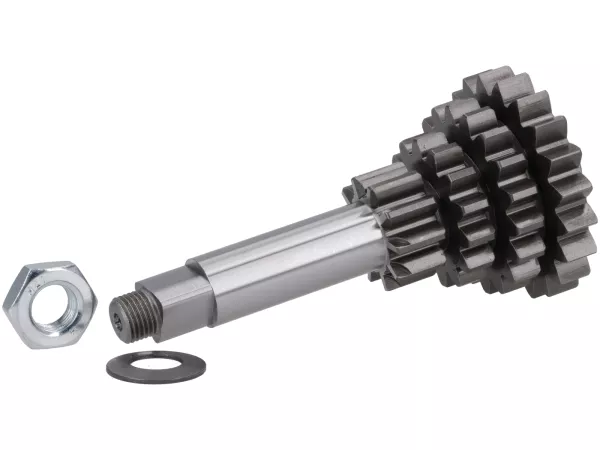
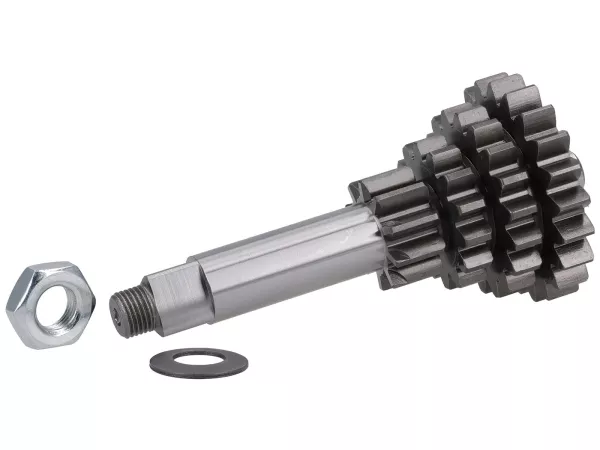
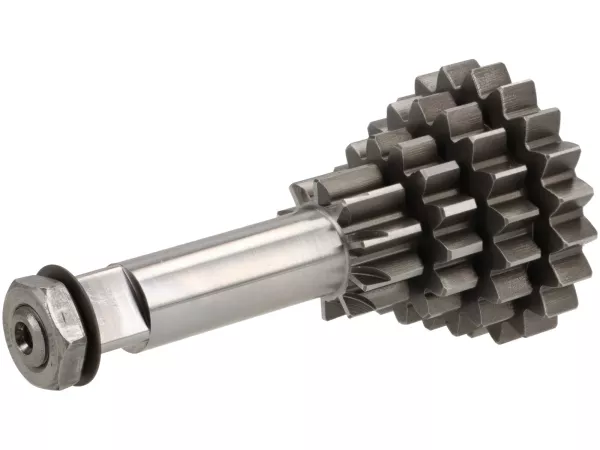
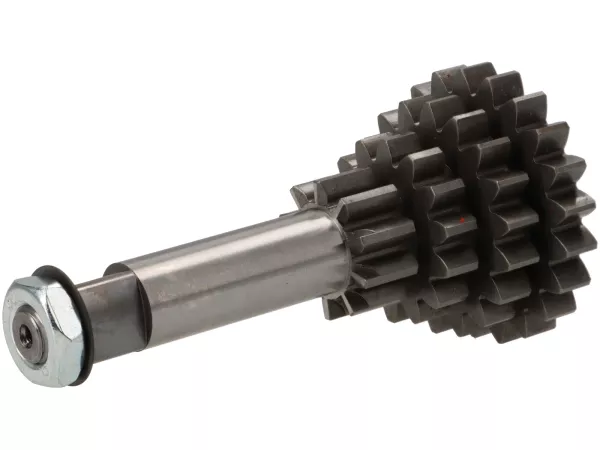
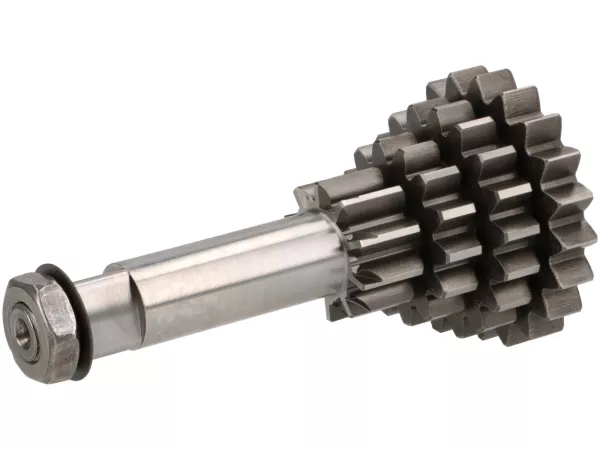
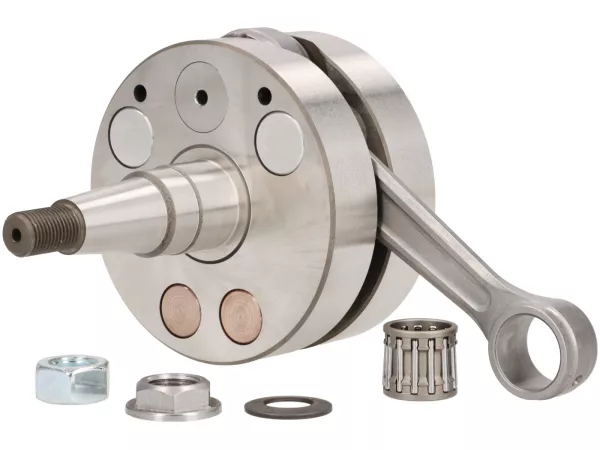
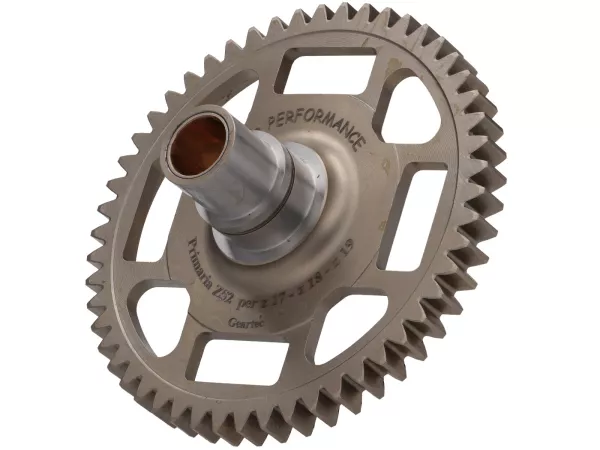
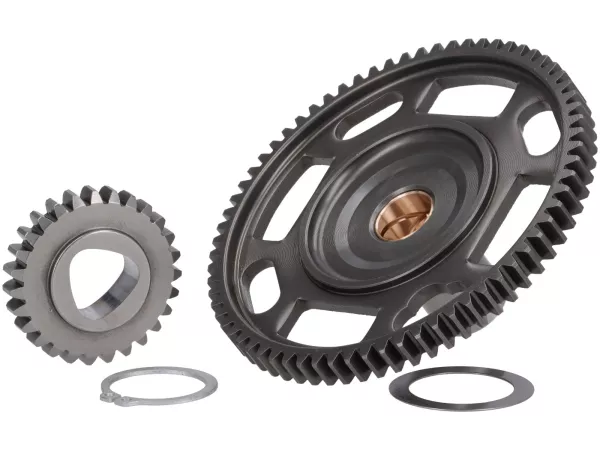
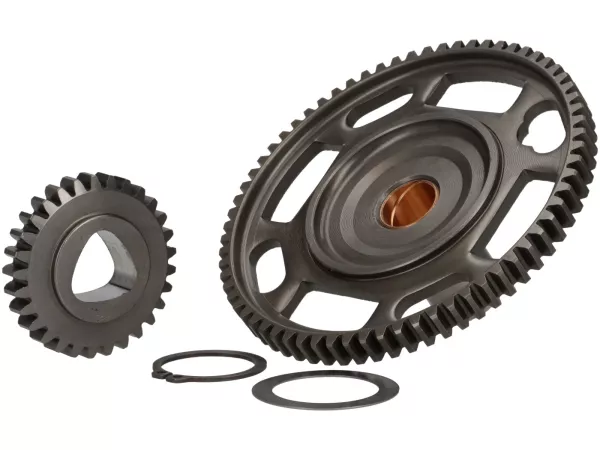
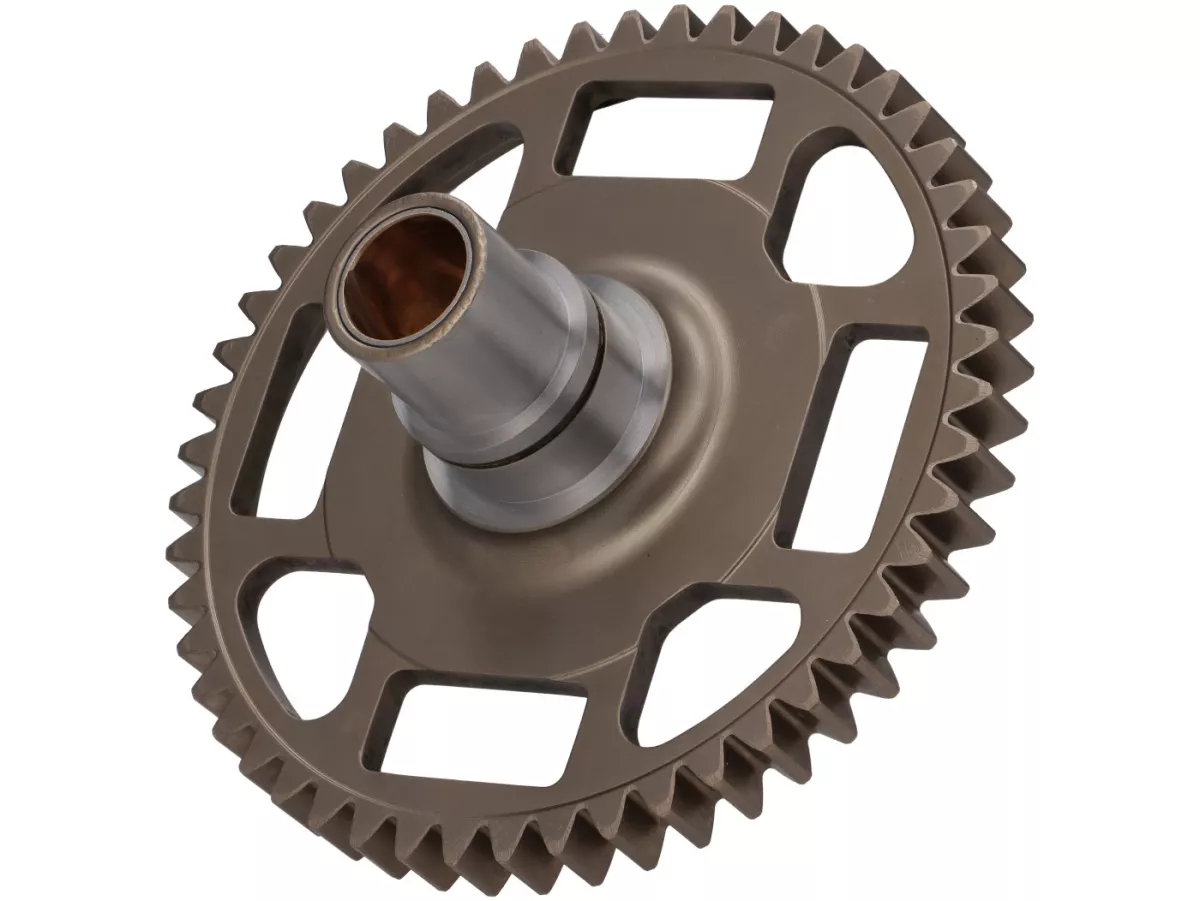
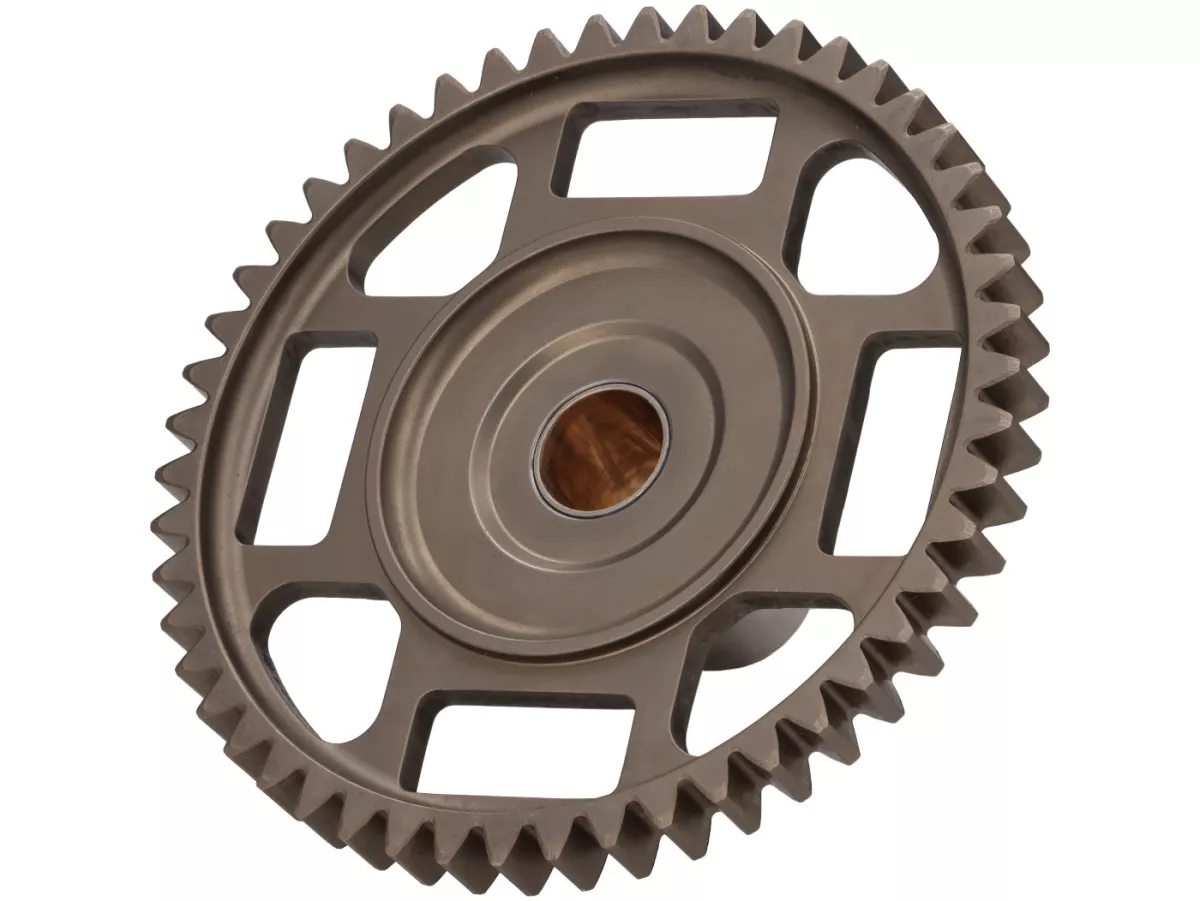
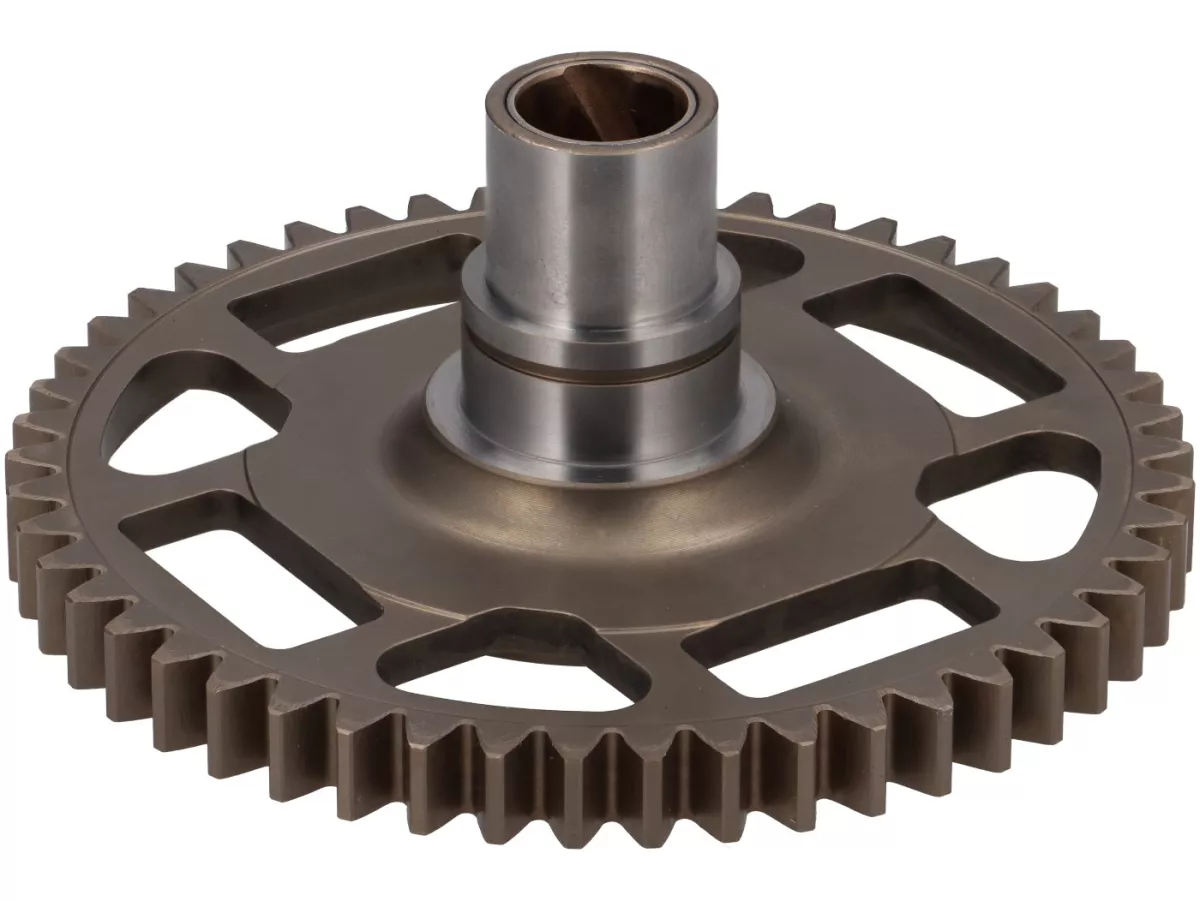
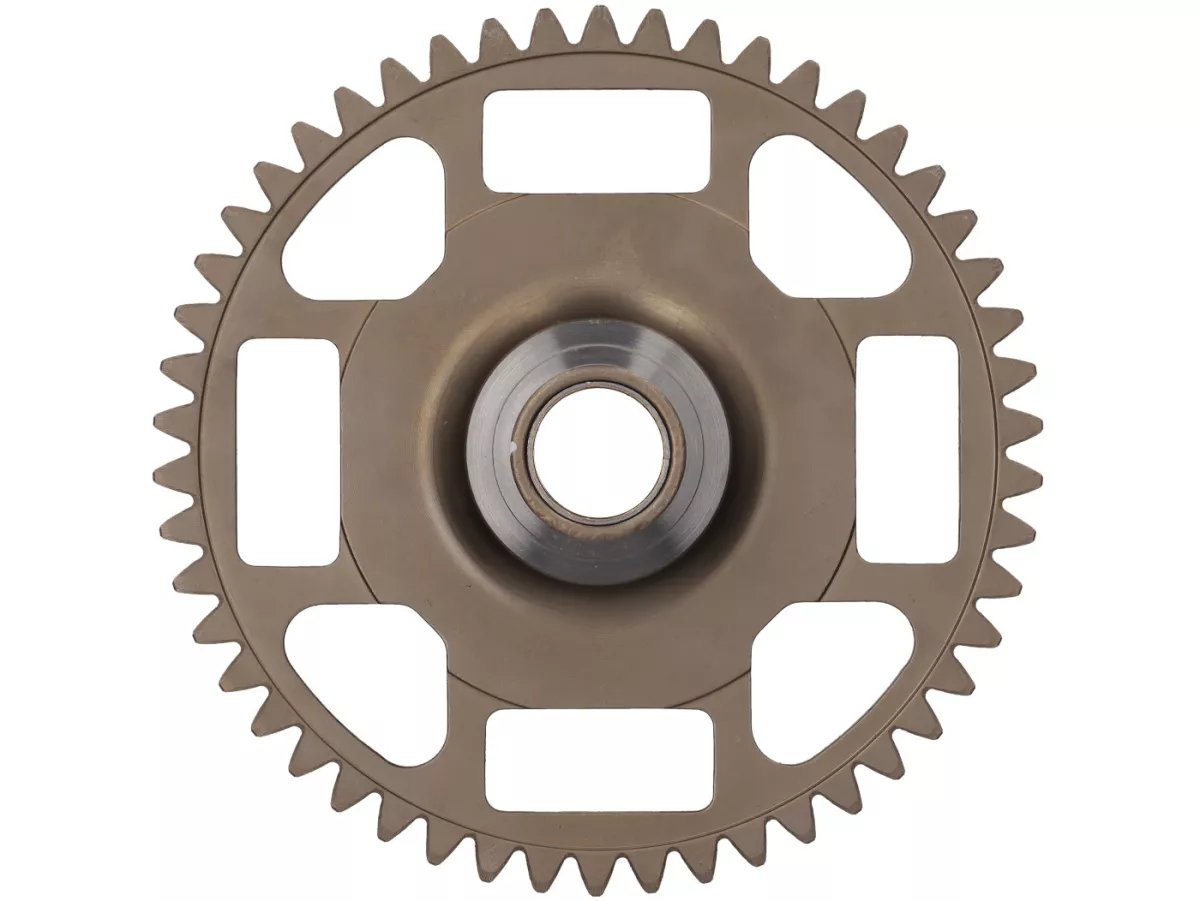
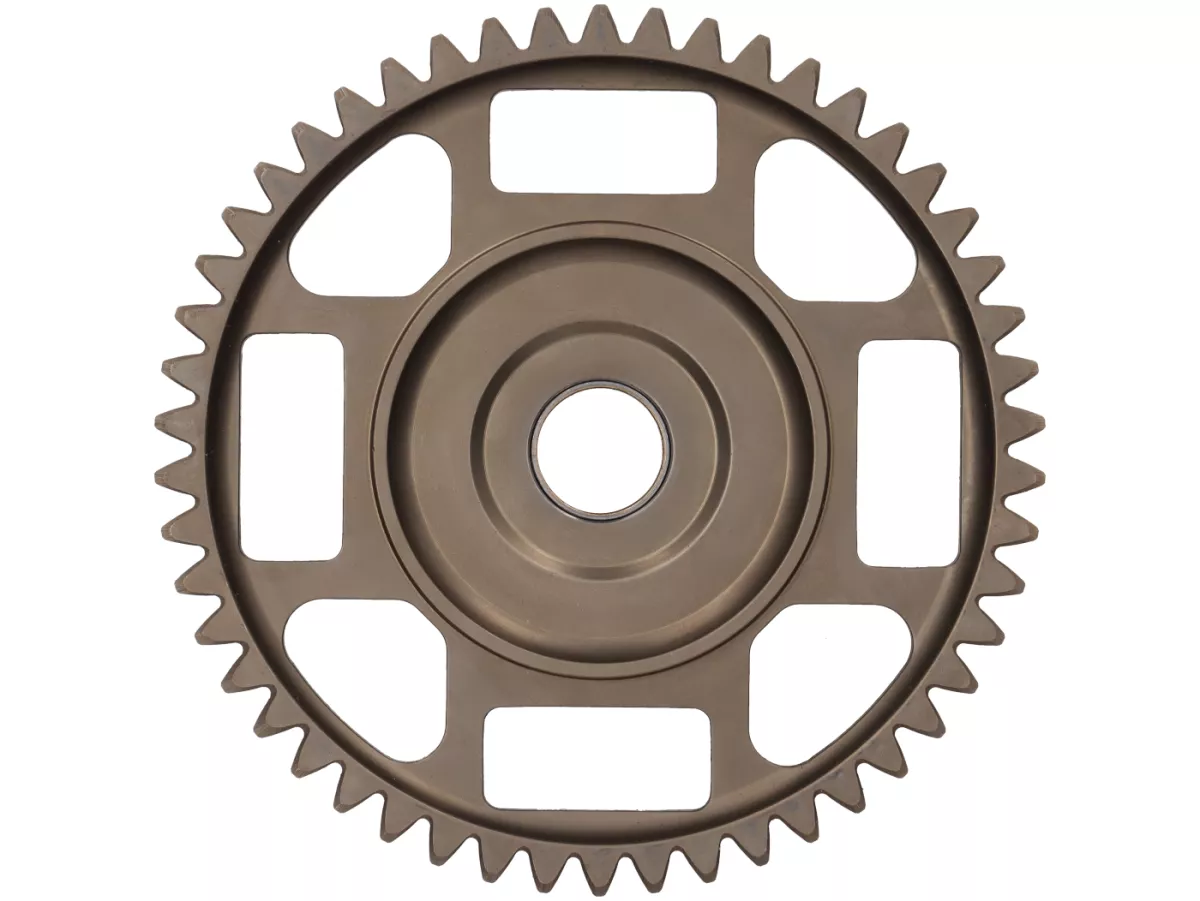
The straight-toothed FAIO / EGIG PERFORMANCE Z50 primary sprocket was developed for high-performance Vespa small-frame engines. It can be combined with the corresponding 20- or 21-tooth primary sprockets, enabling two long primary gear ratios for high-torque engines such as the EGIG 220 or Quattrini M200.
The low total number of teeth compared to conventional small-frame primary drives is a key design feature of this system. With the same center distance, fewer but significantly larger teeth can be used. This creates strong tooth bases and durable tooth flanks capable of withstanding the high forces generated by modern small-frame engines.
FAIO / EGIG PERFORMANCE
Z50
straight-toothed
Z20 or Z21
for powerful small-frame engines
Advantages and Features
Straight-toothed primary sprocket with 50 teeth
Can be combined with FAIO / EGIG Z20 and Z21 primary pinions
Two long primary gear ratios: 2.50 or 2.38
Large tooth geometry with a robust and durable tooth root
No axial gear forces due to the straight-toothed design
Compact pinion diameter creates additional clearance in the motor housing
With a matching polygon pinion, positive-lock power transmission with lower tightening torque
Reduces stress on the relatively slender thread of the secondary shaft
For high-power, high-torque Vespa small-frame engines
Typically used with EGIG 220, Quattrini M200, and comparable engine designs
Z50 with Z20 and Z21 primary sprockets
The primary sprocket can be combined with two different primary pinions. This allows the final drive ratio to be specifically tailored to displacement, torque, RPM range, gear ratios, tire size, and intended use.
Possible primary gear ratios
| Primary pinion |
Primary sprocket |
Ratio |
Character |
| Z20 |
Z50 |
2.50 |
The shorter of the two combinations, with slightly more pulling power and a smoother transition |
| Z21 |
Z50 |
2.38 |
Very long primary gear ratio for high-displacement, high-torque engines |
Calculation: Number of teeth on the primary sprocket divided by the number of teeth on the primary pinion. A higher number corresponds to a shorter primary gear ratio.
For long gear ratios and high engine torque
With the 20/50 and 21/50 combinations, this primary sprocket covers a particularly wide gear ratio range. Such gear ratios are intended for engines that generate sufficient torque even at comparatively low RPMs to smoothly handle the long primary gear ratio.
High-displacement engines in particular, such as the EGIG 220 or Quattrini M200, can benefit from a long gear ratio. With the appropriate transmission gearing, engine speed decreases at cruising speed, while the available torque can still be utilized for powerful acceleration.
Selecting the Gear Ratio for the Overall Engine Setup
A particularly long primary gear ratio is not automatically the best choice for every setup. The design must match the usable RPM range and the gear ratios.
Consider engine torque and usable RPM range
Check the gear transition between third and fourth gears
Take exhaust character and the onset of resonance into account
Consider tire size when determining the overall gear ratio
The Z21 generally requires more engine torque than the Z20
Why so few teeth?
Conventional Vespa small-frame primary gear ratios often use significantly higher tooth counts. FAIO and EGIG PERFORMANCE take a different approach: The gear pair has fewer, but larger, teeth.
Given a fixed center distance, the reduced total number of teeth allows for a larger tooth geometry. This results in more material in the tooth root and a correspondingly strong tooth flank. This is particularly advantageous for high-displacement engines, as the individual teeth are subjected to considerable stress during acceleration and load changes.
Advantages of the reduced number of teeth
Larger teeth: Fewer teeth allow for a stronger tooth geometry
Wider tooth root: More material in the particularly heavily loaded root area
High-load-capacity tooth flanks: Designed for high torques and severe load changes
Compact pinion: The small pinion diameter creates additional clearance
Less housing machining: Depending on the motor design, the compact design can reduce the required machining effort
Straight-toothed gear without axial forces
The primary gear has straight teeth. Unlike a helical primary gear set, this prevents the generation of axial tooth forces that would place additional lateral stress on the coupling, bearings, and retaining elements.
The force is transmitted directly via the tooth flanks. This makes straight-toothed designs particularly suitable for high-performance motors. Operating noise depends largely on tooth geometry, manufacturing quality, tooth flank clearance, and assembly.
Cone and Polygon – Two Different Mounting Principles
In the conventional system, the primary pinion is mounted on the cone of the secondary shaft. Power is transmitted via the frictional contact between the two tapered surfaces. To ensure that this frictional connection functions reliably even at high motor torque, the mounting nut must be tightened to a sufficiently high torque.
When the tapered connection is correctly assembled, the disc spring—often referred to as a half-moon spring—does not transmit the motor torque. Its primary function is to position the primary pinion and prevent it from rotating on the taper when the nut is tightened.
High Loads in Conventional Tapered Seats
To generate the necessary frictional engagement on the cone, tightening torques of up to approximately 90 Nm may be required, depending on the design. This high torque acts on the comparatively narrow thread of the auxiliary shaft.
The motor torque is transmitted via the frictional engagement of the tapered surfaces
This requires a high axial preload
The necessary preload is generated via the nut and the auxiliary shaft thread
Repeated assembly and disassembly place additional stress on the thread
The disc spring serves solely for positioning during assembly
Polygonal connection: Power transmission via positive locking
In the polygonal design, torque is not transmitted via the frictional engagement of a cone. The primary pinion and housing engage with each other via a form-fit using a suitably shaped polygonal profile.
The retaining nut must therefore primarily secure the pinion axially. It does not need to generate the frictional fit required for torque transmission through a very high tightening torque. As a result, the required tightening torque can be significantly reduced compared to conventional conical fastening.
Advantages of the polygonal connection
Positive-lock power transmission: The motor torque is transmitted via the polygonal profile
Reduced tightening torque: No extremely high frictional engagement between two conical surfaces is required
Reduced stress on the thread: The comparatively slender thread of the secondary shaft is protected
Defined position: The profile unambiguously determines the position of the primary pinion
For high torques: A practical design for heavily loaded small-frame engines
The specified tightening torque must always be adhered to in accordance with the manufacturer’s instructions for the polygon components used.
For EGIG 220, Quattrini M200, and comparable engines
High-displacement small-frame engines place significantly greater demands on the primary drive than a standard Vespa engine. In addition to sheer engine power, the primary pinion and primary sprocket are subjected to high torque, severe load cycling, and rapid changes in RPM.
The FAIO / EGIG PERFORMANCE Z50 primary sprocket is particularly well-suited for engines that provide sufficient torque for a long primary gear ratio. Typical applications include the EGIG 220, Quattrini M200, and comparable small-frame setups with high displacement and torque.
Typical Applications
EGIG 220 and other high-performance EGIG engine designs
Quattrini M200
High-displacement Vespa small-frame engines
Torque-oriented street and touring engines
Sport engines with a long overall gear ratio
Engines requiring a primary gear ratio of 2.50 or 2.38
Z50 and Z52 – two different gear ratio ranges
Within the FAIO / EGIG PERFORMANCE system, primary sprockets with 50 and 52 teeth are available. The two versions are combined with different primary pinions, thereby covering different gear ratio ranges.
System Overview
| Primary Sprocket |
Possible primary pinions |
Gear Ratio Range |
Basic Characteristics |
| Z50 |
Z20 or Z21 |
2.50 or 2.38 |
Wide gear ratio range for high-torque motors |
| Z52 |
Z17, Z18, or Z19 |
3.06 / 2.89 / 2.74 |
Shorter and more versatile gear ratio range |
The primary gear and primary pinion must be selected from their respective tooth count ranges. The Z17, Z18, and Z19 pinions are designed for the Z52 primary gear and are not compatible with this Z50 primary gear.
Important: Use the correct primary pinion
The Z50 primary sprocket may only be combined with the designated straight-toothed FAIO / EGIG primary pinions with 20 or 21 teeth.
Select Z20 or Z21 to match the desired gear ratio
Do not use helical-toothed primary pinions
Do not combine tapered and polygonal versions
Select a primary pinion mounting that matches the secondary shaft being used
Check tooth flank clearance and free play before final assembly
Compatible vehicle models
Vespa 50 / V50
Vespa 50 Special
Vespa Primavera 125 / PV125
Vespa 125 ET3
Vespa PK50
Vespa PK80
Vespa PK125
The key factor is the Vespa small-frame engine used and its primary drive. The vehicle specification alone does not confirm that all required FAIO or EGIG components have already been installed.
Technical Specifications
| Manufacturer |
FAIO / EGIG PERFORMANCE |
| Component |
Primary Sprocket |
| Number of Teeth |
50 teeth |
| Tooth Profile |
Straight-toothed |
| Matching primary pinions |
Z20 and Z21 |
| Possible gear ratios |
2.50 and 2.38 |
| Vehicle range |
Vespa Smallframe |
| Models |
V50, PV125, ET3, PK50, PK80, and PK125 |
| Typical engines |
EGIG 220, Quattrini M200, and comparable high-performance small-frame engines |
| Special Feature of the Gear Teeth |
Large tooth geometry achieved by reducing the total number of teeth in the gear pair |
| Advantage of the polygonal pinion |
Positive-lock torque transmission with reduced tightening torque and lower stress on the auxiliary shaft thread |
Installation Instructions
Select the appropriate primary pinion, Z20 or Z21
Check the mounting type of the primary pinion: tapered or polygonal
Use only straight-toothed components designed for Z50
Inspect the teeth of the primary gear and pinion for damage before installation
Check for tooth flank clearance and an even tooth contact pattern
Check for free movement relative to the motor housing and surrounding components
For tapered designs, ensure that the tapered surfaces are clean, dry, and free of grease during installation
For polygon designs, use only profile parts that are fully compatible with each other
Observe the specified tightening torque for the respective design
Match the shock absorber, clutch basket, and retaining elements to the motor’s power rating
Conclusion
The FAIO / EGIG PERFORMANCE Z50 primary sprocket, when paired with the Z20 and Z21 pinions, offers two long primary gear ratios for Vespa small-frame engines with particularly high torque. The reduced total number of teeth allows for a robust tooth geometry with a wide tooth base and durable flanks.
When paired with a compatible Poligon primary sprocket, engine torque is transmitted via a positive-lock engagement. Unlike with a conventional conical mounting, the necessary positive engagement does not have to be achieved via a tightening torque of up to approximately 90 Nm. This reduces the required tightening torque and protects the comparatively slender thread of the secondary shaft.
FAQ
The primary sprocket can be combined with the designated straight-toothed FAIO / EGIG primary pinions with 20 or 21 teeth.
With Z20, the primary gear ratio is 2.50. With Z21, the ratio is longer, at approximately 2.38.
The Z20 pinion provides a slightly shorter gear ratio of 2.50, making acceleration and gear engagement easier. The Z21 pinion provides an even longer gear ratio of 2.38 and requires correspondingly more engine torque.
No. The Z17, Z18, and Z19 are designed for the FAIO / EGIG Z52 primary sprocket. The Z50 primary sprocket described here is used exclusively with the Z20 or Z21.
The reduced number of teeth allows for larger individual teeth while maintaining the same center distance. This enables the tooth base and tooth flanks to be designed more robustly, which is advantageous for high torques and severe load cycling.
The disc spring is used to position the primary pinion and holds it in place when the nut is tightened. In a correctly assembled connection, the motor torque is transmitted via the frictional engagement of the tapered surfaces.
In a polygonal connection, torque is transmitted by positive engagement via the polygonal profile. Therefore, a very high tightening torque to create a force-fit conical seat is not required. This reduces the load on the nut and the secondary shaft thread.
No. The primary pinion must be compatible with the secondary shaft being used. A tapered design requires the corresponding tapered seat, while the polygonal design can only be used with the matching polygonal counter-contour.
Yes. The EGIG 220 and Quattrini M200 are typical examples of applications. However, the long 21/50 gear ratio in particular requires a motor with correspondingly high torque and a suitable gear ratio.


 DE | €