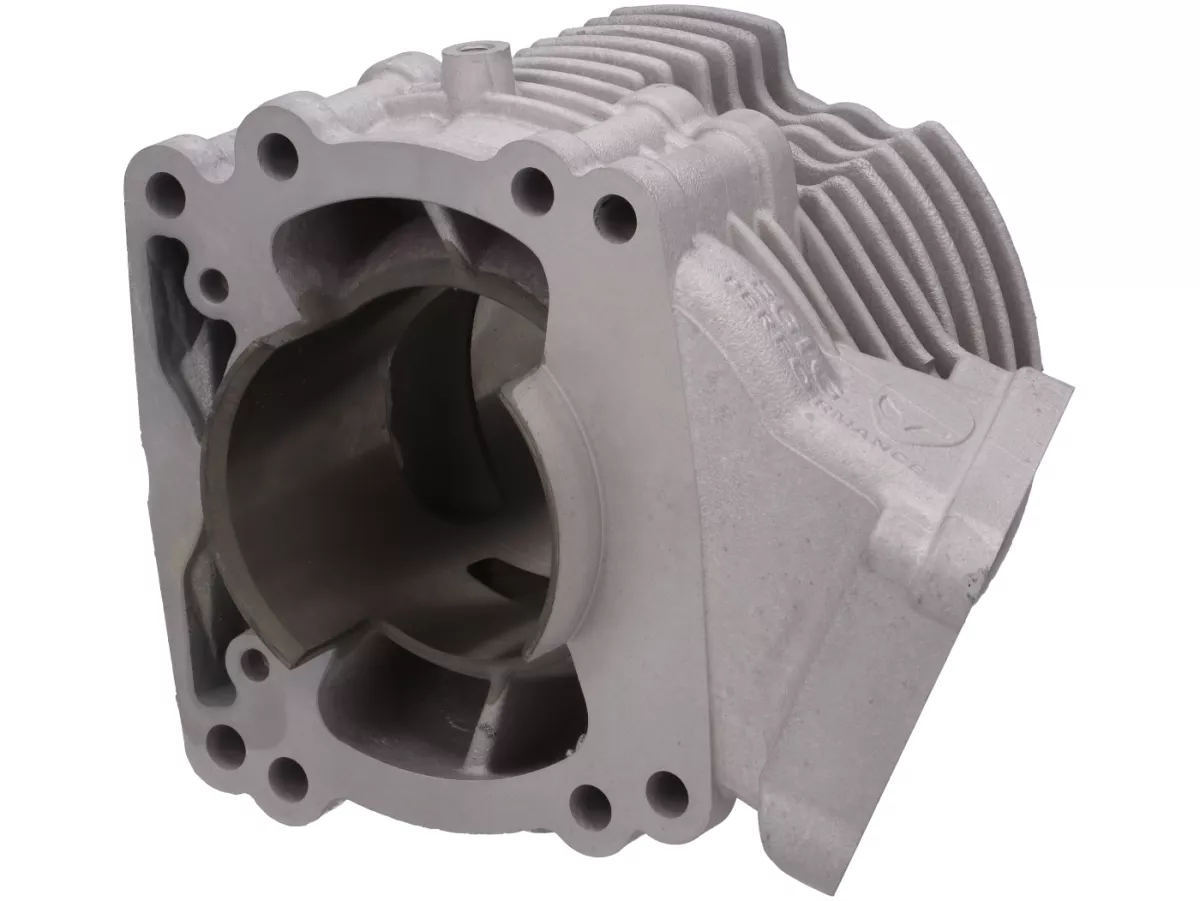
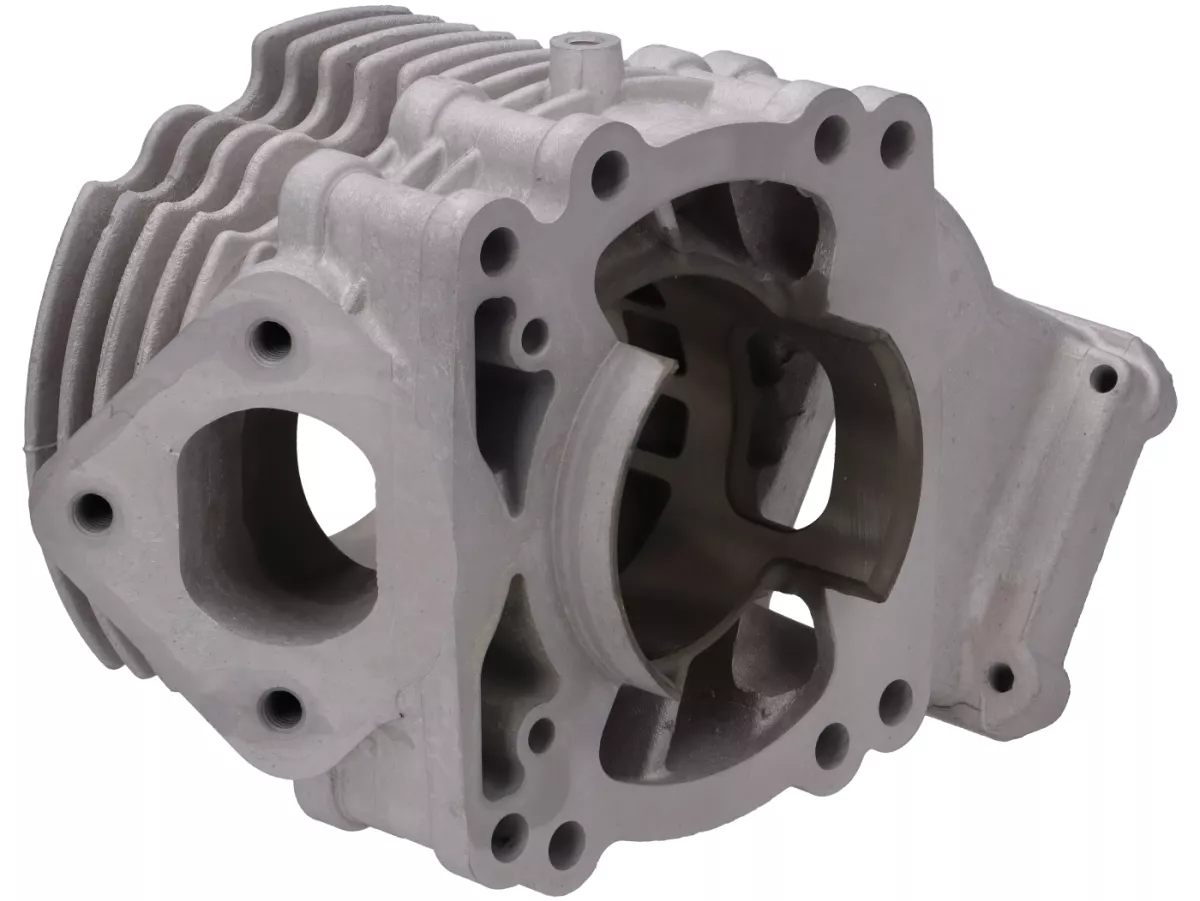
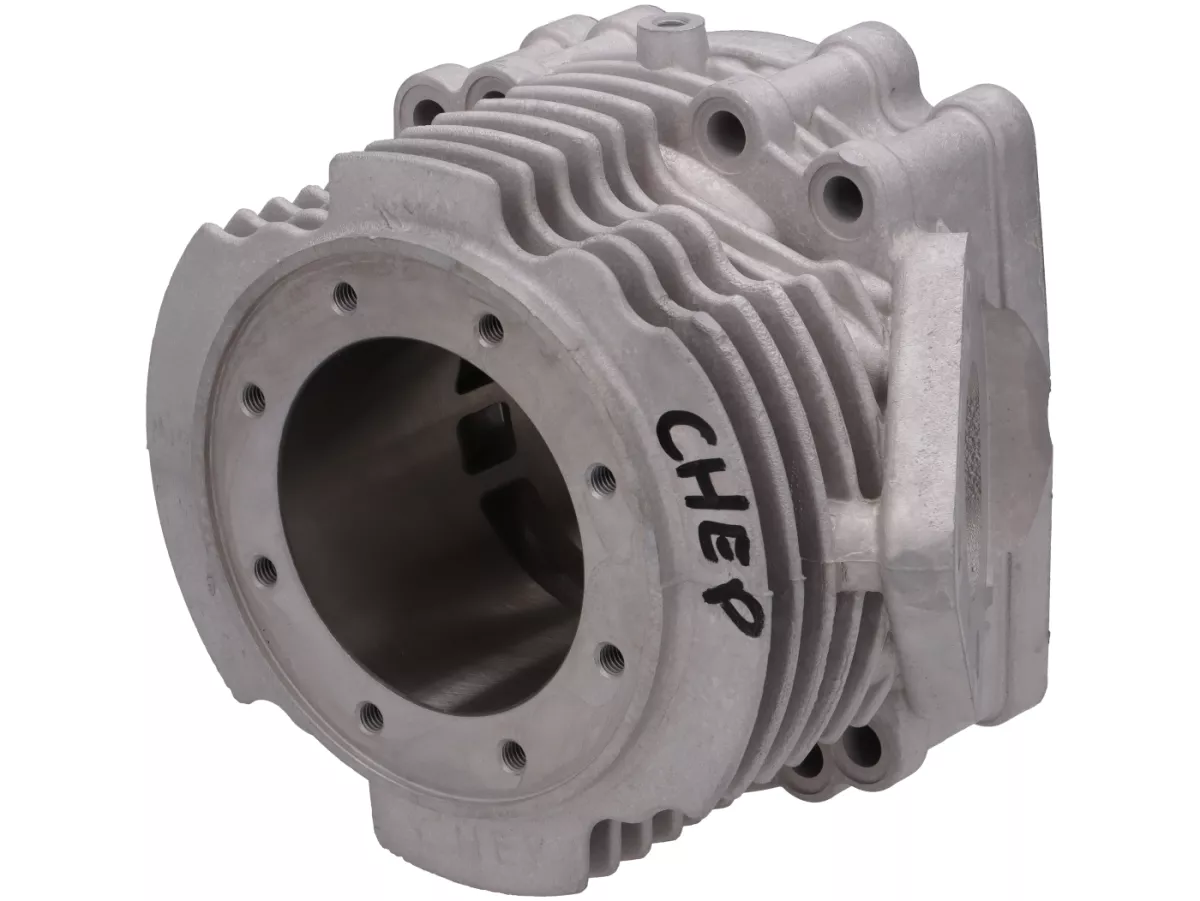
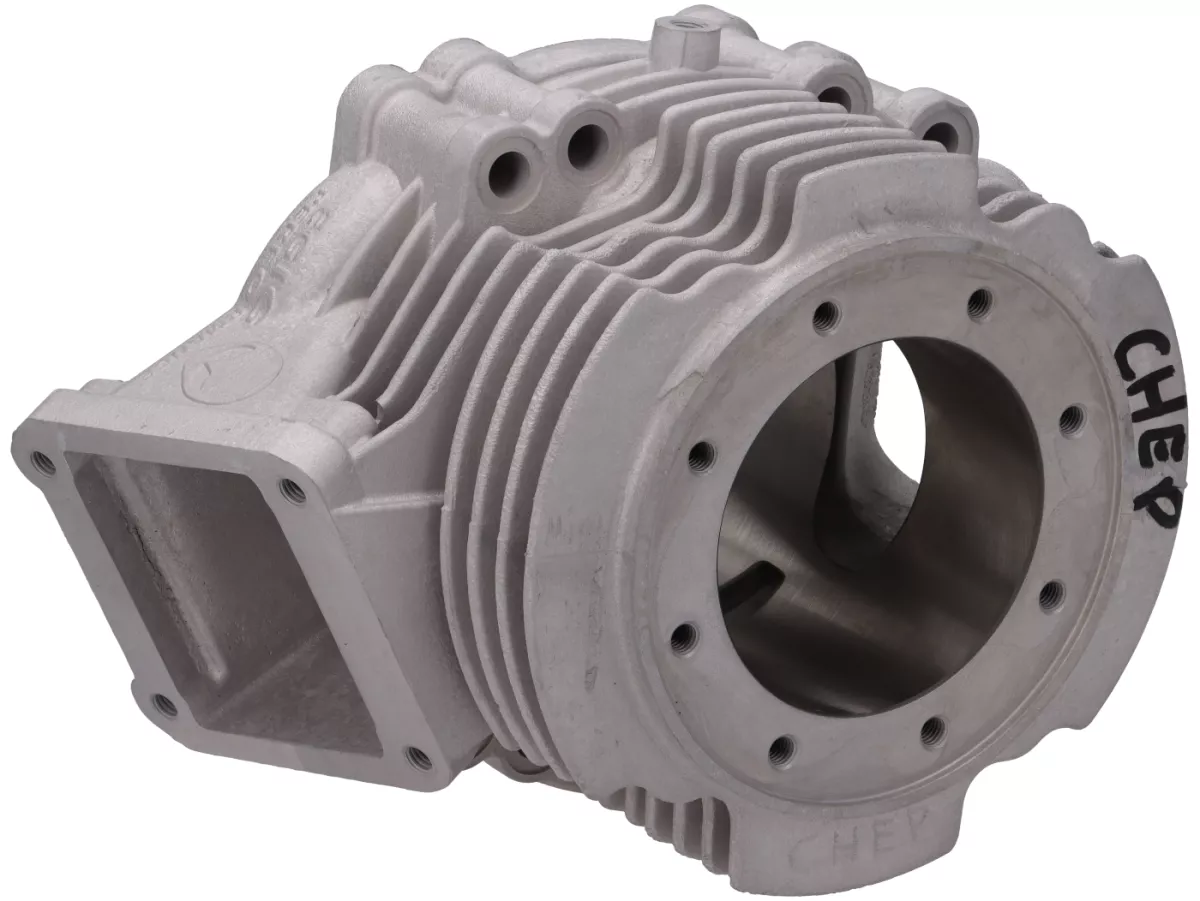
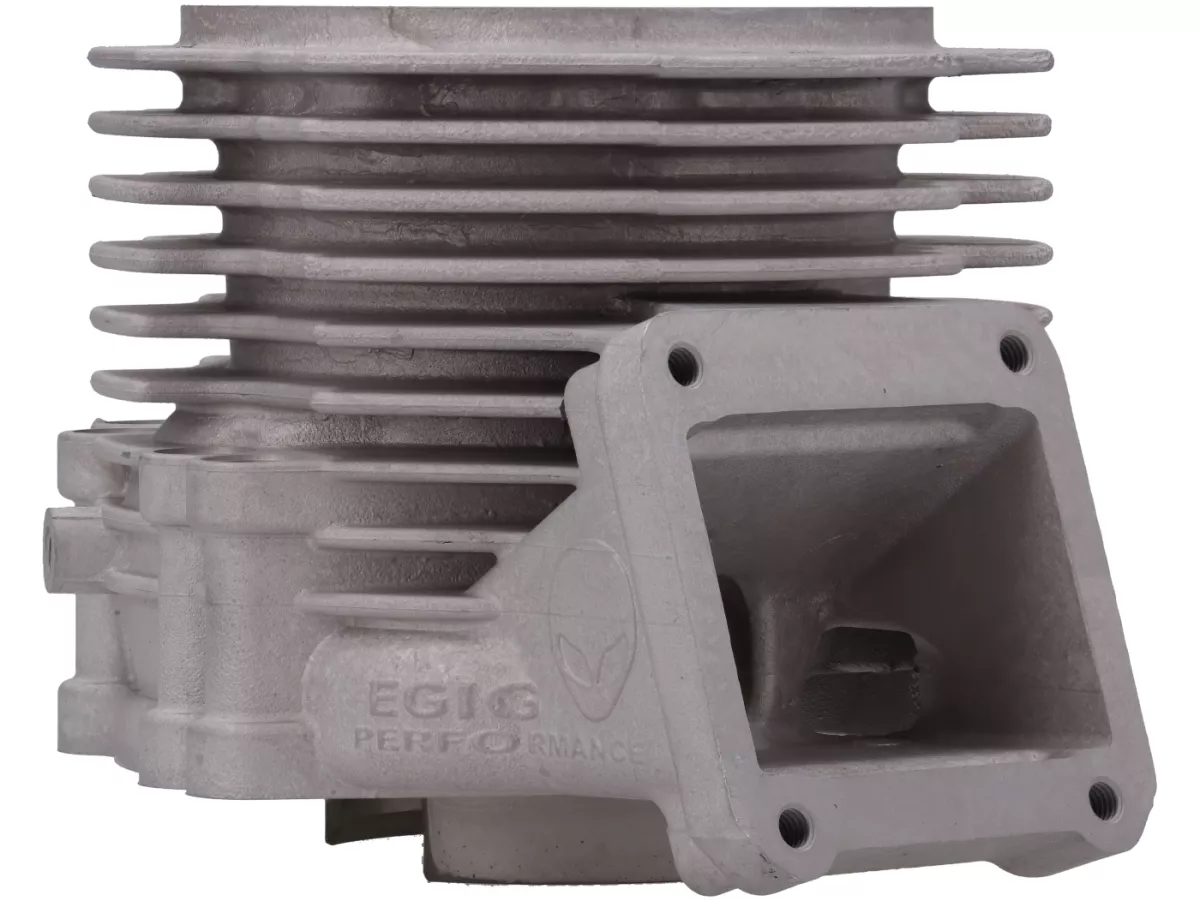
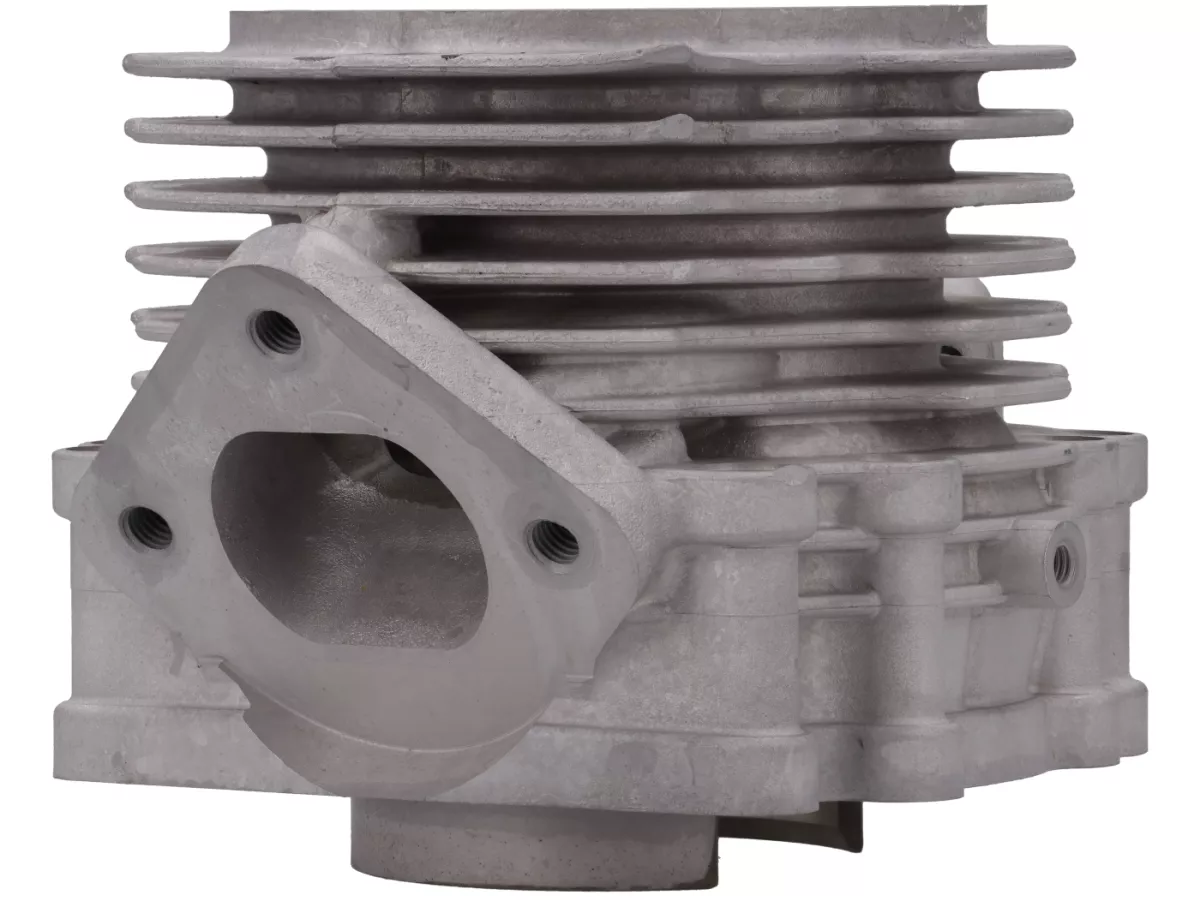
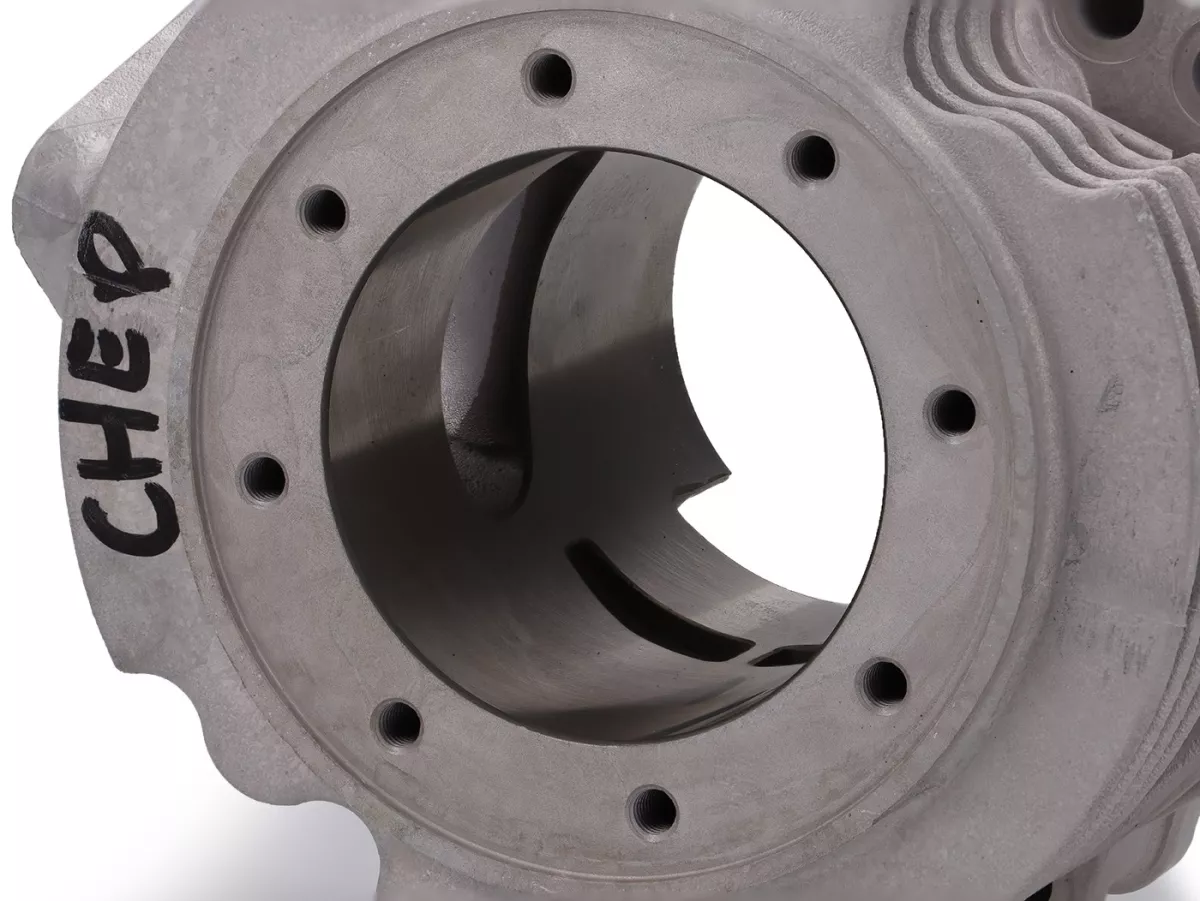
EGIG PERFORMANCE CHEB500 Replacement Cylinder with 220 cm³
Hand-machined one-piece exhaust cylinder for Vespa small-frame high-performance engines
The EGIG PERFORMANCE CHEB500 replacement cylinder is the sport-tuned single-exhaust version of the EGIG-220 cylinder design. With a 68 mm bore, designed for a 60 mm stroke and 117 mm connecting rod, and a hand-machined one-piece exhaust port, it forms the basis for high-performance 220 cm³ Vespa small-frame engines.
Unlike its Revo counterpart with a three-piece exhaust port, the CHEB500 features a single large exhaust port. At a 60 mm stroke, the valve timing is approximately 129° intake and 190° exhaust. This allows the cylinder to combine a sporty design with the crisp, direct characteristics of a one-piece exhaust port.
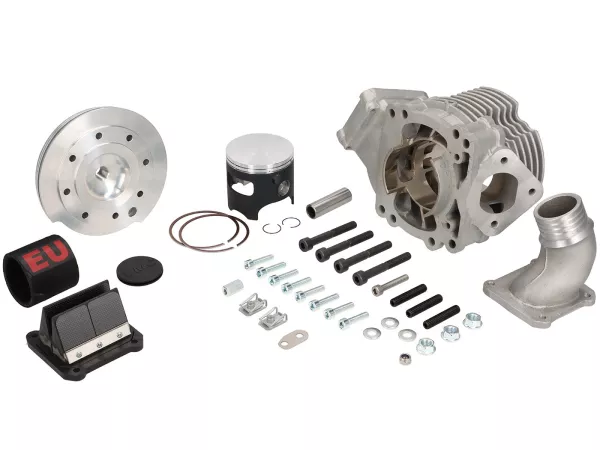
This item includes only the machined and coated cylinder body. The piston, cylinder head, diaphragm, intake manifold, gaskets, and other components must be selected to match the existing engine configuration.
EGIG PERFORMANCE
CHEB500
220 cc
Single Exhaust Port
Hand-machined
Nikasil
Cylinder block only
Advantages and Features
EGIG PERFORMANCE CHEB500 model with hand-machined single exhaust port
220 cm³ displacement with a 68 mm bore and 60 mm stroke
Designed for a connecting rod length of 117 mm
Sporty valve timing of approx. 129° / 190° at a 60 mm stroke
One-piece exhaust port with direct and even power delivery
Aluminum cylinder block with Nikasil coating
Hand-machined exhaust layout prior to the final raceway coating
For high-performance diaphragm and resonance exhaust setups
Stud pattern for M200 and EGIG-250/300 hole patterns
Exhaust flange with 65-mm bore and additional center M8 thread
CHEB500: hand-machined one-piece exhaust
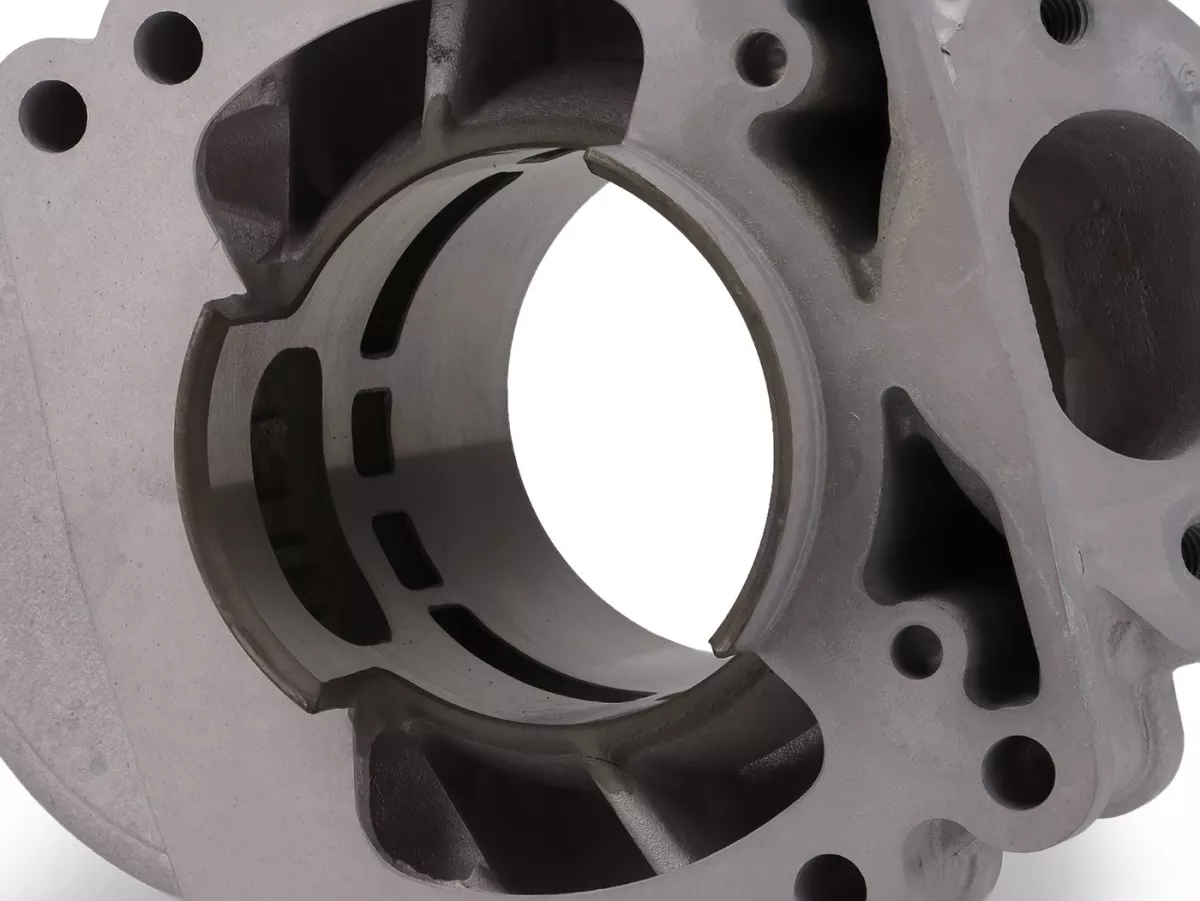
The CHEB500 features a large, one-piece exhaust port. Unlike the three-piece Revo exhaust port, the exhaust flow is not routed through a main window and two side ports, but rather through a continuous exhaust opening.
The outlet contour is machined by hand to the CHEB500 specification. Machining takes place prior to the Nikasil coating, ensuring that the finished channel and window areas are also incorporated into the final coating process.
Characteristics of the Single Outlet
Direct gas path: continuous outlet window without lateral side outlets
Uniform power delivery: less heavily influenced by multiple exhaust ports
Sporty valve timing: 190° exhaust timing for performance-oriented engine setups
Clear tuning characteristics: easily predictable behavior when making changes to the exhaust and carburetor
Wide range of applications: can be used for powerful street, touring, or sport engines, depending on the surrounding components
CHEB500 and Revo Compared
The CHEB500 and Revo use the same large-volume EGIG base design but differ in their exhaust layouts. The CHEB500 features a one-piece, hand-machined exhaust. The Revo, on the other hand, uses a three-piece exhaust system with two additional side exhausts.
Exhaust Variants Compared
| Feature |
CHEB500 |
Revo |
| Exhaust |
One-piece |
three-piece |
| Machining |
Hand-finished |
hand-finished |
| Control times at 60 mm stroke |
approx. 129° / 190° |
approx. 129° / 190° |
| Basic character |
Sporty single-outlet design with direct and even power delivery |
greater potential exhaust area and more focused on the upper RPM range |
| Target Application |
Powerful street, touring, and sport engines |
Performance-oriented resonance and racing engines |
The actual engine characteristics are not determined solely by the exhaust layout. The exhaust system, carburetor, diaphragm, ignition, compression ratio, crankshaft, and gear ratio all significantly influence the result.
220 cm³ from a 68 mm bore and 60 mm stroke
In this configuration, the CHEB500 is designed for a crankshaft with a 60 mm stroke and a connecting rod 117 mm long. Combined with the 68-mm bore, this results in a displacement of approximately 220 cm³.
Crank mechanism design
| Bore |
Ø68 mm |
| Crankshaft stroke |
60 mm |
| Connecting rod length |
117 mm |
| Displacement |
approx. 220 cm³ |
Different stroke or connecting rod combinations alter the cylinder position, valve timing, and compression edge. Such configurations must be individually adjusted using suitable spacers, gaskets, or by machining the components.
Valve timing at 60 mm stroke
In the intended 220-cm³ configuration, the valve timing is approximately 129° at the intake valves and 190° at the exhaust valves.
This results in a calculated exhaust advance of about 30.5°. This design is clearly sporty and requires an exhaust system that matches the cylinder’s RPM range and airflow capacity.
Measuring valve timing on the assembled engine
The values listed are guidelines for the intended setup. Even minor changes to the cylinder head gasket, spacers, engine block, or crankshaft assembly can alter the actual valve timing.
Check intake and exhaust valve timing with a degree disc
Do not determine cylinder position based solely on table values
Re-measure the compression edge based on the final cylinder position
Adjust the exhaust system selection to match the actual measured valve timing
Aluminum cylinder with Nikasil coating
The CHEB500 is made of aluminum and features a Nikasil coating as the running surface. Aluminum quickly dissipates the heat generated during combustion to the cooling fins, while the hard coating forms the running surface for the piston and piston rings.
The exhaust layout is machined manually prior to coating. As a result, the coated running surface already matches the final CHEB500 channel geometry.
Properties of the coated aluminum raceway
Rapid heat transfer from the piston to the cylinder body
Hard and wear-resistant running surface
Lighter weight than a comparable gray cast iron design
The machined exhaust area is incorporated into the coating process
Designed for the high thermal and mechanical loads of a 220-cm³ engine
Compression and squish edge
The actual compression ratio is not determined by the cylinder alone. The piston, cylinder head, cylinder position, and squish edge must be considered as an integrated system.
With a properly designed piston and cylinder head, the guideline value for a squish edge of approximately 1.2 to 1.3 mm is around 12.5:1. This value must be verified on the specific engine and tuned to the fuel, ignition, exhaust system, and intended application.
Do not apply guideline values without verification
Measure the squish edge on the fully assembled engine
Take the combustion chamber volume of the cylinder head being used into account
Check the piston shape and piston protrusion
Select ignition timing and fuel quality for compression
Check the engine under load for knocking and excessive temperature
Stud pattern and exhaust connection
The cylinder block features an eight-bolt pattern that accommodates both the M200 bolt pattern and the EGIG-250/300 configuration.
A 65 mm hole pattern is used at the exhaust outlet. Additionally, there is a third M8 thread in the center for attaching a correspondingly designed exhaust flange.
Stud pattern: M200 and EGIG 250/300, eight-point configuration
Exhaust hole: 65 mm
Additional mounting: center M8 thread
Exhaust: must be compatible with the flange mounting and the CHEB500 performance characteristics
Cylinder head and cylinder cover
The cylinder head is not included in the scope of delivery and must be selected to match the piston used, the bore, and the desired compression ratio.
The mounting points and external dimensions of the EGIG cylinder design are intended for a PX125 cylinder cover. During assembly, the cover, head, and spark plug position must be checked together to ensure proper fit and sufficient clearance.
Diaphragm and Intake
The EGIG cylinder concept is designed for high-performance diaphragm engines. It can be combined with a separately available Italkit 8-valve diaphragm and matching 30- or 34-mm intake manifolds.
Depending on the intake manifold used, the intake can be routed through the existing frame hole. The diaphragm block, intake manifold, and carburetor are not included with this replacement cylinder.
Note the engine housing and centering pins
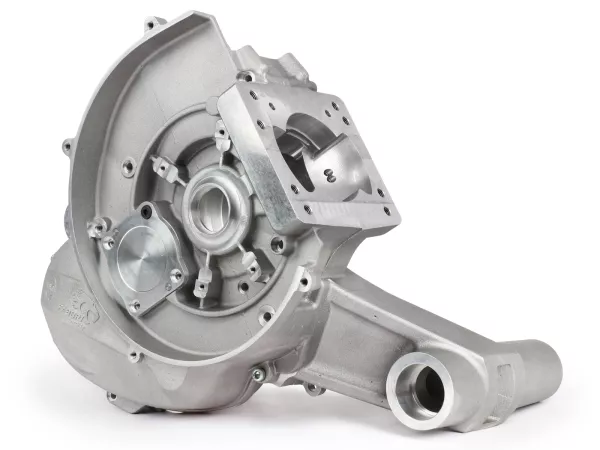
There are two centering pins at the base of the cylinder. This centering feature can only be used in conjunction with an EGIG/Fabbri engine housing designed for this purpose.
Check the centering holes in the engine housing before installation
Do not force the centering pins into an unsuitable housing
Check that the cylinder base and housing surface fit together completely and without tension
If using a different housing, verify technical feasibility before installation
The CHEB500 is not a simple replacement for a standard Smallframe cylinder
For consistently built small-frame engines
A 220-cm³ engine places high demands on the entire powertrain. The cylinder alone does not determine either performance or durability. The crankshaft, bearings, clutch, primary drive, transmission, ignition, and fuel system must be capable of withstanding the load.
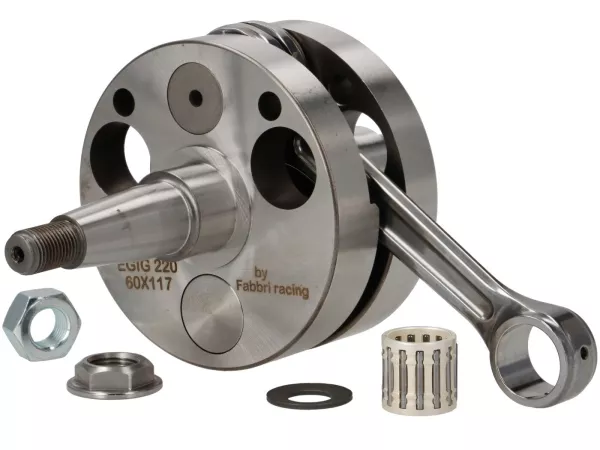
Crankshaft with 60 mm stroke and 117 mm connecting rods
Matching Ø68-mm piston
Cylinder head compatible with the piston
Adequately sized diaphragm block and carburetor
Exhaust system compatible with 129°/190° valve timing
Heavy-duty clutch and reinforced primary drive
Gear ratios and primary drive ratio matched to the power band
Ignition system with timing and adjustment suited to the engine configuration
Compatible vehicle models
| Vespa 125 Primavera |
VMA2T, only with the corresponding EGIG/Fabbri engine configuration |
| Vespa 125 ET3 |
VMB1T, only with corresponding EGIG/Fabbri engine configuration |
| Vespa PK125 |
VMX1T, check engine base and peripherals |
| Vespa PK125 S |
VMX5T, check engine base and peripherals |
| Vespa PK125 XL |
VMX6T, Check Engine Base and Peripherals |
| Vespa PK125 ETS |
VMS1T, Check engine base and peripherals |
The vehicle specification describes the possible small-frame base. The cylinder cannot be mounted on a stock PV, ET3, or PK125 engine without a comprehensively modified engine assembly.
Technical Specifications
| Manufacturer |
EGIG PERFORMANCE |
| Series |
CHEB500 |
| Component |
Replacement cylinder / cylinder body |
| Displacement |
220 cm³ |
| Bore |
Ø68 mm |
| Crankpin stroke |
60 mm |
| Connecting rod length |
117 mm |
| Cylinder material |
Aluminum |
| Bearing surface |
Nikasil coating |
| Exhaust design |
One-piece, hand-finished |
| Flow-through time at 60 mm stroke |
approx. 129° |
| Exhaust angle at 60 mm lift |
approx. 190° |
| Calculated advance angle |
approx. 30.5° |
| Exhaust port depth |
65 mm |
| Additional exhaust mounting |
Center-mounted M8 thread |
| Stud configuration |
M200 and EGIG 250/300, with eight studs |
| Cylinder head cover |
Mounting points and dimensions for PX125 cylinder head |
| Centering |
2 centering pins on the cylinder base; can only be used with a compatible EGIG/Fabbri housing |
| Compatible with |
Vespa PV125, ET3 125, and PK125 with corresponding engine configuration |
Scope of Delivery
This item includes only the EGIG PERFORMANCE CHEB500 cylinder body.
Included: EGIG PERFORMANCE CHEB500 replacement cylinder, 220 cm³
Not included: Piston
Not included: Piston rings, piston pins, and retaining clips
Not included: Cylinder head
Not included: Diaphragm block
Not included: Intake manifold and carburetor
Not included: Gaskets, studs, nuts, and other mounting parts
Check before installation
Check that the crankshaft stroke is 60 mm
Check that the connecting rod length is 117 mm
Select a compatible Ø68-mm piston
Check piston clearance and ring gap according to the manufacturer’s specifications
Check the compatibility of the cylinder head
Check the centering pins and centering holes in the engine block
Measure valve timing and compression edge on the assembled engine
Check the exhaust flange and the hole cutout
Check that the piston, crankshaft, and cylinder base move freely
Adjust the carburetor, ignition, and gear ratio to match the overall system
Installation and Tuning Instructions
The CHEB500 is not a plug-and-play replacement for a stock engine
Assemble the engine only with a compatible housing and matched peripherals
Install the cylinder base and sealing surfaces without applying tension
Check piston clearance in all crankshaft positions
Do not merely calculate the squish edge; actually measure it
Record valve timing on your own engine using a degree disc
Start carburetor tuning with a sufficiently rich base setting
Select the ignition timing to match the compression ratio, fuel, and exhaust system
Check the engine under load for knocking, temperature, and fuel delivery
Size the clutch, primary drive, and transmission for the expected torque
Conclusion
The EGIG PERFORMANCE CHEB500 is a hand-machined 220-cm³ replacement cylinder for demanding Vespa small-frame projects. Its one-piece exhaust combines a clean, direct port layout with sporty valve timing of approximately 129°/190°.
Compared to the three-piece Revo exhaust, the CHEB500 relies on the characteristics of a large single-piece exhaust. This makes it ideal for riders who want to build a high-performance engine with smooth, predictable power delivery and a wide, adjustable operating range.
This requires a carefully planned complete system consisting of a 60-mm crankshaft, 117-mm connecting rod, matching piston and cylinder head, diaphragm intake, exhaust, ignition, and a robust drivetrain. Only the cylinder block is included in the delivery.
FAQ
Only the EGIG PERFORMANCE CHEB500 cylinder block is included. The piston, cylinder head, diaphragm, intake manifold, gaskets, and other components are not included.
The CHEB500 features a large, one-piece, hand-machined exhaust port. It does not use side exhaust ports like the three-piece Revo version.
The CHEB500 features a one-piece exhaust port. The Revo has a three-piece exhaust port with two additional side ports. As a result, the CHEB500 offers the more direct and consistent characteristics of a large single exhaust port, while the Revo provides more potential exhaust port area for a tuning profile more focused on peak power.
With the intended combination of a 60-mm stroke and 117-mm connecting rod, the approximate values are 129° intake timing and 190° exhaust timing. The actual values must be measured on the assembled engine.
The 220-cm³ version is designed for a crankshaft with a 60-mm stroke and a 117-mm-long connecting rod.
The CHEB500 is not a simple replacement for a stock engine. The two centering pins on the cylinder base can only be used with a properly prepared EGIG/Fabbri crankcase. The engine base used must be carefully inspected before installation.
No. The Ø68-mm piston must be ordered separately and checked for piston bore, piston clearance, piston pin, and compatibility with the cylinder head being used.
The mounting points and external dimensions of the cylinder are designed for a PX125 cylinder head. The actual fit must be checked together with the separately used cylinder head.
Yes. The compression edge must be measured on the fully assembled engine and adjusted via cylinder position, gaskets, or spacers. As a guideline, a value of approximately 1.2 to 1.3 mm is recommended, depending on the cylinder head and piston used.


 DE | €