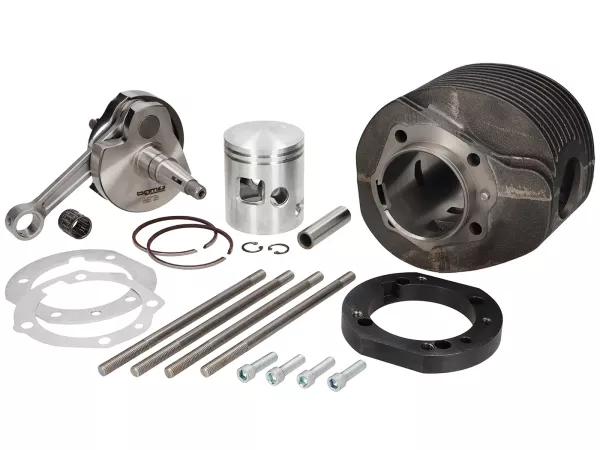
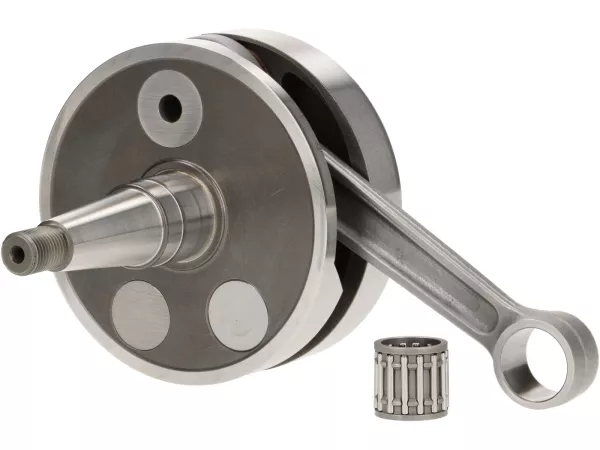
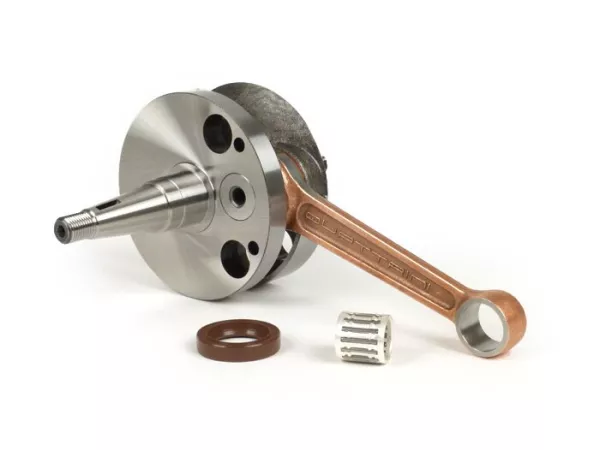
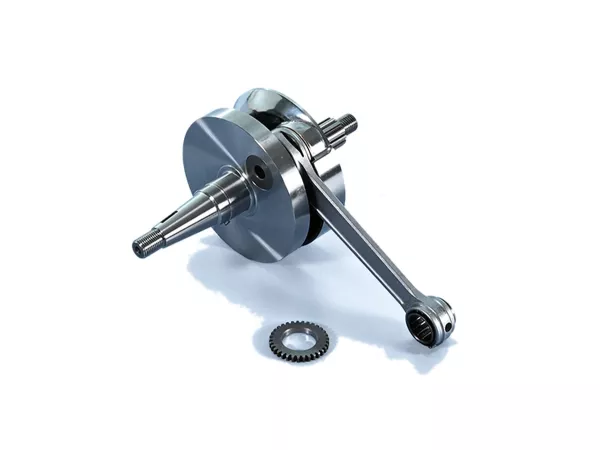
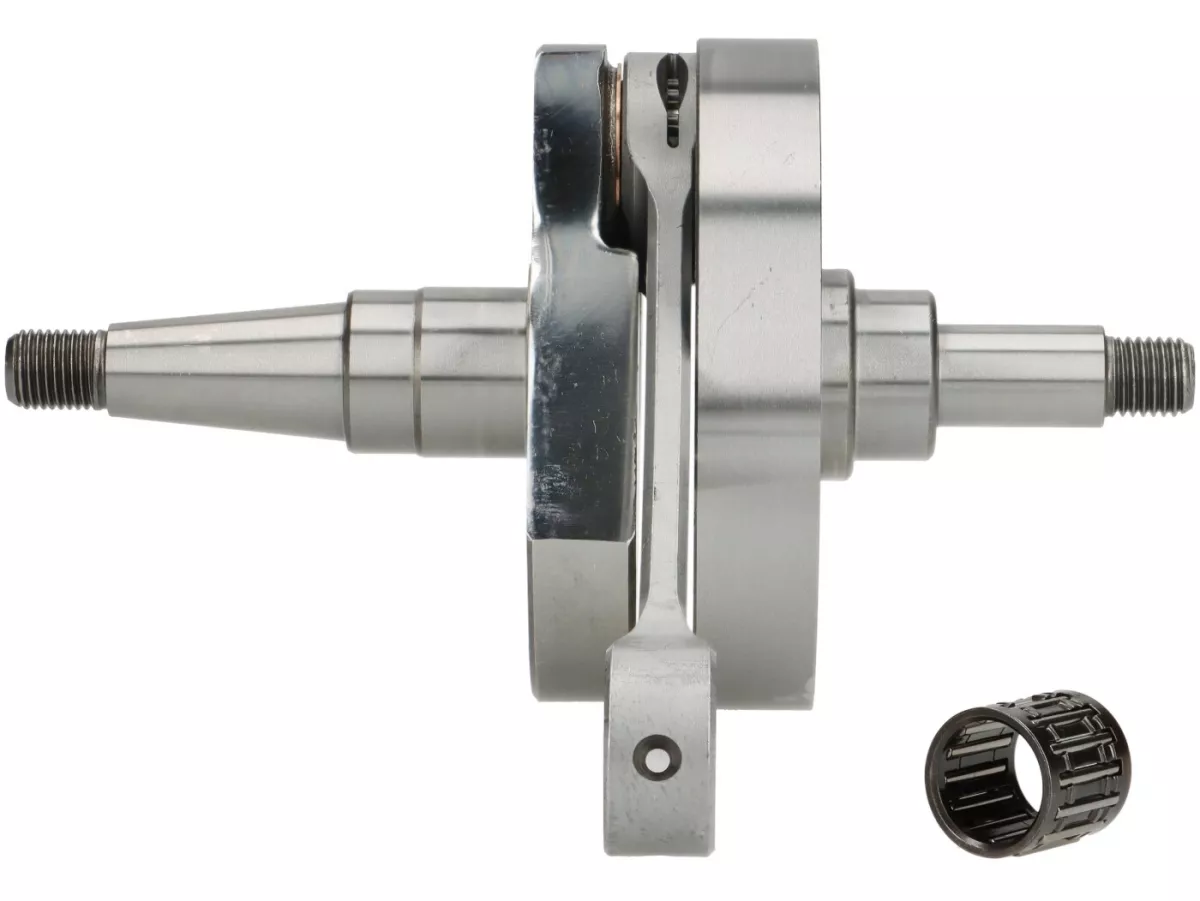
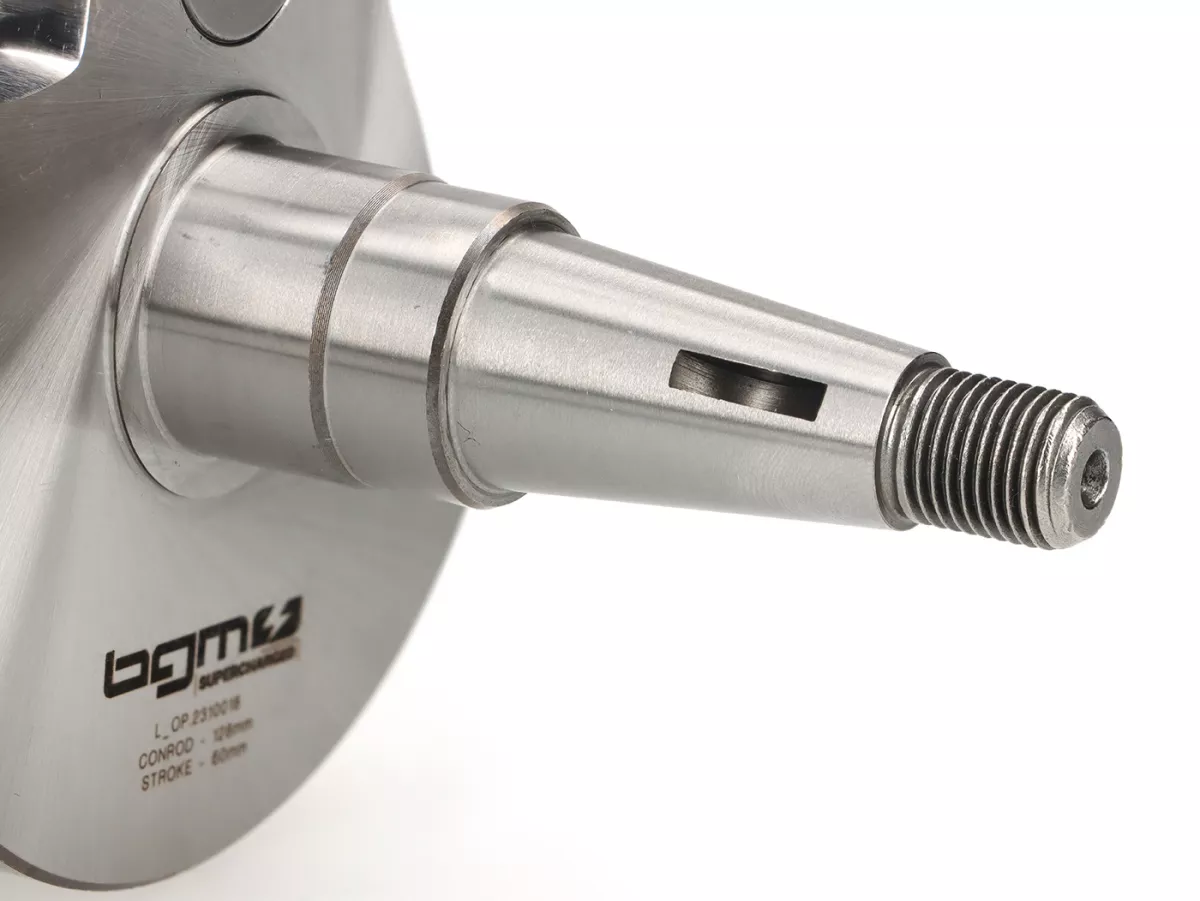
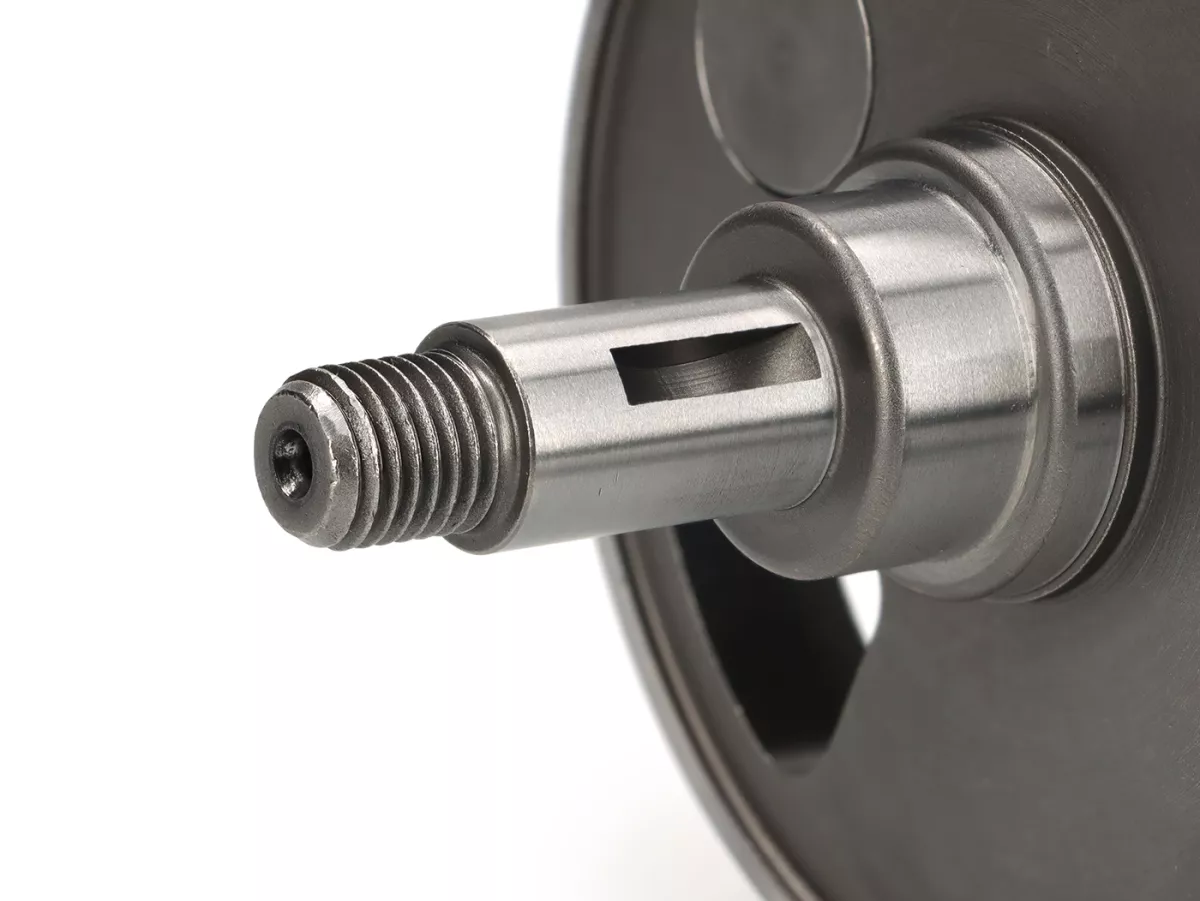
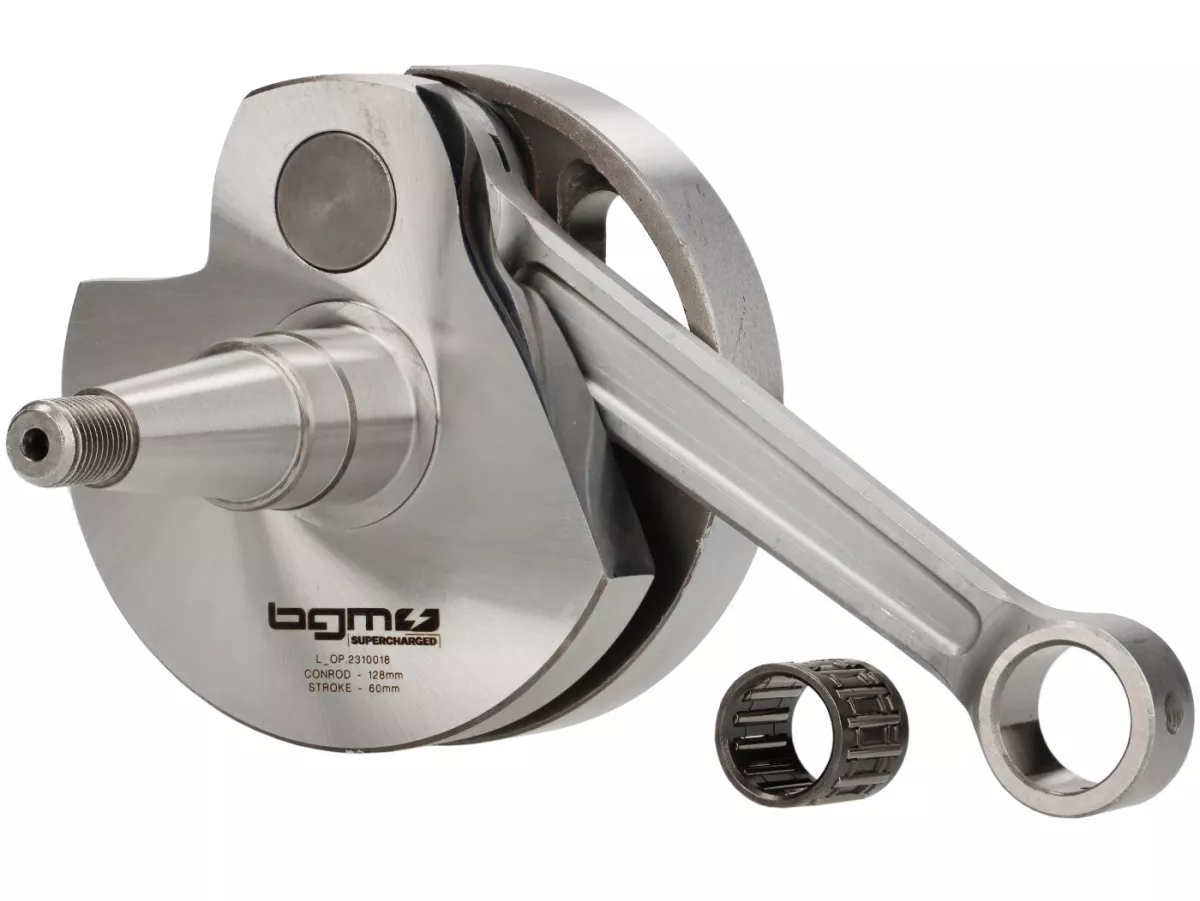
BGM PRO Touring Evo Crankshaft – 60 mm stroke, 128 mm connecting rod, rotary valve
244-cm³ long-connecting-rod design without boring out the PX200 crankcase
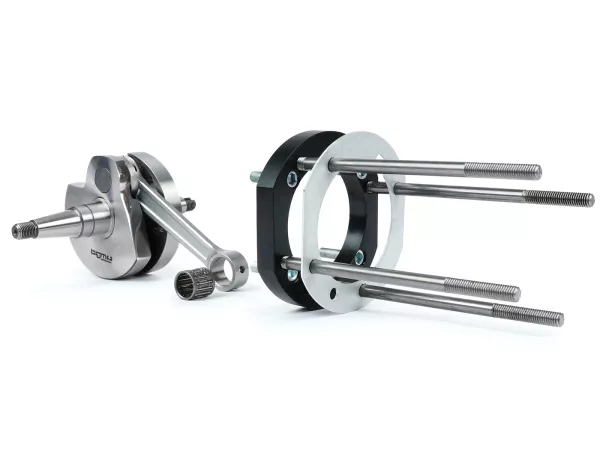
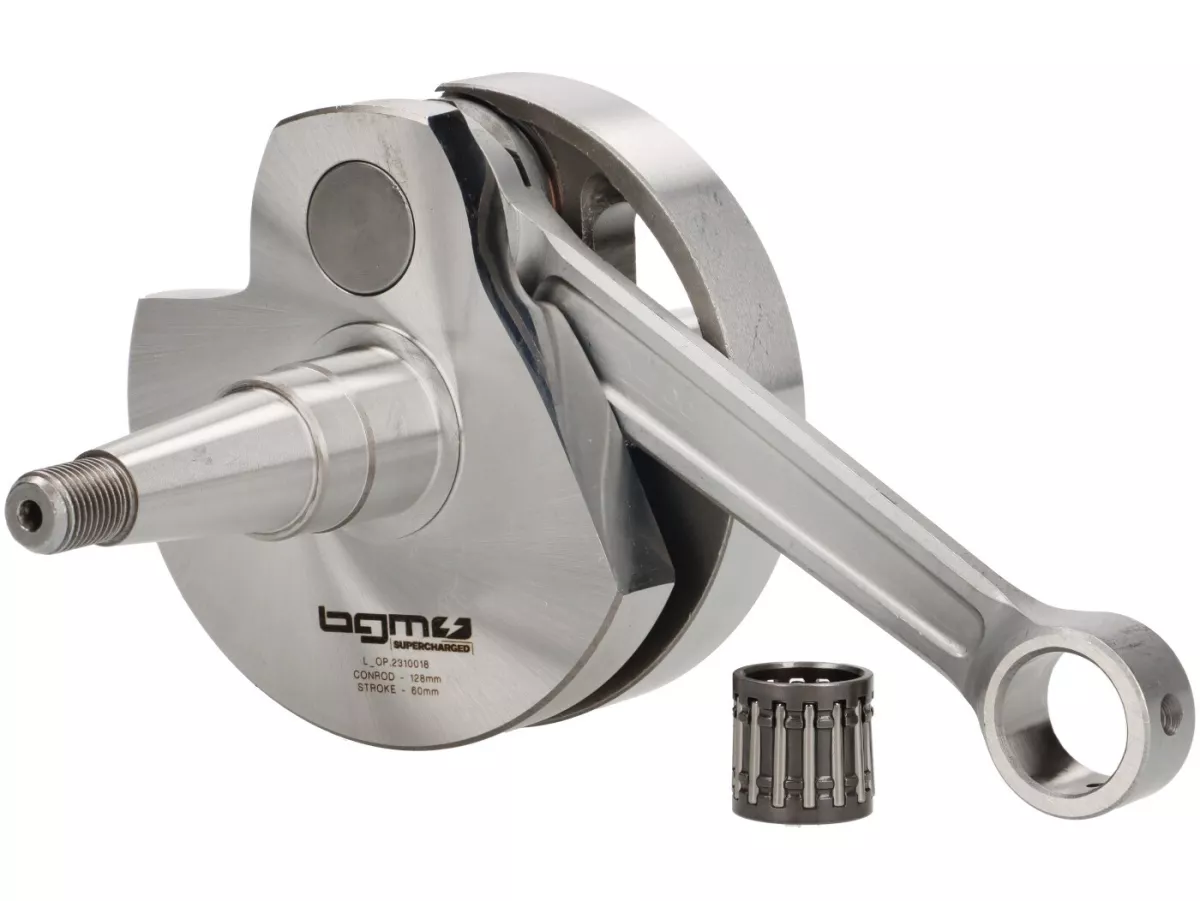
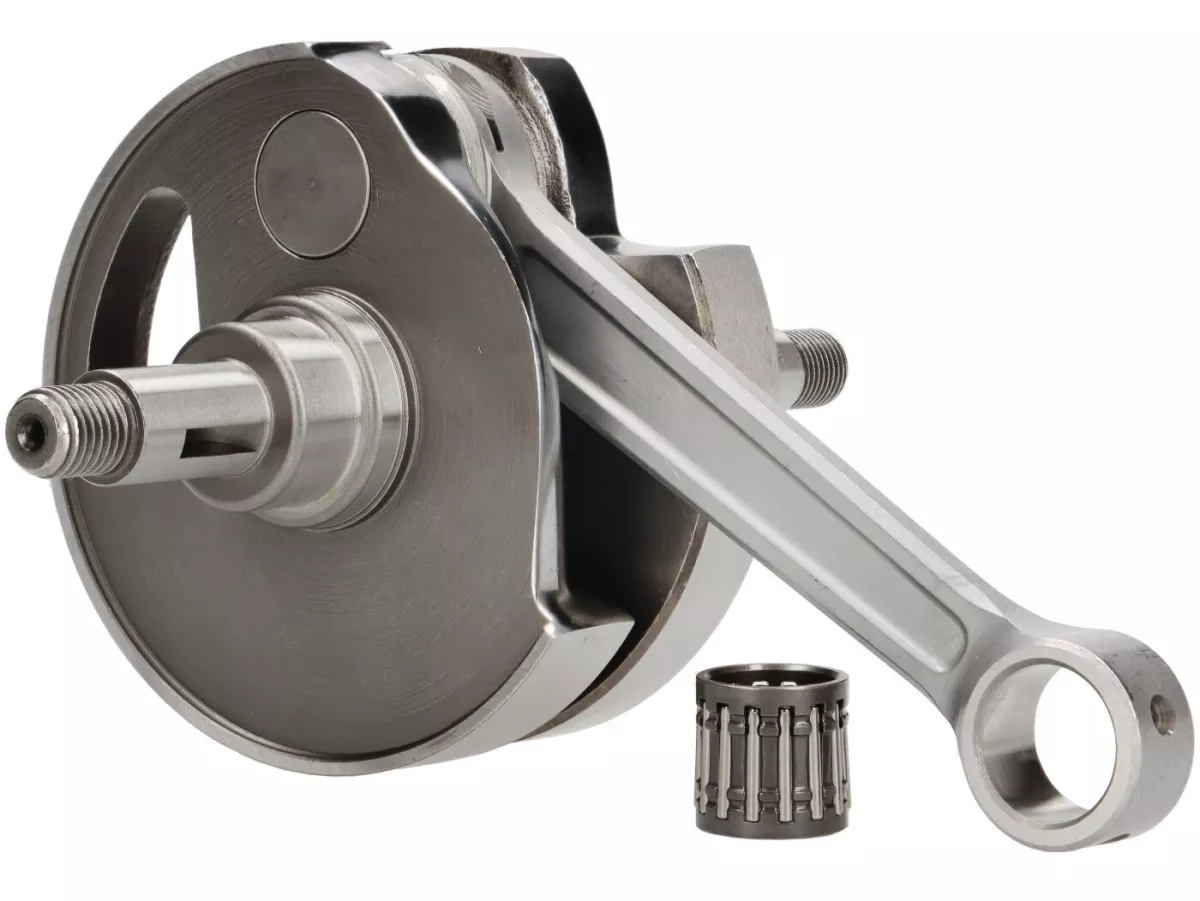
The BGM PRO Touring Evo crankshaft BGM031128G combines a 60-mm stroke with an exceptionally long 128-mm connecting rod —and fits into a stock PX200 crankcase without requiring the crank chamber to be bored out for the crankshaft. It thus combines modern 244-cm³ long-connecting-rod designs with a key practical advantage: the original engine block can be retained.
At the same time, the crankshaft assembly is consistently designed for high load-bearing capacity. The crankshaft journals and connecting rods are forged. The forging process produces a favorable grain orientation tailored to the component’s geometry and a highly resilient microstructure—an excellent foundation for high toughness, fatigue strength, and resistance to bending and torsional stresses. In the Evo version, this is complemented by a precise press fit and additional chemical hardening of the crankpin.
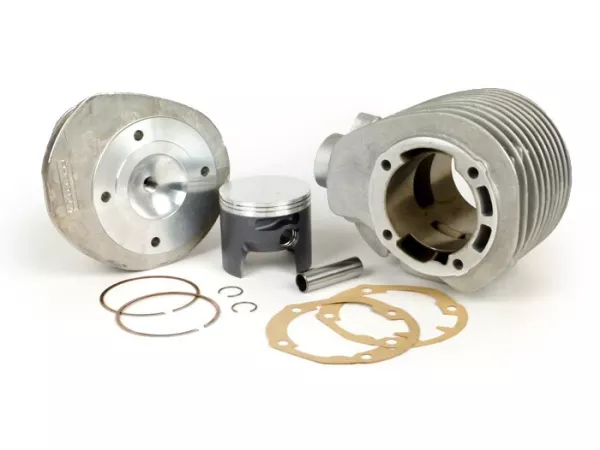
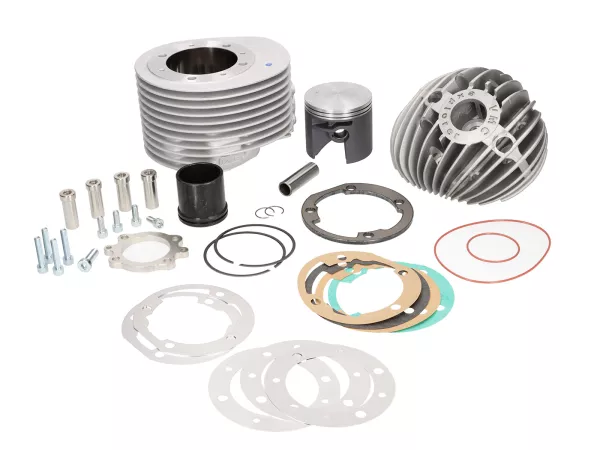
Typical applications include the Quattrini M244, the VMC Explorer 244, and the Polini 244. The long connecting rod provides additional flexibility regarding cylinder position, compression edge, and valve timing angles. At the same time, the conventional PX coupling stub allows for a free choice among the standard compatible PX coupling systems.
Another key design feature is the intake layout. The crankshaft flange features a very deeply machined intake shoulder in the area below the rotary valve intake. This provides a large free cross-sectional area early on when the rotary valve is open. This allows for a high effective intake cross-sectional area to be achieved without having to generate the required flow rate solely through extremely long intake valve timing.
No spindling on the PX200 housing
Forged crankshaft journals
Forged connecting rod
60 mm stroke
128 mm connecting rod
Quattrini M244
VMC Explorer 244
Polini 244
Evo connecting rod lock
Deep intake shoulder
Key Benefits
No need to bore out the PX200 crankcase: despite a 60 mm stroke and a 128 mm long connecting rod, the crankshaft fits into the stock PX200 crankcase
Forged crankshaft journals and forged connecting rod: robust microstructure and favorable fiber orientation for high toughness and fatigue strength
Evo main journal connection: precise press fit plus additional chemical bonding for high resistance to twisting
Extra-long 128-mm connecting rod: ideal for modern large-frame cylinders with a high cylinder position
Greater setup flexibility: Cylinder position—and thus the valve timing angle—can be precisely adjusted using spacers
Deep intake shoulder: large free cross-sectional area directly beneath the rotary valve intake
Performance without extreme intake timing: a large effective intake cross-sectional area enables high-performance setups with comparatively moderate valve timing
Conventional PX clutch stub: free choice among standard compatible PX clutch systems
Field-tested: Reliably in use in numerous high-performance PX200 setups with over 30 PS and more than 35 Nm
Sophisticated connecting rod bearing lubrication: large lubrication slots, additional side pockets, and INA piston pin bearings
60/128 in the stock crankcase—no boring required
One of the most important design advantages of the BGM031128G lies in its external dimensions. Although the crankshaft combines a 60 mm stroke with a very long 128 mm connecting rod, the stock PX200 crankcase remains unchanged. The PX200 engine block does not need to be bored out or enlarged in diameter to accommodate the crankshaft itself.
This is a decisive advantage, especially with high-quality original crankcases: it eliminates the need for an irreversible machining step on the crankcase. At the same time, the foundation for large-displacement cylinders such as the Quattrini M244, VMC Explorer 244, and Polini 244 is preserved. Machining on the cylinder and intake sides may still be necessary depending on the desired setup; the advantage specifically refers to the free movement of the crankshaft within the PX200 crankcase.
Large displacement without modifying the crankcase
Stock PX200 crankcase: no need to bore out the crankcase for the BGM031128G
Original material is preserved: no unnecessary material removal from the crankcase
60 mm stroke + 128 mm connecting rod: modern long-connecting-rod geometry despite a stock-like crankcase
Less machining required: eliminates the need for a complex machining operation on the crankcase
Forged crankshaft assembly – high reserves for bending, torsion, and continuous load
The crankshaft journals and connecting rods of the BGM PRO Touring Evo are forged. During forging, the material is plastically deformed under high pressure. This results in a favorable grain orientation that follows the component’s contour, which is particularly advantageous for components subjected to high alternating stresses, such as crankshaft journals and connecting rods.
The key factor here is not a supposedly higher steel density, but rather the load-bearing microstructure and the oriented grain orientation. This provides an excellent foundation for high strength, toughness, and fatigue strength, as well as resistance to bending and torsional forces. This is a significant design advantage, particularly for large-displacement two-stroke engines with high combustion pressures, severe load cycles, and long full-load phases.
Why Forging Matters for a Crankshaft
Favorable fiber orientation: follows the component geometry and enhances resistance to bending and torsional loads
High fatigue strength: an excellent foundation for constantly changing combustion and inertial forces
High toughness: important for load peaks, high torques, and rapid load cycles
Designed for high continuous loads: suitable for high-performance street engines, high RPMs, and long periods of full load
For Quattrini M244, VMC Explorer 244, and Polini 244
The 128-mm connecting rod length makes the BGM031128G particularly suitable for cylinders whose geometry is specifically designed for a long connecting rod.
| Cylinder |
Compatibility with BGM031128G |
| Quattrini M244 |
A very typical application for a 60-mm stroke and a long connecting rod; spacers allow for precise positioning of the cylinder. |
| VMC Explorer 244 |
Suitable for long-connecting-rod 244-cm³ setups with a 60 mm stroke and variable cylinder position. |
| Polini 244 |
Polini specifies 60/127 as standard. The BGM031128G provides a 60 mm stroke and 128 mm connecting rod; the additional 1 mm connecting rod length is accounted for via the cylinder position or appropriate spacers. |
128-mm connecting rod – more freedom in valve timing
Compared to the standard 110-mm PX200 connecting rod, the 128-mm connecting rod is exceptionally long. While the stroke remains unchanged at 60 mm, the geometric relationship between the crankshaft radius, connecting rod, and piston changes significantly.
Of particular importance to the engine builder is the additional freedom in cylinder positioning. With appropriate base spacers and, if necessary, head spacers, the cylinder can be positioned higher or lower. This alters the opening and closing points of the intake and exhaust valves.
Long connecting rod = more tuning flexibility
More spacer flexibility: Cylinder height can be precisely adjusted to the desired setup
Variable valve timing angles: Intake and exhaust valve timing can be deliberately adjusted within mechanical limits
Touring or performance: enables different setups using the same base engine
Squeeze angle separately adjustable: Cylinder position and combustion chamber geometry must be considered together
This point is particularly interesting with the Polini 244: The cylinder is originally designed for a 127-mm connecting rod. The 128-mm connecting rod from the BGM031128G provides an additional millimeter of design leeway, which can be utilized or compensated for via the spacer configuration. This allows the final cylinder position to be more precisely tuned to the desired valve timing concept.
Important for long connecting rods and spacer setups
Do not select spacers based solely on connecting rod length; instead, select them based on the actual desired cylinder position
Measure and readjust the compression edge after every change
Check the piston position at TDC and BDC
Measure the valve timing angle after assembly is complete; do not simply assume it based on calculations
Check that the piston, crankshaft, and cylinder move freely before final assembly
Deep intake shoulder—cross-sectional area rather than unnecessarily long intake duration
In a rotary vane engine, it is not just the pure intake duration that determines how well the engine is filled. Equally important is the effective cross-sectional area that is open while the intake is open.
This is precisely where the layout of the BGM PRO shaft comes into play. In the area below the intake port, the crankshaft web is deeply recessed. This deep intake shoulder creates plenty of free space right where the mixture flows from the intake manifold into the crankcase.
The result is a large usable intake cross-sectional area even at moderate rotary valve times. This makes it possible to build a high-performance engine without necessarily having to close the intake very late.
Why this is interesting for a street engine
Large clear area: the deep shoulder generously opens up the space beneath the intake
Moderate valve timing is possible: flow does not have to be generated exclusively through longer opening duration
Good tuning basis: attractive for road engines that offer both high torque and high power
Less need for late intake valve closure: helps avoid unnecessarily extreme rotary valve timing
Intake Timing
On a typical PX200 engine case, the BGM PRO Touring Evo cam closes the rotary valve intake approximately 58° after TDC. The actual value depends on the engine case used and its intake port.
For a performance-oriented yet rideable street engine, an intake start of approximately 120° before TDC has proven effective as a starting point. The necessary machining is performed on the intake port of the engine block.
The combination of moderate opening duration and the deep intake shoulder of the crankshaft is a deliberate choice: It is not merely the maximum number of degrees of intake timing that generates flow, but rather a large effective cross-sectional area during the open phase.
Connecting Rod Ratio and Piston Guidance
The long connecting rod alters the geometry of the crankshaft assembly. With a 60-mm stroke, the crankshaft radius is 30 mm. The ratio of crankshaft radius to connecting rod length is approximately 0.234 for a 128-mm connecting rod; with a standard 110-mm connecting rod, it is approximately 0.273.
With the same crankshaft geometry, the longer connecting rod reduces the lateral angle of the connecting rod relative to the cylinder. This can reduce lateral forces on the piston and contributes to a mechanically favorable crankshaft assembly. However, the actual smoothness of an engine’s operation also depends on balancing, piston weight, ignition, clutch, flywheel, and the overall engine design.
Evo – the Current Stage of Evolution
The designation “Touring Evo” denotes the current stage of development within the BGM PRO Touring series. The focus is not on a single detail change, but rather on the manufacturing of the complete crankshaft assembly, which has been refined over the years.
Particular emphasis is placed on the connection between the crankshaft journals and the crankpins. In addition to the precisely defined press fit, the crankpin is chemically secured with a high-strength anaerobic Loctite adhesive. This additional securing measure increases the crankshaft journals’ resistance to twisting under high loads and makes the Evo version particularly suitable for high-performance, high-torque engines.
What “Evo” Means for This Crankshaft
Advanced manufacturing: optimized processes for a precise and reproducible connection of the crank arms
Defined press fit: high mechanical holding force at the crankpin
Additional chemical locking: high-strength Loctite bonding adhesive complements the press fit
High torsional rigidity: designed for high torques, severe load cycles, and performance-oriented setups
Within the well-known BGM PRO Touring product line, the “Evo” designation thus represents not merely a cosmetic model update, but a concrete technical advancement in manufacturing and joining technology.
Forged crankshaft journals, forged connecting rods—and consistently refined manufacturing processes
The BGM PRO Touring Evo crankshafts are constructed with forged crank webs. The connecting rod is also forged. The key advantage lies in the grain orientation—which is shaped by the forging process and aligned with the component’s geometry—and in the microstructure, which is highly resilient for components subjected to high cyclic loading.
Just as important as the base material is the connection between the crankshaft journals and the main bearings. The manufacturing and assembly processes for BGM PRO crankshafts have been continuously refined over the years. In addition to a precisely defined press fit, the journal is now also secured with a high-strength anaerobic bonding adhesive from Loctite.
This additional chemical lock complements the mechanical press fit and enhances protection against twisting of the crankarms under high loads. Together with the forged components, this results in a particularly rigid and durable crankshaft assembly for large-displacement engines with high torque, severe load cycles, and performance-oriented applications.
Evolution in Detail: Maximum Safety at the Connecting Rod Journal
Forged crankpin shells: robust microstructure and optimal, component-specific fiber orientation
Precise press fit: defined connection between the crank arms and the crankshaft journals
Additional chemical locking: high-strength Loctite bonding adhesive enhances resistance to twisting
Designed for high loads: particularly suitable for high torque, high power, and rapid load cycles
Elaborate lubrication of the connecting rod bearing
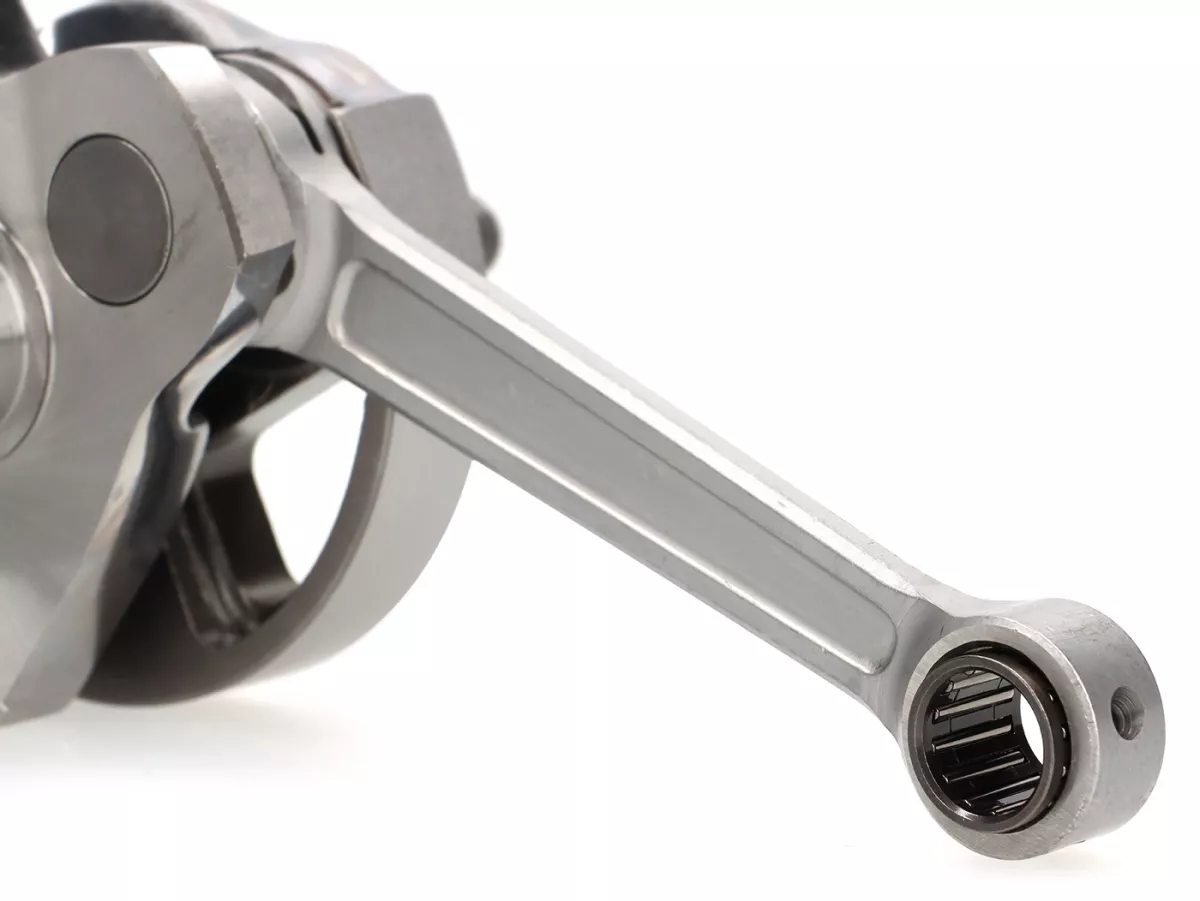
The lower connecting rod bearing is supplied with fuel mixture via two large lubrication slots and additional lateral lubrication areas. Together with the racing bearing and the lateral thrust washers, this creates a connecting rod bearing assembly designed for high load capacity.
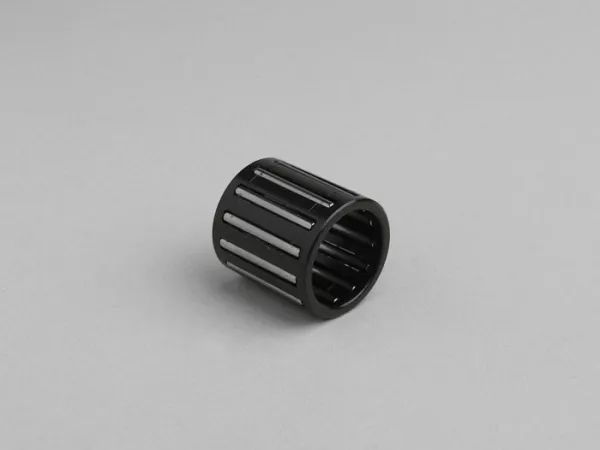
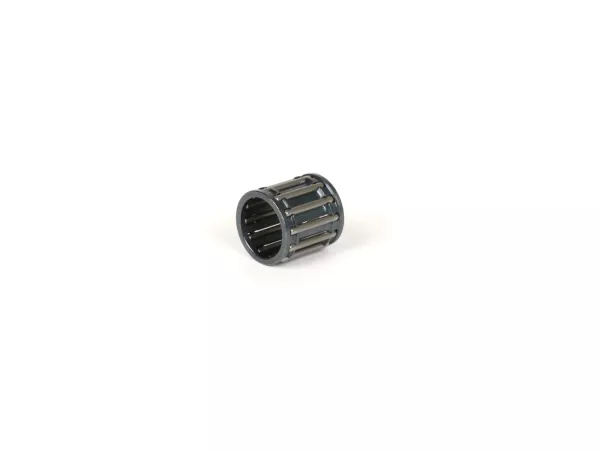
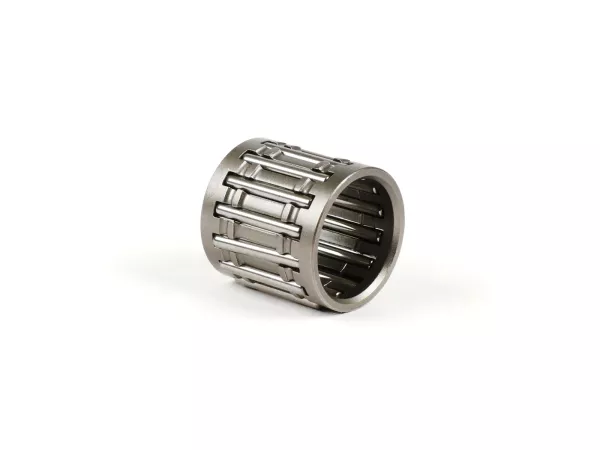
The upper connecting rod bearing is supplied through two lubrication holes. An INA piston pin bearing is included in the scope of delivery.
Piston pin Ø16 mm
The connecting rod is designed for a piston pin with a Ø16 mm diameter. This means the rod fits directly onto corresponding pistons in modern large-frame cylinders.
If a piston with a 15-mm piston pin is to be used, this can be achieved with a conversion piston pin bearing designed for this purpose.
Conventional PX clutch stub
On the clutch side, the BGM031128G uses the conventional PX mounting. This is particularly interesting when used with the Polini 244: Polini’s own 60/127 shaft features special splines and is designed to fit a corresponding Polini clutch hub.
With the BGM PRO shaft, however, you retain the freedom to choose from the standard clutch systems compatible with the PX200 crankshaft stub.
Proven in high-performance setups
The BGM PRO Touring crankshaft has been in use for years in numerous high-performance PX200 engines. Real-world setups with over 30 PS and more than 35 Nm of torque demonstrate that the crankshaft functions reliably even with significantly increased engine power.
The combination of forged crankshaft journals, a forged connecting rod, high-quality connecting rod bearings, and the precise, chemically treated main journals provides an exceptionally robust foundation for this. It is precisely this manufacturing quality—refined over the years—that makes the crankshaft appealing not only for classic touring engines but also for very high-performance street and sport setups.
Field-tested at high power
Over 30 PS: extensively tested in high-performance PX200 setups
Over 35 Nm: also suitable for engine designs with very high torque
Wide range of applications: from powerful touring engines to performance-oriented street setups
Proven crankshaft assembly: high-quality materials, sophisticated bearing design, and chemically treated crankpins
For high-performance engines, we also recommend a properly balanced rotating mass. A pole wheel weighing up to approximately 2,300 g has proven to be an excellent combination of smooth operation, responsiveness, and low dynamic stress in our setups.
Technical Specifications
| Manufacturer | BGM PRO |
|---|
| Part Number | BGM031128G |
|---|
| Type | Touring Evo Rotary Valve Crankshaft |
|---|
| Evo Version | Current evolution stage with advanced joining technology and additional chemical connecting rod pin reinforcement |
|---|
| Stroke | 60 mm |
|---|
| Connecting rod length | 128 mm |
|---|
| Standard PX200 connecting rod length for comparison | 110 mm |
|---|
| Piston pin | Ø16 mm |
|---|
| Ø15-mm piston pin | Possible with a suitable conversion piston pin bearing |
|---|
| Intake control | Rotary valve |
|---|
| Cheek width | PX200 design |
|---|
| PX200 crankcase | No need to bore out the standard crankcase for the crankshaft |
|---|
| Intake layout | Deep intake shoulder for large clear cross-section |
|---|
| Intake Closure | Approx. 58° after TDC on a typical PX crankcase, depending on the crankcase |
|---|
| Recommended intake start as a tuning starting point | Approx. 120° before TDC |
|---|
| Crankpin | Forged |
|---|
| Connecting rods | Forged |
|---|
| Connecting pin joint | Precision press fit with additional chemical locking using high-strength Loctite adhesive |
|---|
| Upper connecting rod bearing | INA piston pin bearing included |
|---|
| Clutch housing | Conventional PX200 crankshaft stub |
|---|
| Typical cylinders | Quattrini M244, VMC Explorer 244, Polini 244, and comparable 60-mm long-connecting-rod designs |
|---|
| Vehicles | Vespa PX200, Rally200 with Ducati ignition, Cosa200, Motovespa TX200 |
|---|
| Additional Applications | Appropriately prepared or bored-out 80–150-cm³ large-frame casings |
|---|
Installation and Setup
Check the crankshaft for full freedom of movement within the engine casing before final assembly
Check the rotary valve sealing surface and intake port of the housing being used
For 244-cm³ cylinders, determine the cylinder position to match the connecting rod length and desired valve timing configuration
Do not assume standard values for the base or head spacers; instead, measure the squish edge and piston position
Actually measure the valve timing angle after assembly
If the intake port has been machined, ensure there is sufficient remaining rotary valve sealing surface
Adjust the flywheel weight and clutch to match the engine’s power output and intended application
Conclusion
The BGM PRO Touring Evo BGM031128G combines two features that are particularly important in modern 244-cm³ large-frame designs: a 60-mm stroke with 128-mm long connecting rods without boring out the stock PX200 crankcase , and a forged crankshaft system consistently designed for high load capacity.
This makes the crankshaft an excellent basis for the Quattrini M244, VMC Explorer 244, Polini 244, and comparable designs. The long connecting rod offers additional flexibility in cylinder positioning and the selection of valve timing angles; at the same time, the conventional PX clutch stub provides a wide range of compatible clutch systems.
Of particular interest is the deeply machined intake shoulder on the crankshaft journal: it provides a large amount of free cross-sectional area directly below the rotary valve intake. This allows for high-performance setups without having to rely solely on extremely long intake valve timing to achieve the required flow rate. This makes the crankshaft particularly attractive for powerful yet still drivable street engines.
Added to this is the crankshaft assembly’s manufacturing process, which has been refined over the years. The crankpin is not only precisely press-fit but also chemically secured with high-strength Loctite adhesive. Together with the forged components and the sophisticated bearing arrangement, this results in a crankshaft that has proven itself convincingly even in high-performance, high-torque setups.
FAQ for the BGM PRO Touring Evo BGM031128G
Typical applications include the Quattrini M244, VMC Explorer 244, and Polini 244, as well as other cylinder designs that can effectively utilize a 60 mm stroke with a very long connecting rod.
The long connecting rod provides more freedom in positioning the cylinder. Using appropriate spacers, the intake and exhaust valve timing angles can be specifically adjusted to the desired engine configuration. At the same time, the longer connecting rod alters the crankshaft drive geometry and reduces the maximum connecting rod angle while maintaining the same stroke.
Yes. The Polini 244 is originally designed for a 60-mm stroke and a 127-mm connecting rod length. The BGM031128G also offers a 60 mm stroke, but with a 128 mm connecting rod length. The additional millimeter must be taken into account when determining cylinder position and spacer configuration. The compression edge, piston position, and valve timing angles must then be measured.
The BGM031128G features a conventional PX clutch stub. This allows the use of standard compatible PX clutch systems. In addition, the 128-mm connecting rod offers one millimeter more leeway for cylinder positioning via spacers compared to the 127-mm design.
It creates a large free cross-sectional area directly below the rotary valve inlet. This ensures that a significant amount of effective opening area is available even with moderate intake valve timing. For a high-performance street engine, the necessary airflow therefore does not have to be generated exclusively through extremely long intake valve timing.
On a typical PX200 case, the shaft closes at approximately 58° after TDC, though the exact value depends on the engine case. An intake start of 120° before TDC has proven to be a practical starting point for tuning. The final values should always be determined based on the specific engine and intended application and measured on the fully assembled engine.
Yes. The crankshaft is designed for a 16-mm diameter, but can also be combined with a 15-mm diameter piston pin using a suitable conversion piston pin bearing.
Yes. The BGM PRO Touring Evo crankshaft is reliably used in numerous high-performance PX200 engines with over 30 PS and more than 35 Nm of torque. This makes it ideal for very powerful street and sport setups as well.
The crankpin is mounted with a precisely defined press fit and additionally chemically secured with a high-strength anaerobic Loctite bonding adhesive. This combination increases the resistance to twisting of the crankshaft journals and is a key component in the high load-bearing capacity of the current BGM PRO Touring crankshafts.
“Touring Evo” denotes the current development stage of the BGM PRO Touring crankshaft. A key feature is the advanced joining technology at the connecting rod journal: In addition to the precise press fit, there is an additional chemical lock using high-strength anaerobic Loctite bonding adhesive. This combination increases the resistance of the crankarms to twisting and supports high load-bearing capacity in high-performance, high-torque setups.
No. The BGM PRO Touring Evo BGM031128G is designed such that even the standard PX200 crankcase does not need to be bored out for the crankshaft. Depending on the cylinder and desired setup, adjustments to the engine case may still be necessary in other areas.
During forging, the material is shaped under high pressure. This creates a favorable grain orientation that aligns with the component’s geometry. Together with the material, heat treatment, component geometry, and the precise die-forging process, this creates a highly resilient foundation for high toughness, fatigue strength, and resistance to bending and torsional stresses.


 DE | €